Retail park: stock rises to 42,7 million sq m. Who are the major European and Italian players?
Retail park: stock rises to 42,7 million sq m. Who are the major European and Italian players?
- Information
Retail parks are the most robust commercial asset, both today and in the future, in the main markets across our continent. This is demonstrated by a study drawn up by Mapic.
The analysis, which highlights one of the trends that will emerge at the next Mapic Cannes (3-4 November 2026), was conducted in collaboration with the French property company Mercialys and Imocom Partners, a specialist in managing this asset class.
In a context of the gradual normalisation of liquidity following the interest-rate shock, retail parks are proving to be a major investment and development opportunity, just as they were during the Covid era, when they outperformed other formats thanks to their extensive open spaces and the distance between one outlet and another.
Retail parks, low rents and high yields
The study, which covers seven national areas (the United Kingdom, France, Italy, Germany, Spain, Benelux and Poland), is based on the mapping of the segment’s main assets and the latest data made available by investors at the beginning of 2026.
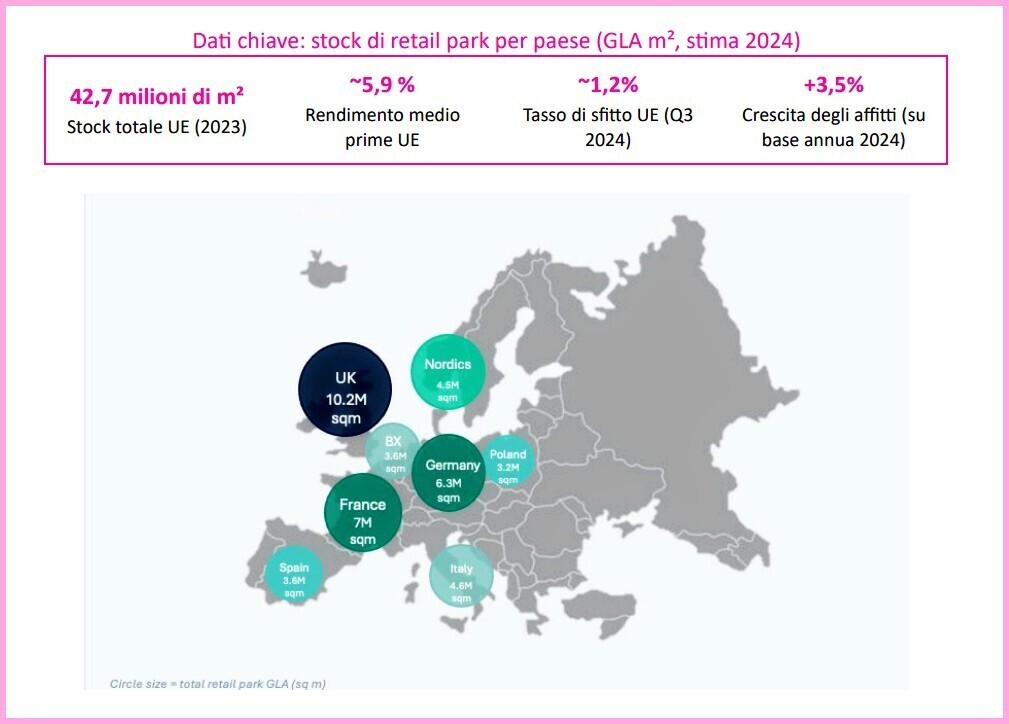
The figures reveal an overall stock (8 countries, including Luxembourg), estimated, in 2024, at 42,7 million sq m of GLA, with an increase, compared with 2023, of around 6 percentage points, a very low vacancy rate of 1,2 per cent, an average yield of 5,9%, and an annual increase in rents of 3,5 per cent.
The research identifies several factors behind the favourable performance of retail parks: attractive consumer prices and numerous promotions; convenience—in the sense of easy access, spacious car parks and quick shopping trips—; structural compatibility with click and collect; footfall driven by essential goods; a presence in provincial areas, where rents are low and there is less competition; and lower overheads than traditional shopping centres.
Ownership remains fragmented at national level. However, several pan-European platforms stand out for their scale and their ability to structure the market.
The leaders of Western Europe…
Let us start with Redevco, a pan-European retail park fund, with 10,5 billion euros in portfolio value and 350 assets under management.
A major player is Frey: the European leader in premium open-air destinations, active in France, Spain, Portugal, Poland and Italy, where it acquired Land of Fashion.
Another major player is Pradera: a European specialist in managing retail assets, with positions in France, Italy, Germany, Poland and the Czech Republic.
Also significant is Mitiska Reim, a Belgian investor focused on the convenience segment in Western, Central and Eastern Europe
Then there is Trei Real Estate of Düsseldorf, a driving force in Central Europe with its Vendo Park format.
Last but not least, Cpi Europe-Immofinanz with the Stop Shop brand, established in Central and Eastern Europe and Italy, where it has, however, partially thrown in the towel, retaining its interests in the Maximo shopping centre in Rome.
… and the leaders of Italian retail parks
Among the main operators in Italy are Settimo Sviluppo (linked to the Settimo Cielo project in Settimo Torinese), Pradera, Svicom, Odos Group and Klépierre.
In Italy, as elsewhere, three categories shape tenant demand, both in shopping centres and retail parks: grocery/discounter, large fashion stores, and DIY and home furnishings. Leisure, quick-service restaurants, health/sport and pet products are becoming established, in any case, as ways of enriching the offering and building loyalty.
Among the main tenants in Italy are Decathlon, Leroy Merlin, Euronics, Mondo Convenienza, PittaRosso and Cisalfa.
The Italian property stock includes, for this type, 4,6 million sq m and more than 380 sites, representing 15% of total investments 2025 in retail real estate—investments driven primarily by foreign capital.
There are three types: retail warehouses, developed along the main roads by local operators; retail parks integrated into existing shopping centres—often developed by the same owners to accommodate brands that have no space inside the mall—and large standalone retail parks, still relatively uncommon but growing rapidly.
The increase in rents, estimated at between 3 and 4% annually, is among the highest in Western Europe and reflects the strong pressure in a market that is still developing but has little property supply.
By contrast, France and Great Britain stand out. The former has 7 million sq m of retail parks ( 24% of the country’s gross lettable retail area) spread across 1.200 assets. The latter has around 10,2 million sq m and more than 1.500 parks.
This article was translated from the original Italian version with the assistance of artificial intelligence. In case of discrepancies, please refer to the original Italian version.