

Rice: 75% of crops insured. Can more be done for natural disasters?
Rice: 75% of crops insured. Can more be done for natural disasters?
- Information
In recent days, during Risò – the Vercelli International Rice Festival, 11-13 September – Ismea published data on the rice market, which boasts an extremely high insurance rate.
The focus of the research was, in fact, the relationship between this sector and risk insurance: it emerged that the sector is a model of protection, with almost 740 million euros in insured value (+12% of 2024) and around 75% of the area covered by policies.
Rice at 3% in the world of cereals
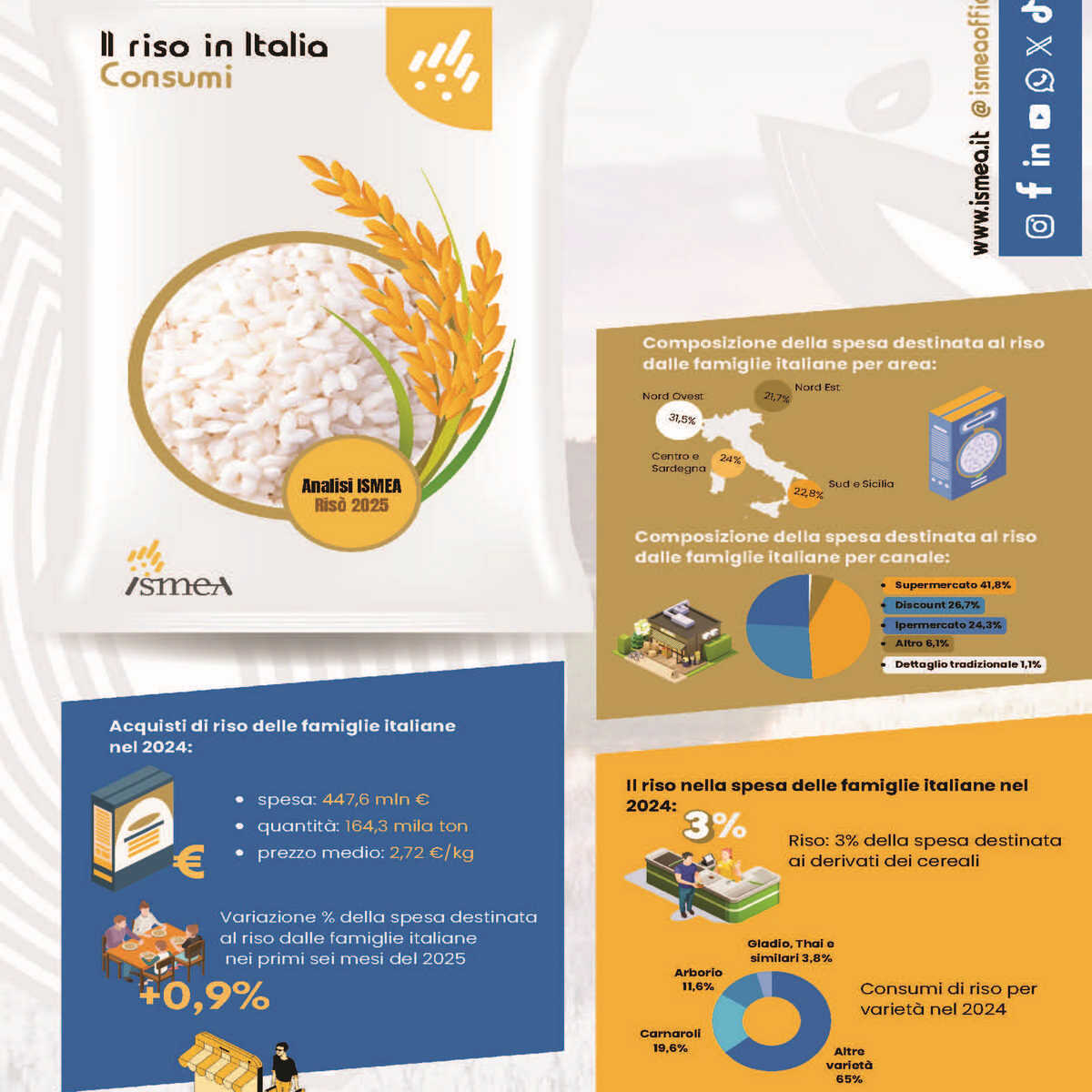
But how much is consumed? In Italian households’ shopping baskets, expenditure on rice reached 447,6 million euros, for 1.643.000 tonnes purchased.
In 2024the average price per kilogram, at the checkout, was 2,72 euros.
The product represents 3% of expenditure on cereal derivatives.
Although it does not have the role of pasta (where the industry’s turnover is approximately 7 billion euros) or bread (approximately 13 billion spent on the domestic market), rice nevertheless retains a specific central role, linked to culinary tradition and targeted consumers.
By geographical area, still in 2024, rice consumption was distributed fairly evenly, with a peak in the North-West (31,5%), followed by Central Italy and Sardinia (24%), the South and Sicily (22,8%) and the North-East (21,7%).
Rice grows where it is not produced
In the first months of 2025, the South and Sicily nevertheless drove the growth in demand with a +2,8% in value and +2,2% in volume.
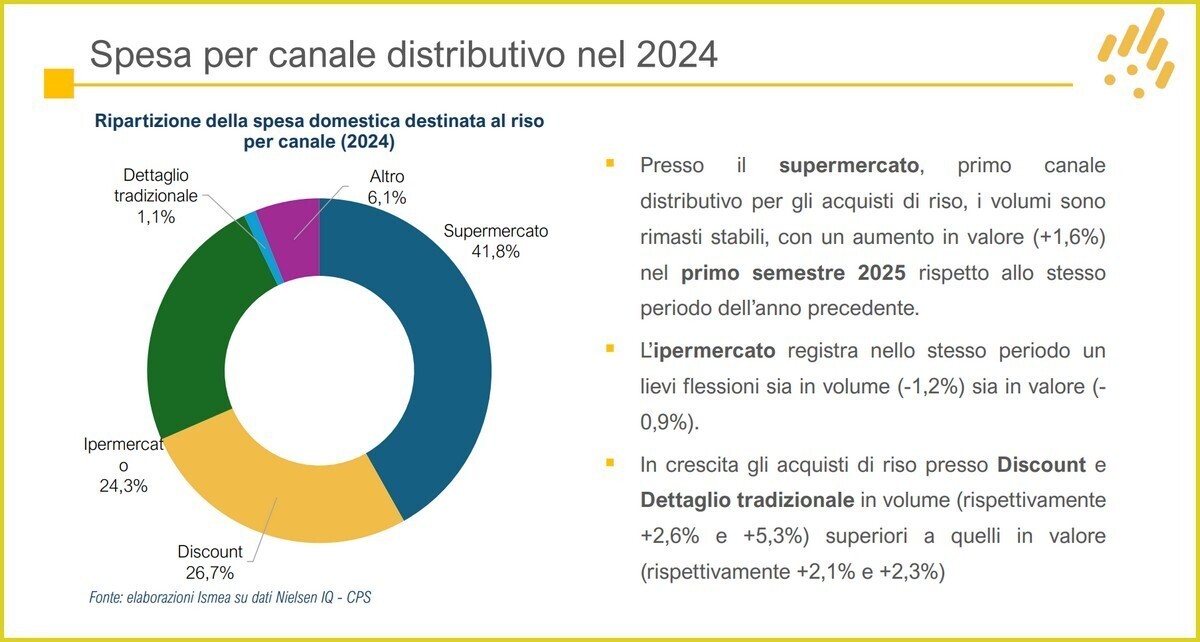
Supermarkets remain the main purchasing channel (41,8% of expenditure), followed by discount stores (26,7%) and hypermarkets (24,3%), while traditional retail accounts for only 1,1%.
By type, Italians prefer processed white rice (73% of the volumes purchased), while parboiled rice has carved out a substantial share, thanks to its ease of use and ability to hold its shape during cooking (25%).
Among the varieties, Carnaroli (17,1% of quantities) and Arborio (11,6%), a symbol of Italian risotto, stand out, confirming the strong cultural link between rice and national gastronomy.
The varieties of long-grain rice (Indica or long B group), Gladio, Thai and similar varieties account for only 5,4%.
Policies for 75% of cultivated areas
These are the key figures. But let us go back to the beginning. Why is rice insured so extensively, reaching a share of 75% of total area, compared with a national average which, for other arable crops, stands at just 9%?
This is shown by the composition of the policies, which indicates a clear prevalence of cover against recurring adverse events, particularly hail, strong winds and excessive rainfall.
By contrast, insurance protection against catastrophic risks remains more limited, including drought, which has nevertheless had a significant impact on production in the current season.
It should be noted that the territorial distribution of coverage reflects that of the cultivated areas: Northern Italy accounts for 99,7% of insured values, confirming the strong local concentration of Italian rice farming.
The analysis also highlights lower volatility in insurance costs compared with the average for arable crops. “This is a particularly significant factor,” Ismea writes, “at a time when farms must contend with increasingly frequent and severe climate and production risks, as also evidenced by the events that affected the summer of 2026.”
Events certainly not to be underestimated. According to the major organisations in the primary sector, such as Confagricoltura and Cia, the heatwave and the rare but severe thunderstorms took an estimated value of between 1,5 and 2 billion euros from our country.
This article was translated from the original Italian version with the assistance of artificial intelligence. In case of discrepancies, please refer to the original Italian version.