Confimprese-Jakala: weak consumption in the first 8 months, but retailers are opening
Confimprese-Jakala: weak consumption in the first 8 months, but retailers are opening
- Information
Consumption fluctuates, but retail continues with its expansion strategy. This is the analysis of the six-monthly Confimprese-Jakala Retailer Barometer.
Resca: the real problem is the lack of confidence
Explaining the apparent contradiction in the research (released at the end of September), the president of Confimprese, Mario Resca said: “The figures tell us that the problem today is not retail, but the country’s climate of confidence. Businesses have invested, innovated and opened new outlets. What is missing is the peace of mind families need to return to spending with a medium-term outlook.
“As long as uncertainty remains the main driver of purchasing decisions, we will see a market that is ‘treading water’, but struggling to express its full potential. Nevertheless, despite the situation, sectoral momentum and companies with positive performance are emerging.
“The development plans of our membership base confirm an expanding network that looks beyond the current situation. The 86% reiterates the openings estimated at the beginning of the year, while only 14% will reduce them”.
Confimprese-Jakala consumption in the first 8 months
Consumption: the first eight months of 2026 ended with a decline of 0,6% compared with the same period of 2025, while August alone recorded a contraction of 2,3% in value compared with the corresponding period.
A scenario of overall turnover showing a slight decline compared with 2025 is taking shape, across all the main sectors.
What is weighing most heavily is the reduction in the average transaction value (-0,4%), a phenomenon particularly evident in clothing and accessories, where the decrease in spending per purchase was not offset by the increase in the number of transactions. A very similar trend can also be seen in food service.
The forecasts, too, for the end of the second half of the year 2026, confirm that the sectors have differing resilience.
On the one hand, so-called “other retail” benefits from demand considered more essential and forecasts the highest growth, at +2,5%; on the other hand, the period of weakness in food service continues, with a decline of 1,4% expected, a figure indicating that Italians remain particularly attentive to spending away from home, in a context still characterised by economic and geopolitical uncertainty.
The clothing and accessories sector occupies an intermediate position at +1,5%, showing signs of recovery, but without reaching the development levels forecast at the beginning of the year, confirming that the market remains cautious and reflects families’ persistent prudence regarding discretionary spending.
Entrepreneurs look to the future
In any case, development plans are confirmed as a long-term strategic lever: the majority of operators continue to invest in strengthening their presence across the country.
Entrepreneurs, in fact, plan development with a perspective ranging from 3 to 5 years. This explains the difference between the fluctuating trend in consumption and the forecasts for openings both in Italy and abroad. “It may happen,” Confimprese points out, “that demand is weak today, but companies consider the Italian market likely to remain attractive in the medium term”.
Among the various sales channels, the August data 2026 on August 2025 indicate growth, albeit limited, only for shopping centres, which are expected to increase by 0,7%.
A negative trend, on the other hand, was recorded for high streets (-1,3%) and for local neighbourhood shops (-1,2%).
The ranking of retail locations
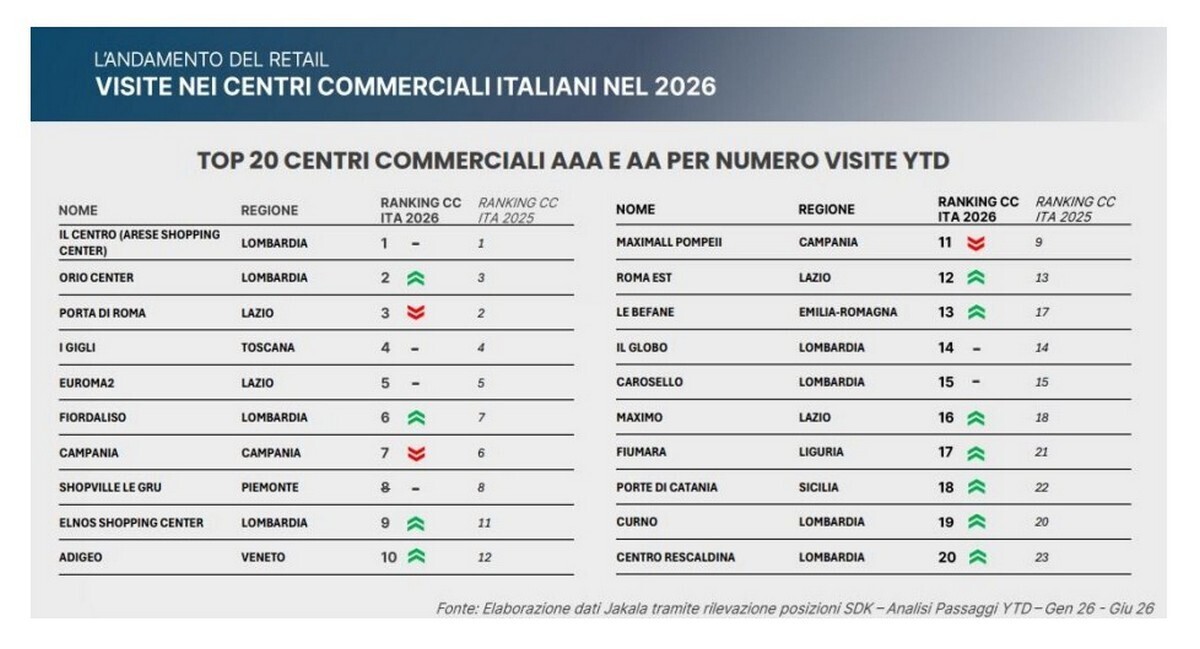
The ranking of the ten shopping centres with the highest number of visitors confirms Lombardy’s prominence, with 4 positions.
Il Centro di Arese is in first place, followed by Orio Center. Also in the top ten are Porta di Roma (Lazio), I Gigli (Tuscany), Euroma2 (Lazio), Fiordaliso (Lombardy), Campania, Shopville Le Gru (Piedmont), Elnòs Shopping Center (Lombardy) and Adigeo (Veneto).
Shopping centres are also seeing new proximity dynamics. Consumers look for proximity rather than choice, to the extent that 36% choose a location within, remarkably, 5 minutes.
For shopping streets too, 64% of families prefer to reach the relevant area in less than 5 minutes.
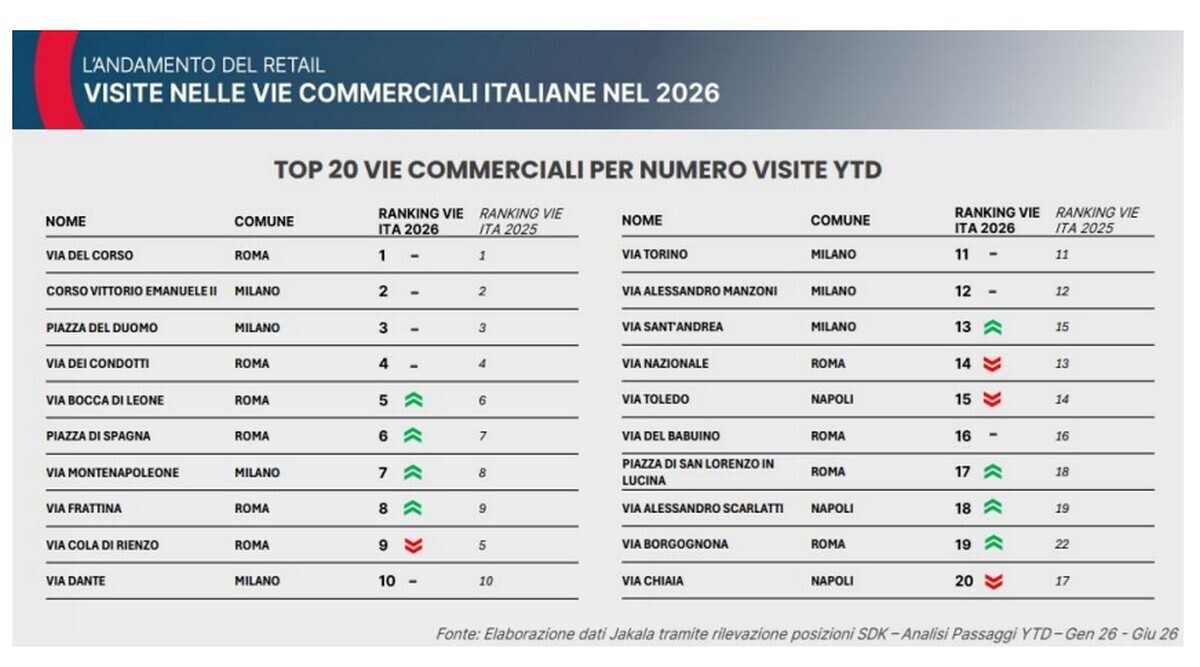
The ranking of the ten most visited streets shows a perfect tie between Rome and Milan: Via del Corso and Corso Vittorio Emanuele lead the ranking. They are followed by Piazza del Duomo, Via dei Condotti, Via Bocca di Leone, Piazza di Spagna, Via Montenapoleone, Via Frattina, Via Cola di Rienzo and Via Dante.
This article was translated from the original Italian version with the assistance of artificial intelligence. In case of discrepancies, please refer to the original Italian version.