“Nuda Cola” bearing the Coop brand arrives on the shelves, without colourings, sugar or caffeine
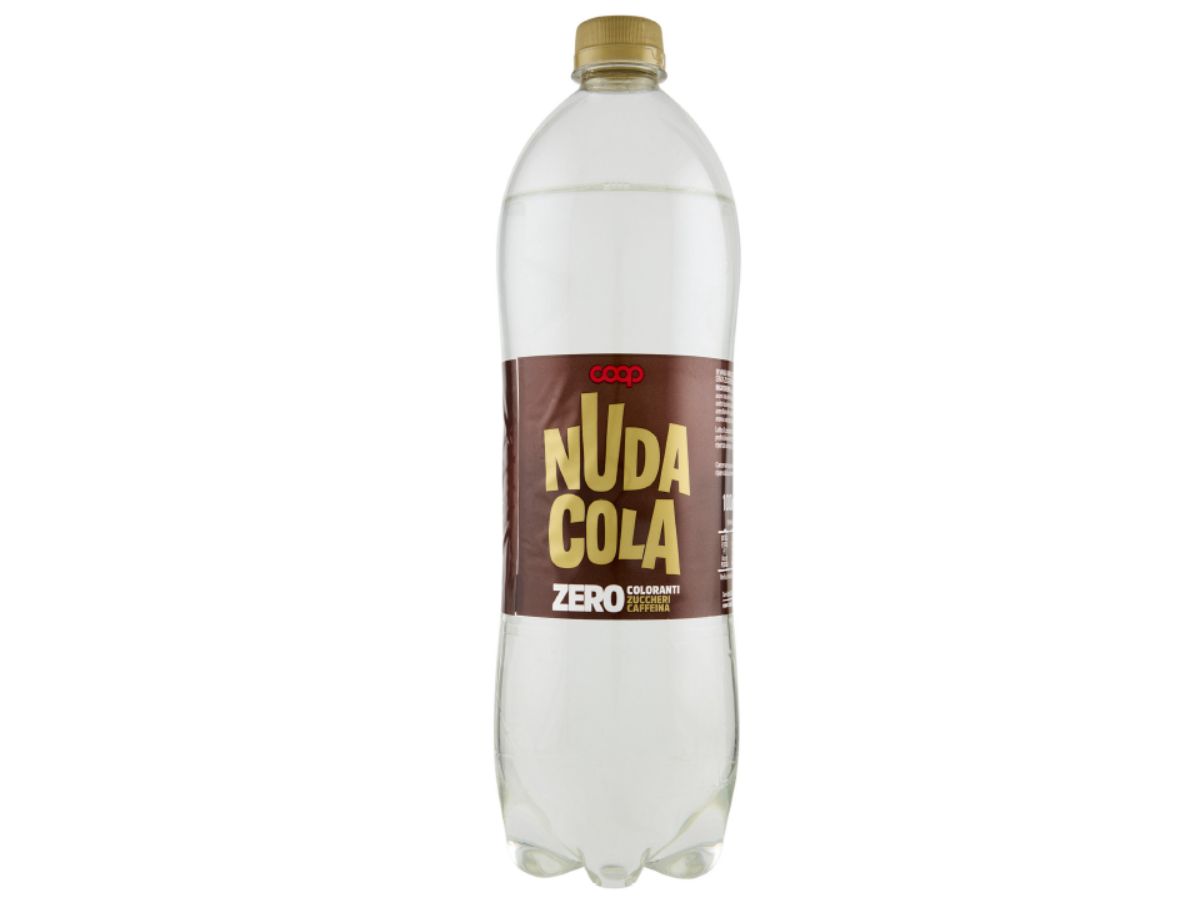
“Nuda Cola” bearing the Coop brand arrives on the shelves, without colourings, sugar or caffeine
- Information
Coop launches “Nuda Cola”, the new carbonated soft drink, formulated without colourings, whether artificial or natural, and also without sugar or caffeine.
The characteristics
As its name suggests, “Nuda Cola” is a Cola stripped of anything superfluous; it is completely transparent and only apparently anonymous, because the cola nut extract together with the natural flavourings gives the drink that typical taste we all know. It arrives in limited edition on the shelves of the main consumer cooperatives, the result of a production process that required the supplier to carry out a careful preliminary selection of the flavourings used, until the right balance was found. Care was also taken with the tasting tests, carried out blind to avoid being misled by the colour of the drink.
Coop’s strategy on colourants
“Nuda Cola” is in every respect a totemic product that reaffirms the Coop strategy concerning artificial and natural colourants (that is, colouring additives). A strategy that began in 1980 and has never been interrupted. If we focus on food products, today we are talking about over 3.000 packaged consumer products that completely exclude artificial and natural colourants.
The choice to impart colour does not come from added substances, even if they are natural, but from the ingredients themselves that have colouring properties. Thus, for example, in Coop-branded ice lollies, the green and orange colours are mainly generated by spirulina and safflower plant extracts in the first case, and by concentrated black carrot juice in the second. Or Coop Rosso bitter gets its colour from blackcurrant and carrot concentrate. And, if we want to make an inverse comparison, curcumin, for example, which is obtained from turmeric, and therefore from a plant, is nevertheless classified as an additive and is consequently not found in branded products. Essentially, Coop relies on formulations that are as simple as possible, reducing everything that is not strictly necessary, all the more so when, as in the cases mentioned, the added substances are used exclusively to give a particular aesthetic appearance.
The comment
"Protecting consumers’ health guides our choices, and the precautionary principle is part of the way we operate," explains Sandro Luca Galasso, Quality and Product Safety Director at Coop Italia. "Scientific knowledge is constantly evolving: new evidence emerges and assessments of the safety of substances are updated. When research and the opinions of scientific authorities, such as Efsa, reveal well-founded concerns about possible health risks, we believe it is important to act preventively, even before these factors translate into new legal obligations, by introducing restrictions or bans on use into our supply requirements. The decision to exclude added, artificial and natural colourants from as early as 1980 expresses this precautionary approach and the simplicity of formulations: for us, the colour of a food must derive from its ingredients. A concrete commitment that we continue to renew by placing the health of our consumers at the centre."
This article was translated from the original Italian version with the assistance of artificial intelligence. In case of discrepancies, please refer to the original Italian version.