Coop predicts a “little Italy” of consumption. Better to close on Sundays?

Coop predicts a “little Italy” of consumption. Better to close on Sundays?
- Information
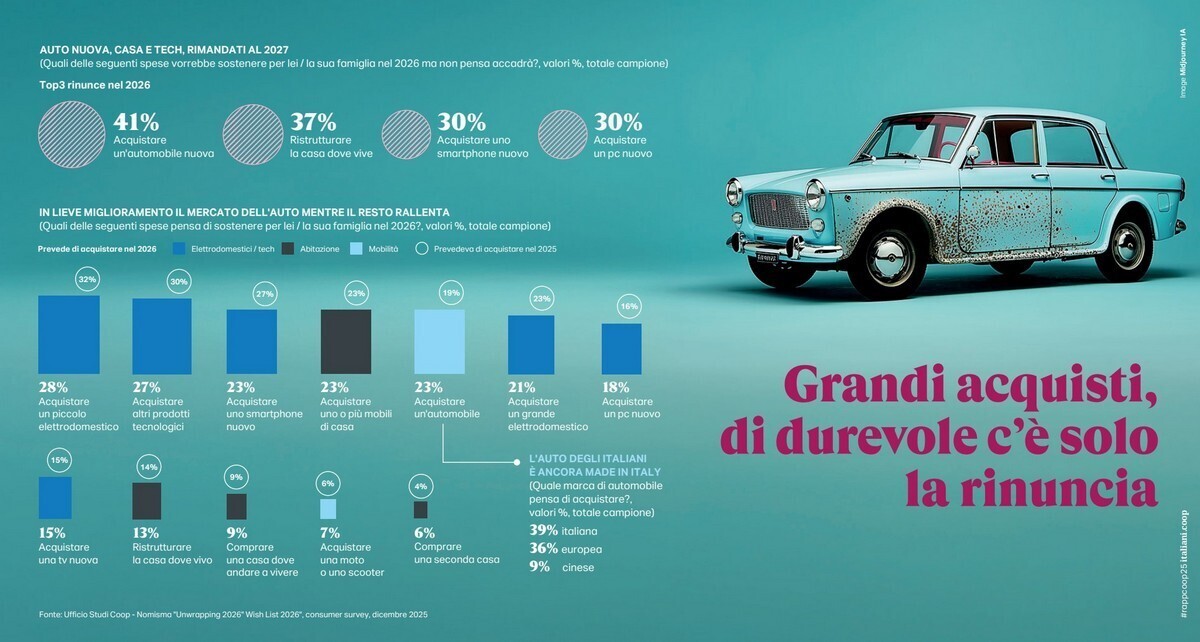
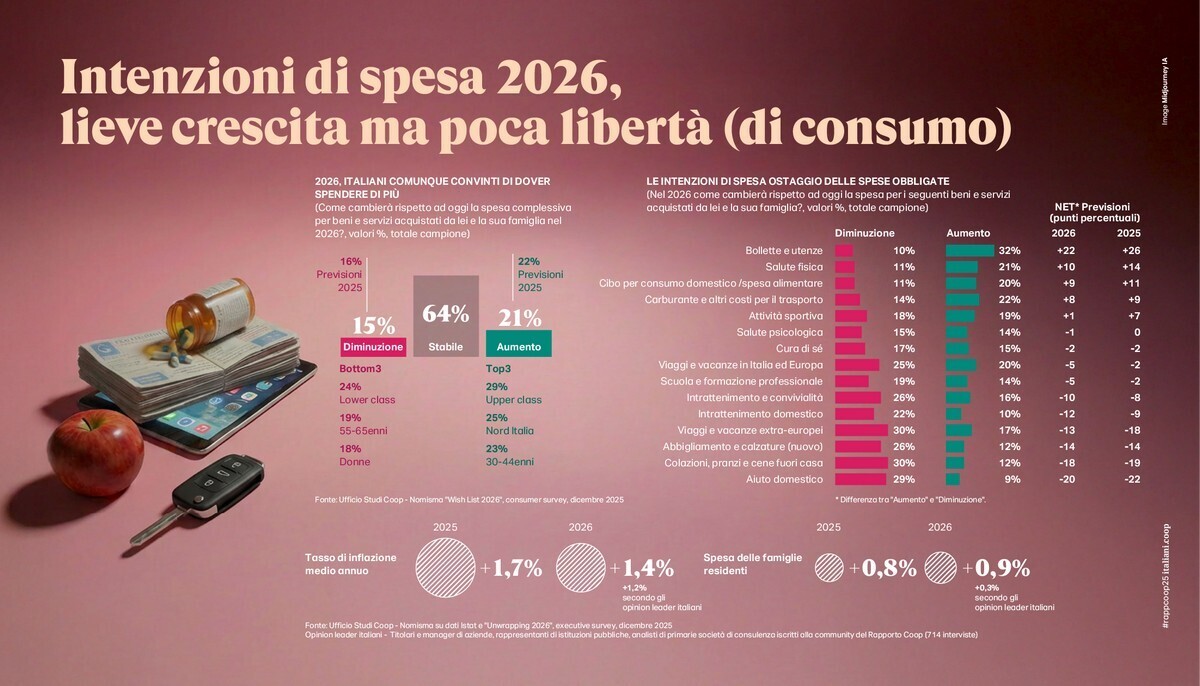
In a context such as the present one, generally marked by fear and distrust, it is difficult to imagine dynamism. This is what the Coop Report Winter edition, released a few days ago, has to say.
The resulting withdrawal into ourselves means that the home continues to be the place where food is consumed.
The kitchen is a healthy refuge
Growth in home cooking is therefore stable: 7 Italians out of 10 foresee no changes in household food spending, while 20% anticipate an increase. Even home deliveries are growing again, driven by the desire to stay within one’s own four walls.
Innovation and more time spent cooking are the key words for the 2026 table, made up of healthy, simple, authentic foods. Those planning to buy more foods without preservatives and additives exceed, by 21 percentage points, those who think they will buy fewer of them (+14% in 2024).
Virtually identical – but by +18 points – the gap in the segment of goods with no or reduced sugar content (+13 in 2024) and of +15 products with little or no fat (+12% in 2024).
And so almost the entire fresh-food sector is growing: fruit and fish are on the rise (those wanting to buy more of them exceed, respectively, by 23, 21 and 9 points, those who think they will buy less of them), in sharp contrast with forecasts for red meat (-21), but also for cured meats (-28).
The mantra of Italians who, especially in recent years, have been pursuing wellbeing at the table, associated with the principle of prevention—a truly established principle—has emerged in a more radical form.
Quality finds its place in the shopping basket, alongside value for money: in this sense, one can read both the further expansion of Mdd, which has now won over our fellow citizens (the 81% of food & beverage managers anticipate another rise in private-label products), and the slowdown, albeit ambiguous, in the discount retailers’ pursuit.
The sentiment in fast-moving consumer goods
In fast-moving consumer goods, with regard to 2026, the mood is more grey than black: 12% of the food & beverage managers interviewed foresee an improvement, 66% anticipate stability, and 22% a deterioration.
Although food purchasing intentions are moderately positive, if there is an increase it will still have to be described as “small-scale manoeuvring” (+0,9% by value in 2026 compared with 2025), more than offset by rising prices, which should translate once again into a decline in volumes (-0,4%).
Hopes for better performance in the Lcc sector rest primarily on technological innovation, and retail managers are the ones who believe in it most (the balance between those forecasting an increase and those fearing a decrease in technological innovation is +64 points, compared with +55 recorded in the food industry).
Environmental sustainability remains a practicable compromise: 34% of food & beverage executives believe that companies in the sector will pay greater attention to this aspect, compared with 16% sceptics who suggest reduced commitment (balance +18).
Among the most critical aspects, according to food managers, are the items concerning employment levels (balance between improvement and deterioration of -13%) and, above all, labour costs (-27), the trend in raw-material and goods costs (-30, rising to -47 among retail respondents), as well as margins/profitability (-30).
Winning tomorrow
How can they win? According to companies in the sector, the priorities to bet on are human capital (identified by 49% of industrial executives and 57% of distributors), ahead of technological innovation 47% and process optimisation (43%)
And it is certainly also the enhancement of human capital that led the president of Ancc-Coop, Ernesto Dalle Rive, as reported by Il Sole 24 Ore, to reiterate a point of view that is, moreover, in keeping with the concept of cooperation: reinstating Sunday closures, a measure that the top manager, as usual very practically minded, links to the opportunity to contain labour costs, to give some breathing space to a Gdo that, here and now, is nevertheless rather short of breath. Considering a wage premium of 30% applied on public holidays, the estimate by the Coop Research Office is that the savings for the Gdo system would be between 2,3 and 2,6 billion euros.
Closed on Sundays: for and against
A position that is causing an earthquake, since, conversely, one might ask whether, in theory, it is not precisely difficult times that should encourage the preservation of what arose from the so-called Monti Law, or “Save Italy” Decree, of 2011-2012.
This is the view of Carlo Alberto Buttarelli, president of Federdistribuzione, who, again in the pages of the Sole, observed that extraordinary openings are not an obligation, but merely an opportunity
“I was surprised by the proposal and, in some respects, I consider it anachronistic and hostile to businesses and customers,” he said. “In a situation such as the present one, characterised by fragile consumer spending, an initiative such as the one proposed would cause further slowdown and damage to the entire economic system. Moreover, simplifying the whole matter by claiming that closing supermarkets on Sundays would make it possible to save on costs, without considering the impact of the resulting drop in consumption, for example in shopping centres, is truly short-sighted and not credible.”
The trade unions, such as Filcams-Cgil, have joined the Coop sector’s position—it was obvious—writing: “It took the prospect of another year of consumption even lower than the one just ended to arrive at the same assessments that we have been making for years, ever since the infamous Save Italy Decree cleared the way for unrestricted opening in retail, twenty-four hours a day and seven days a week, openings that do not even stop for the most sacred public holidays, such as Christmas and New Year’s Day: Sunday and public-holiday openings do not bring significant revenue to supermarkets, but in return bring major changes to the lives of women and men workers, with a markedly negative impact. It was above all women who bore the brunt of the new, uninterrupted shifts, which have significantly worsened the reconciliation of life and work commitments.”
The view of some sections of Confesercenti is well argued: they maintain, pragmatically, that assessments must be made on a case-by-case basis, allowing extended opening hours where they are worthwhile, namely in tourist destinations and shopping streets.
All perfectly admissible. But meanwhile, in France, where public holidays are observed very strictly, as a result of a long tradition, some retailers, starting with Carrefour, have obtained, after a long battle and following an agreement with the social partners, permission to remain open on Sunday mornings from 8 to 12, starting on 1 January. In Belgium, the new arrangement is instead taking off, again in the Carrefour sphere, in a few days’ time, on 18 January.
Methodological note: the 2026 forecasts are the result of two online surveys (CAWI methodology) conducted in December 2025 by the Coop Research Office and its partners. The first, “Wish List 2026”, was carried out in partnership with Nomisma on a sample of 1.000 individuals representative of the Italian population aged 18-65 and involved collaboration with A21 Consulting, founded by Mirko Veratti. The second, “Unwrapping 2026”, addressed to the Coop Report community, involved 714 national opinion leaders: business owners and managers, representatives of public institutions, and analysts from leading consulting firms.
Other articles:
FMCG: summary of the September 2025 Coop Report
Carrefour Belgium: the Sunday conundrum
This article was translated from the original Italian version with the assistance of artificial intelligence. In case of discrepancies, please refer to the original Italian version.