Confcommercio: even in 2025, the urban desert is expanding its boundaries

Confcommercio: even in 2025, the urban desert is expanding its boundaries
- Information
Confcommercio returns to the serious issue of commercial desertification, with a new survey published on 12 March.
This is the Cities and business demographics study, which examined 122 urban centres (107 provincial capitals and 15 non-capital municipalities with large populations), providing a snapshot of the trends in 18 categories of economic activity and distinguishing between historic centres and suburbs.
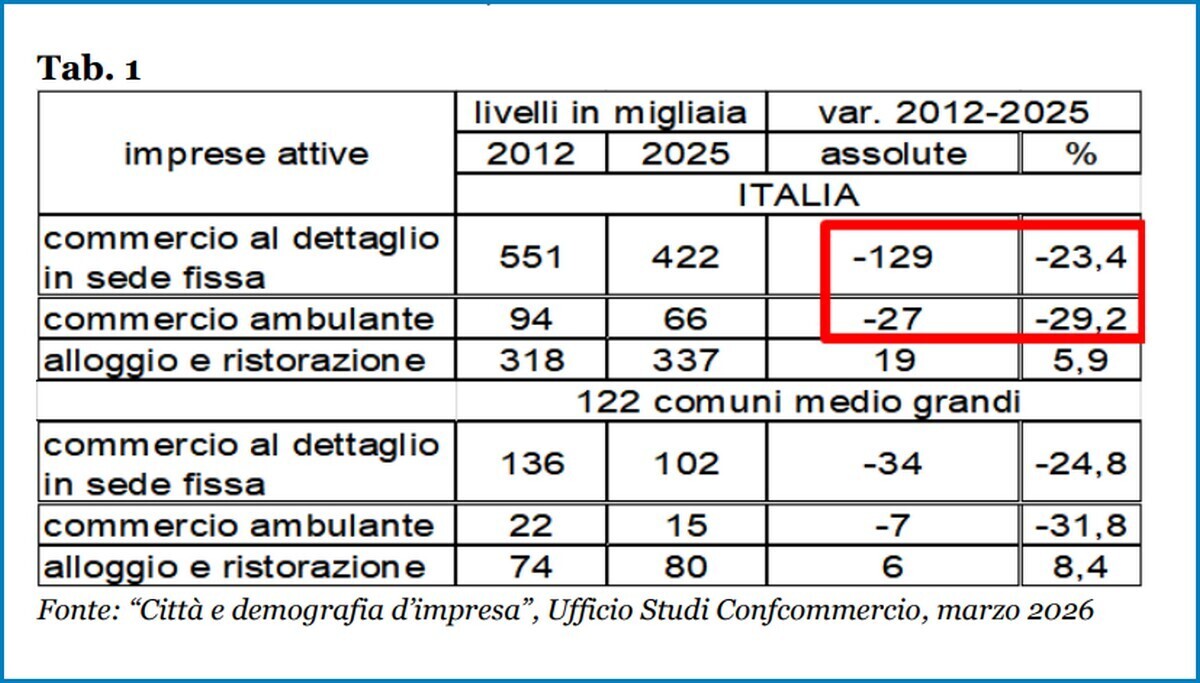
A quarter of businesses have disappeared since 2012
The scenario is more alarming than ever. Between 2012 and 2025, 156.000 retail and street-vending outlets disappeared in Italy, more than a quarter of the total.
Only accommodation and catering businesses are growing (+19.000), while the number of vacant shops is increasing, also because rents are certainly showing no signs of falling, especially in metropolitan areas.
The phenomenon of commercial desertification is therefore accelerating (at an average rate of 3,1% in 2025 compared with 2,2% observed in previous analyses), with the risk that, between now and 2035, we will have less brightly lit cities, dormitory neighbourhoods, an ageing population with difficulty doing its shopping and greater general degradation.
The municipalities of the North show the greatest losses for normal trade (among the first 10, Belluno, Vercelli, Trieste, Alessandria, Savona, Gorizia, with declines of more than 33%), while the South is showing greater resilience.
The pressure of online commerce on urban retail
Changing consumption patterns continue to have a profound impact on the retail structure of cities. In 2025, for example, online sales account for 11,3% of demand for goods and 18,4% of demand for services, helping to reduce the number of physical shops and changing the organisation of supply.
But above all, compared with a change in the total retail sales index of +14,4% between 2015 and 2025, small retail outlets have remained completely stagnant (0,0%) while digital commerce has almost tripled (+187%).
In 2019, the value of Internet transactions, explains Confcommercio's Research Department, amounted to 31,4 billion, while last year it reached 62,3 billion. This process, together with socioeconomic and demographic transformations, tends to trigger a vicious circle: the reduction in the number of physical businesses reduces the commercial attractiveness of urban areas and further fuels the contraction in supply. 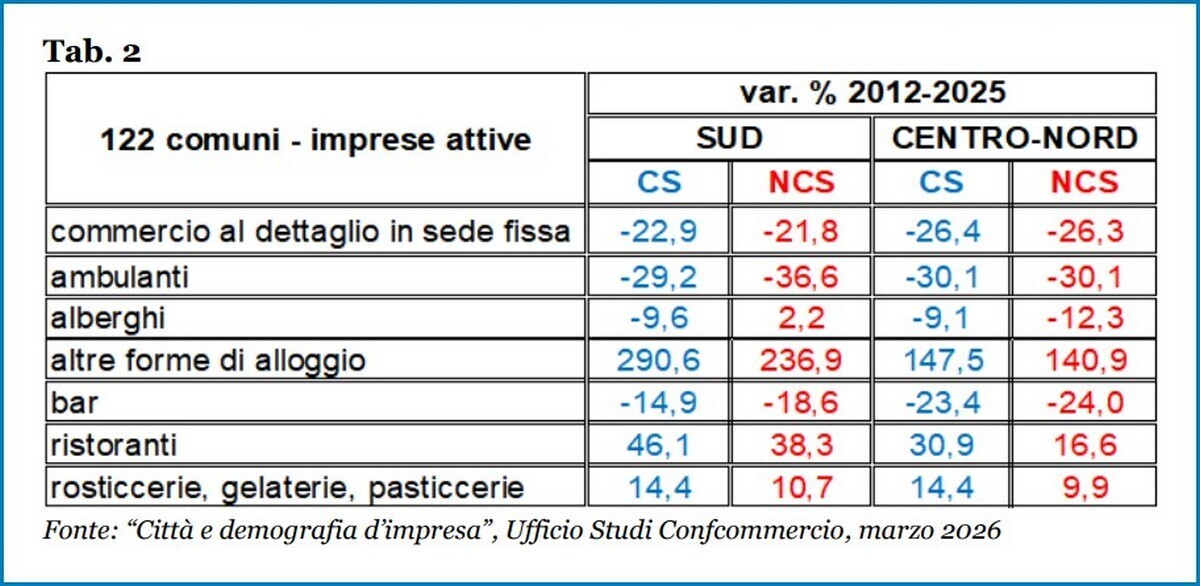
A helping hand from foreign entrepreneurs
In retail and public establishments, however, businesses under foreign ownership continue to make a contribution (+134.000, compared with a decline of 290.000 for Italian-owned businesses over the period 2012-2025), which also perform an important function in economic and employment integration (+194.000 people employed).
At the same time, the size of Italian micro-enterprises is increasing, rising from an average of 2,4 employees in 2012 to 3 in 2025, while those run by foreign operators generally remain smaller and more widespread (from 1,9 employees to 1,7 employees), representing a form of "‘substitution"—albeit disorganised—in more vulnerable residential contexts.
As regards the corporate form, limited companies are increasing (from 9% to 17% in retail and from 14,2% to 30,6% in accommodation and catering) while all other forms (sole traders, partnerships, cooperatives and consortia) are declining, highlighting a process of structuring the tertiary sector, with greater organisation and a growing pursuit of efficiency and productivity.
B&B have almost quadrupled
In cities—both nationally and in the 122 municipalities covered by Confcommercio's analysis—the composition of economic activities continues to change: tourism-related activities are increasing, particularly accommodation for short-term rentals; catering is expanding, both with and without table service; the more traditional retail activities are declining (shops and street vending).
In many cases, the growth of tourist accommodation is taking place at the expense of traditional hotels.
The result is a transformation whose effects on the balance between tourism, residents and local services are still uncertain. The most significant figure is, in particular, that of B&B, which have almost quadrupled in historic centres since 2012.
Non-food: Confcommercio sounds the alarm
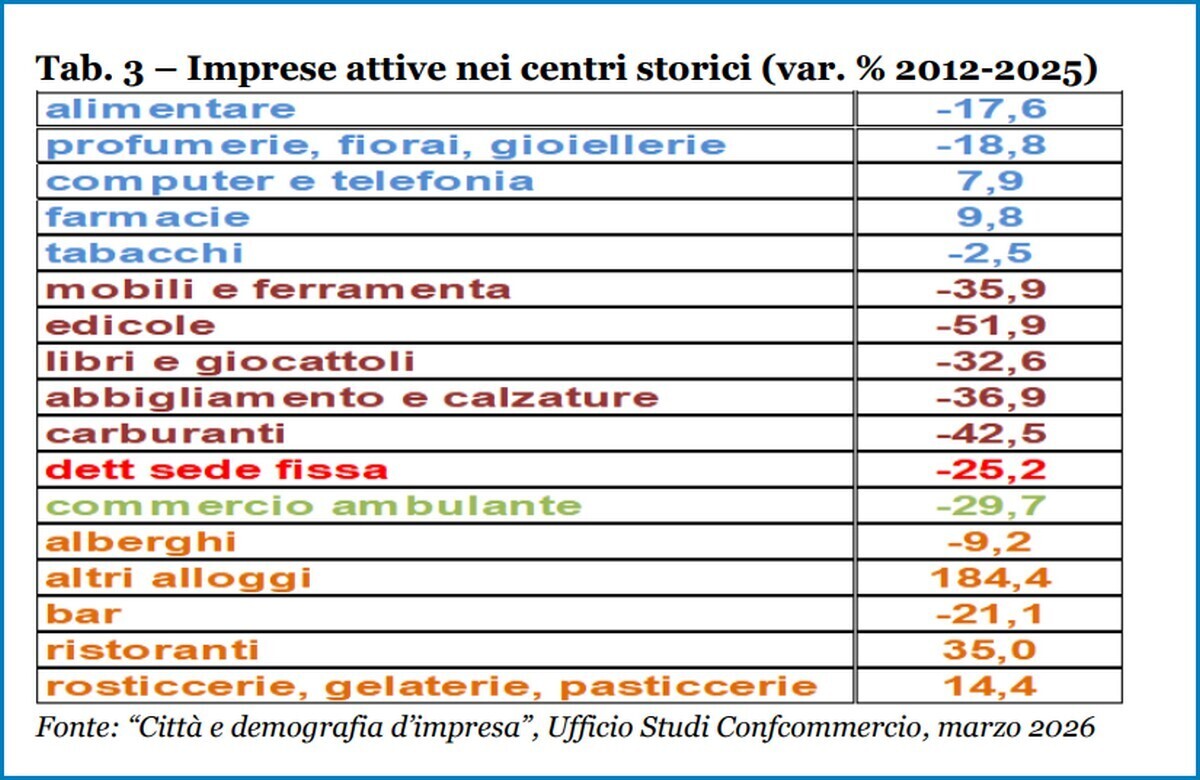
Focusing the analysis on the 18 categories covered by the Confcommercio study—grocery, services and hospitality—the most evident finding is, as mentioned, the widespread decline of traditional distribution activities, particularly in sectors linked to non-food goods, such as newsstands (-51,9%), clothing and footwear (-36,9%), furniture and hardware (-35,9%), books and toys (-32,6%).
By contrast, some categories linked to services and tourist demand are growing: restaurants (+35%), the combined category of rotisseries, ice-cream parlours and pastry shops (+14,4%) and, above all, other accommodation (+184,4%), a category that includes short-term rentals. Positive, but more moderate, trends also concern pharmacies and computers and telecommunications.
At local level, among the 122 municipalities examined in the analysis, the first 10 with the greatest losses of businesses are Agrigento (-37,5%), Ancona (-35,9%), Belluno (-35,8%), Pesaro and Vercelli (-34,9%), Trieste (-34,1%), Alessandria (-33,7%), Savona (-33,5%), Ascoli Piceno (-33,4%), Gorizia (-33,3%); the 10 recording the smallest decline are Crotone (-1,8%), Olbia (-10,1%), Latina (-13,8%), Frascati (-13,9%), Cagliari (-14,4%), Cinisello Balsamo (-14,5%), Iglesias (-15,3%), Imperia (-15,7%), Cuneo (-16,3%) and Vibo Valentia (-16,5%).
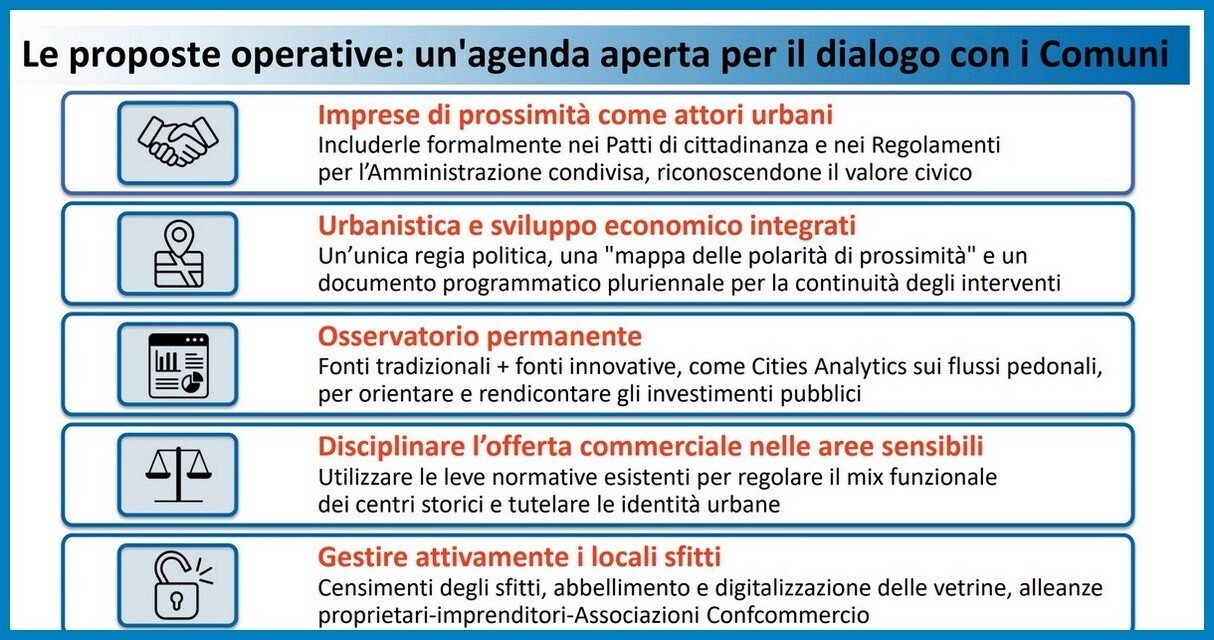
To counter this phenomenon, Confcommercio is promoting the Cities project, structured around 5 operational guidelines, from which concrete proposals emerge. On the strength of its established collaboration with Anci, the Confederation is calling on mayors and councillors to engage in constructive dialogue.
Read also:
Confesercenti: normal trade in free fall
This article was translated from the original Italian version with the assistance of artificial intelligence. In case of discrepancies, please refer to the original Italian version.