Forum Retail 2026: only 17% of Italians are ready to entrust their shopping to AI
Forum Retail 2026: only 17% of Italians are ready to entrust their shopping to AI
- Information
Artificial intelligence is increasingly present in consumers’ habits, but only 17% of Italians aged between 16 and 64 who use the internet are ready to entrust it with autonomous purchases based on their preferences. The luxury market is growing again, supported by an increase in average spending and international tourism, while retail media is entering a new phase, in which measuring return on investment is becoming crucial.
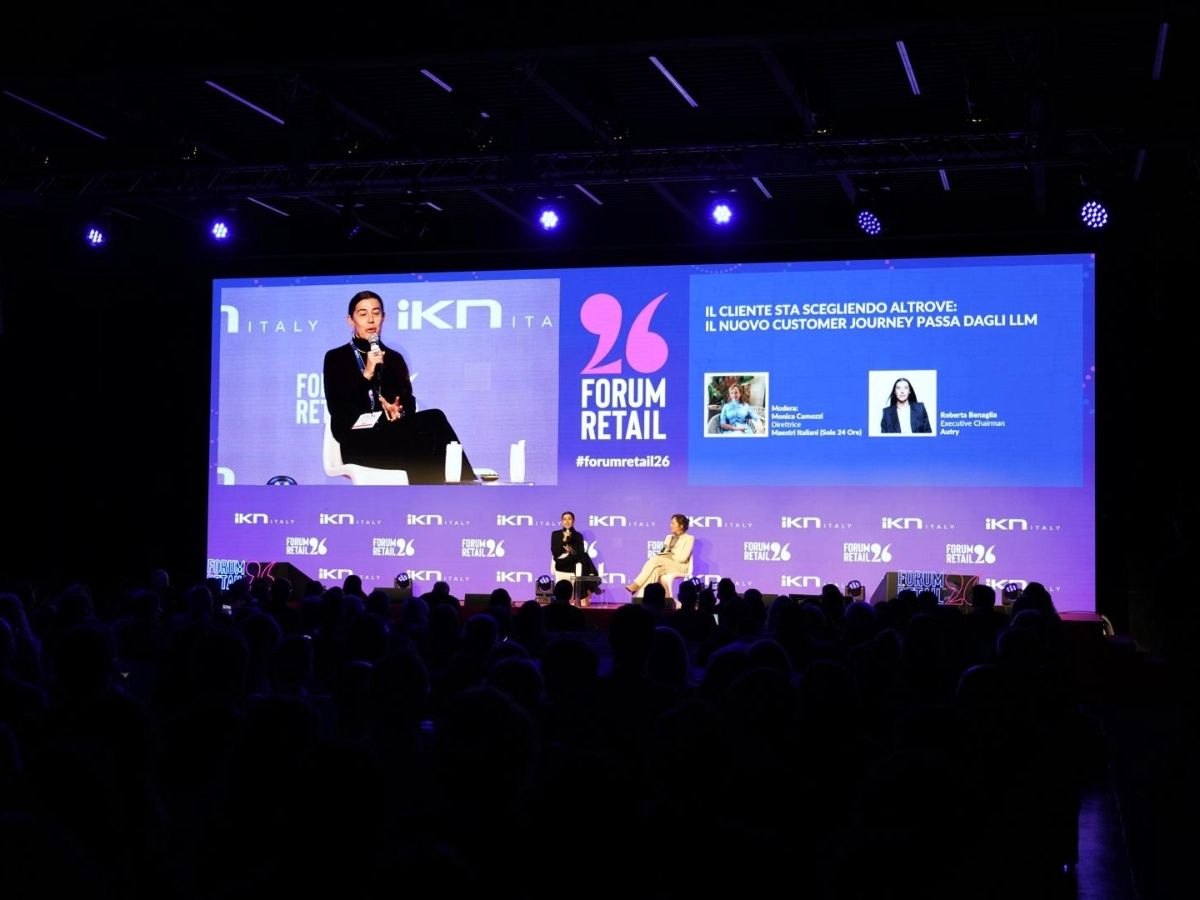
These are some of the main trends to emerge from the first day of Forum Retail 2026, the 26th edition of the flagship event for the Italian retail community, conceived and organised by Ikn Italy, taking place on 11 and 12 November at Superstudio Più in Milan.
The opening day brought together managers, entrepreneurs, retailers, brands and market experts to discuss the transformations redefining commerce, from artificial intelligence and new purchasing behaviours to growth strategies and technological innovation.
Retail media
The research “The governance of retail media – Who leads retail media, who pays for it, and how is it measured?”, conducted by Ikn Italy in collaboration with Casaleggio Associati and presented for the first time, captures a global market worth 200 billion dollars, but showing signs of slowing: forecast growth in 2027, excluding Amazon, is 9,8%, the lowest rate in recent years according to Warc estimates. Only 15% of brands say they are confident in their ability to measure cross-network performance, while retail media still has considerable room to develop in Italy. In the search results of Amazon.it, 26,7% of the top 24 results are sponsored ads, compared with 6,2% for Zalando, 6,1% for Carrefour and 5,8% for Douglas. It is therefore essential for retailers to move beyond simply selling advertising space, focusing instead on leveraging data and measuring investment.
Artificial intelligence
Artificial intelligence is also transforming the relationship between consumers and brands, as highlighted by Federico Capeci, CEO Italy & Spain at Kantar, who presented the findings of the “Kantar Global AI Sentiment Study 2026”. According to the research, 85% of Italians aged between 16 and 64 who use the internet have already tried an AI assistant, but only 11% say they are enthusiastic about the technology. Caution also prevails when it comes to shopping: 33% are willing to receive suggestions for their shopping basket, in categories such as food, household products and personal care, while only 17% are ready to entrust AI with autonomous purchases based on their preferences. For brands and retailers, the challenge will therefore not simply be to gain visibility, but to build trust and remain relevant to intelligent agents that will influence purchasing decisions.
The luxury market
Positive signs are coming from the luxury market, analysed by Raimonda Rosi, director of retail and e-com business development at Mastercard, through the research “Mastercard Luxury Insights 2026: Trends and consumer habits in luxury”. In the first half of 2026, the luxury market recorded growth of 5,6%, driven mainly by increased average spending per customer. The online channel, which accounted for 22% of luxury sales in 2025, grew by 8,2% in the first half of 2026, with differing performances among fashion retailers (+16%) and multi-brand marketplaces (-17%). International tourism made a decisive contribution, generating 56% of luxury spending in Italian stores in 2025. Milan remains a strategic hub, accounting for 34% of national spending in the luxury fashion and jewellery sectors.
A space for discussion
Alongside market data, Forum Retail 2026 provided ample opportunity for discussion among industry leaders, through plenary sessions, round tables and in-depth discussions dedicated to the main challenges facing commerce: from the evolution of distribution models to international growth strategies, from omnichannel retail to artificial intelligence, and new ways of engaging with consumers. Managers and entrepreneurs from the fashion, luxury, beauty, pharma and Gdo sectors shared numerous accounts of their experiences and strategies for navigating a constantly changing market. Among them, Roberta Benaglia, executive chairman of Autry, described the brand’s international growth journey, which aims to reach 160 million euros, highlighting the importance of expanding the retail network without standardising the in-store experience. Emanuele Mazziotta, general manager of Coccinelle, looked back at the company’s transformation from a product-focused business into an international brand, with a strategy increasingly centred on customer relationships. Pietro Negra, president of Pinko, recounted the brand’s forty-year history, highlighting the value of identity and brand recognition in constantly evolving markets.
Innovation in action
There was also a focus on innovation to experience first-hand, with the technological experiences that brought the event to life. These included The Cube by Shopping Cube, Europe’s first immersive and interactive virtual showroom; Fausto, Gulliver’s humanoid robot, the Rhea Barista on Demand and a robot capable of creating personalised portraits using artificial intelligence.
The first day concluded with a moment of humour and reflection led by Francesco Mandelli, the subject of the interview “The usual brands – Why the customer isn’t an idiot”, which explored what happens when companies behave like one.
This article was translated from the original version in Italian with the assistance of artificial intelligence. In case of discrepancies, please refer to the original version in Italian.