

Repair Directive, the delay is in its DNA. And Italy has not transposed it
Repair Directive, the delay is in its DNA. And Italy has not transposed it
- Information
Repair Directive, a false start. Yes, because Italy failed to meet the mandatory transposition deadline set for 31 July.
But, as we shall see, the real fault does not lie with our Government, but with an indispensable EU instrument that will only start operating in a year's time.
Repair Directive approved by the Senate
Let us proceed in order. Here, the parliamentary process has not yet been completed and transposition is not expected before the end of August.
It is difficult to say whether matters proceeded according to schedule in all the other countries. Certainly, France and Belgium managed it, as did Germany, which issued the implementing decree last 23 July.
Here, the journey of the legislation, Directive (EU) 2024/1799, has so far passed the Senate's scrutiny: the Industry and Agriculture Committees of the upper house gave a favourable opinion, with observations on the draft implementing legislative decree.
The producer pays
But since yesterday, which rights and obligations have been introduced to facilitate the free repair of goods, extend product lifespans and reduce electronic waste?
Producers are required, also through third parties and not only through their own authorised centres, while bearing the costs, to repair goods, including those outside the warranty period, to provide accessible spare parts and to grant an additional year's warranty to those who choose repair instead of replacement. A hefty blow for the clever operators behind planned obsolescence.
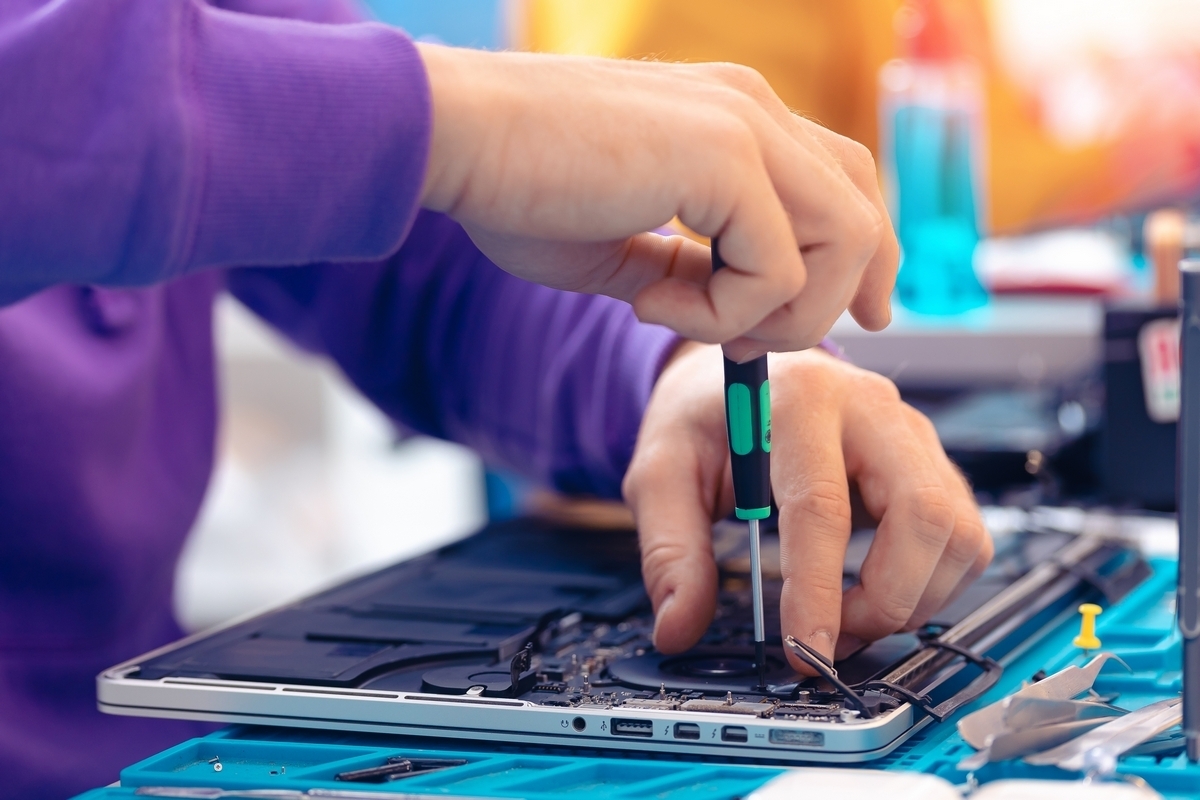
Laptops are among the major exclusions from the right to repair
Repair, yes—but not everything
All those software and hardware devices that could hinder or block the repair of goods are also prohibited.
But which products are we talking about? In the positive list there are major everyday household appliances, such as washing machines, dishwashers, refrigerators, vacuum cleaners and tumble dryers, as well as tablets, smartphones, servers and data-storage devices, displays, e-scooters and electric bicycles.
As Adiconsum explains, laptops, irons, stereo headphones, toasters, coffee machines and many other small household appliances in everyday use are not included.
The European authorities point out that a new EU online platform will help connect consumers with repairers.
This entity will have sections for each Member State, helping consumers find available offers and increasing the visibility of repairers.
But this is where the real problem lies: the website, an extension of the “Your Europe” portal, is expected to become operational only in 2027.
The EU estimates, incidentally, that the new activities generated will produce, once fully operational, a total of 4,8 million euros in new investment.
The Repair Directive stalls: only one comment
Comments? There are none at the moment, perhaps because of the holiday period, or because the delays have complicated a scenario that, at least to a superficial observer, might have seemed straightforward.
Only Altroconsumo intervened on the fateful date of 31 July. In addition to reporting the temporary halt, the association reiterated that this is a fundamental directive that concretely strengthens consumer rights by recognising the possibility of having their products repaired under fair conditions, at reasonable costs and also by turning to independent operators, without being tied to the manufacturer's authorised network.
Even if the Italian transposition had arrived on time, the source continues, it would still have fallen into a sort of void, since, as mentioned, the European platform that will enable consumers to easily identify repairers will only be operational from July 2027.
Our Government nevertheless, Altroconsumo insists, has not provided any financial measure to incentivise repair, despite the directive urging Member States to promote it.
“As highlighted by our association during the consultation on the draft legislative decree, instruments such as vouchers, which have already been successfully trialled in France, could have provided a tangible incentive, especially during the initial phase,” reads the association's website. “Making repair economically more advantageous than buying a new product is in fact essential to changing people's habits and spreading a genuine culture of reuse.”
“The lack of dedicated resources currently prevents this opportunity from being seized and risks limiting the effectiveness of the reform,” a reform severely hampered by the mismatch in timing between the transposition date and the launch of the famous commonplatform.
Other articles:
Textiles: they can no longer be thrown away under EU rules
Electronic waste: collection of small WEEE is increasing
WEEE: the Ecolamp Consortium's results
This article was translated from the original Italian version with the assistance of artificial intelligence. In case of discrepancies, please refer to the original Italian version.