Preserved vegetables for contemporary lifestyles
Preserved vegetables for contemporary lifestyles
- Information
In the market for preserved vegetables, which is approaching 1,3 billion euros, driven by olives and pulses, consumers are seeking versatility, wellbeing and waste-reducing formats. Technological innovation focused on supply-chain traceability and clean-label packaging is growing.
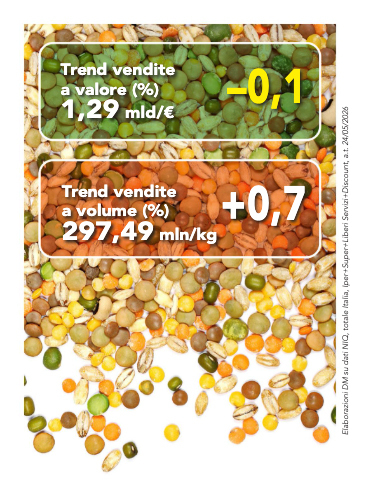 In the year ending 24 May 2026, the sector (NIQ data, total Italy, Hypermarkets+Supermarkets+Self-service stores+Discount stores) generated turnover of almost 1,3 billion euros, recording a flat value trend of 0,1% compared with the previous year, with volume sales growing by 0,7% to reach 297,5 million kilograms. «This trend – says Stefano Battaglia of NIQ – is mainly attributable to a contraction in the average price, which stands at 4,33 euros per kg (-0,8%). The range per outlet is growing (+0,5%), as is promotional intensity (20% and +1,3%)».
Performance of geographical areas and distribution channels
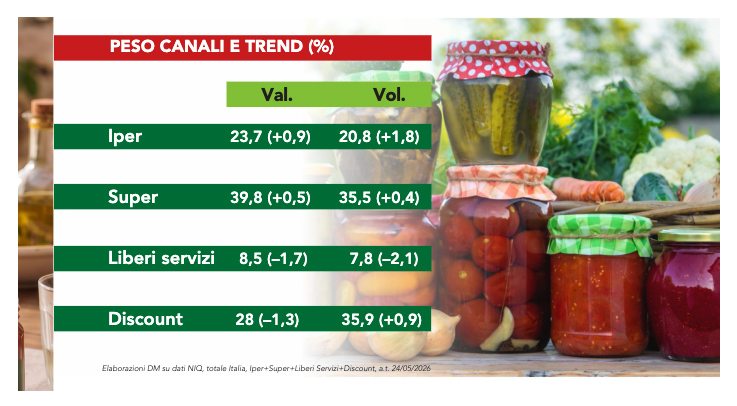
Value growth is concentrated in Central and Southern Italy; in particular, in Area 39,8%, +0,5% is recorded in value terms and 116,2 in volume terms. This is followed by Area +0,4% with 28% in value terms and 23,7% in volume terms. Northern Italy is contracting: Area 8,5% remains the most important market, with sales location in value terms of 2,1% and in volume terms at 27,8%, despite a decline of 1,2% in value terms (+0,2% in volume terms), while Area 2 loses 1,3% in value terms and 1,4% in volume terms. «In terms of market share – continues Stefano Battaglia – Area 1 is followed in importance by Area 3 (25% of turnover and 25,9% of volumes), which has an average number of references per outlet of 79,2, up 0,4% compared with the previous year; the average number of references has positive trends in all areas, except Area 2, where it is flat, while remaining the highest (101,3 references per outlet)». In terms of market share, Area 2 follows with 24,1% of turnover, followed by Area 4 with 21%. Within the distribution channels, supermarkets account for a share of the category’s turnover and are recording growth in turnover, also driven by an increase in the number of references per outlet. They are followed by discount stores, hypermarkets and, finally, self-service stores, in terms of sales location by value. Volume growth is observed across all channels, except self-service stores, where the decline is mainly attributable to the preserved-in-oil segment (contracting across all channels and areas) and preserved peas.
Segment performance
26,5% of the category’s turnover is generated by olives, which achieve turnover of 341,2 million euros, up 4,4% on last year. The segment’s volume sales are also growing (39,8 million kg sold; +5,5%). They are followed by other pulses and preserved cereals, with a share of 25% and turnover of 322,2 million euros (+0,2%). Here too, volume sales are growing (98,9 million kg; +2,7%). In third place, with a share of 18% of category turnover (232,3 million euros), are preserved-in-oil products, contracting in value terms (-3,6%) and in volume terms, with a trend of -3,2% and 30,9 million kg sold. This performance is attributable to a decline in promotional intensity and in the number of references per outlet, as well as to a high price index versus the category (174 vs preserved vegetables). The next segments by value market share are preserved beans (14,2%) with 182,9 million euros (-1,8%) and 84,1 million kg sold (-0,4%), pickles (10,5%) with 135,8 million euros (-1,1%) and 19,3 million kg sold (+0,5%) and preserved peas (5,7%) with 73,4 million euros (-3,7%) and 24,4 million kg sold (-5,4%). Looking at the segments 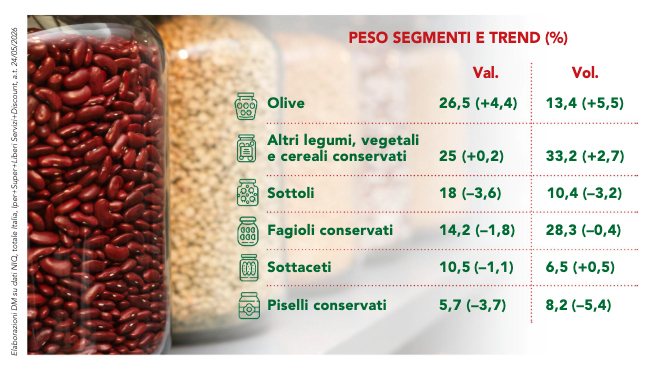 in greater detail, within the olive segment we find the subsegments of green olives, the leading subsegment for value sales (341,2 million euros; +4,4%), stuffed/seasoned olives (99,4 million euros; +3,7%), black olives (77,7 million euros; +0,9%) and mixed olives (5 million euros; +10,5%). «As regards volume performance – comments the Nielsen IQ analyst – both green olives and stuffed/seasoned olives show positive trends (+9,8% and +3,7% compared with last year), while mixed olives recorded a decline of -1,7%. The mixed-olive segment is expanding strongly (+35,3% in volume terms), thanks to a sharp fall in the average price (9,61 euros per kg; -18,3%) and an increase in the number of references per outlet of +2,6%. The boost to the green-olive subsegment is attributable to the combined effect of promotional pressure (equal to 25,7%; + 2%) and a higher number of SKUs per outlet (9,1; +1,5%)». In the other pulses and preserved cereals segment, chickpeas and sweetcorn rank as the two main subsegments, recording 95,5 million euros (+3,6%) and 86 million euros (-4,2%) respectively. They are followed by lentils (36,4 million euros; +1,7%). The growth of chickpeas is driven by a contraction in the average price per kg (2,32 euros; -1,3%) and an increase in SKUs per outlet (+2,5%). For sweetcorn, on the other hand, the decline in prices per kg and per pack does not offset the reduction in the number of SKUs per store, leading to a decline in the subsegment in both value and volume terms. In the same segment, mushrooms and asparagus, although still marginal, show encouraging growth trends both in value terms (respectively +0,8% and +2,4%) and in volume terms (+5,2% and +1,2%). All subsegments in the preserved-in-oil category are contracting: artichoke hearts (-3,8% in value terms and -2,9% in volume terms), with 77 million euros and 10,6 million kg sold; mushrooms (-4,1% in value terms and -3,9% in volume terms), with 74,2 million euros and 9,7 million kg sold; mixed vegetables (-9,6% in value terms and -13% in volume terms), with 8,2 million euros and 1 million kg sold; and other products (-2,2% in value terms and -1,6% in volume terms), with 73 million euros and 9,6 million kg sold. In the pickles segment, only cucumbers are growing in value terms, by +3,5%, with 37,8 million euros, while all other subsegments are declining, particularly onions (-7,8%) with 23,5 million euros.
Read more in DM Magazine July–August 2026.
This article was translated from the original Italian version with the assistance of artificial intelligence. In case of discrepancies, please refer to the original Italian version.