Bread and substitutes drive functionality and flexible formats
Bread and substitutes drive functionality and flexible formats
- Information
In the bread and substitutes market, companies are focusing on nutritional content and on packaging and portioning solutions designed to adapt dynamically to consumers’ different needs and to new consumption occasions.
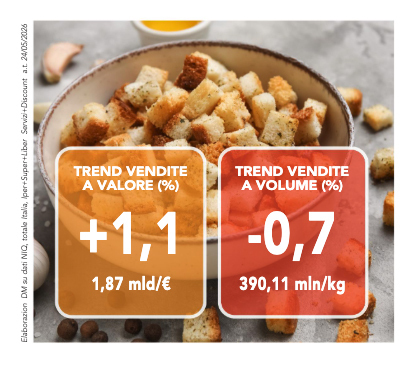 In the last year ending 24 May 2026, the sector reached a turnover of almost 1,87 billion euros (NIQ data, total Italy, Hypermarkets+Supermarkets+Free-standing services+Discount), with value growth of 1,1% compared with the previous year, but a slight contraction in volume (approximately 390 million kilograms, -0,7%), contrary to the positive development recorded the previous year (+1%). The average price by volume, meanwhile, confirms its growth trend (+1,8%), proving even stronger than previously observed: a sign that rising prices continue to support turnover despite the slight decline in volumes.
Performance by geographical area
“Area 1 – explains Filippo Morlini of NIQ – while representing the most significant geographical area in terms of turnover (30,9%), records the lowest value growth (+0,5%), with a significant decline in volume (-1,3%). Area 2, second in importance in terms of market share (25,6%), shows a similar trend, with value growth of 0,9% and a volume contraction of 1,6%. Area 3, with a turnover share of 22,4%, unlike the previous areas, shows greater resilience: it records value growth of 1% and a more limited decline in volume, equal to -0,8%. Area 4, which represents the smallest share in terms of turnover (21,1%), stands out for its strongest performance. In fact, it records an increase both in value (+2,1%) and in volume (+1,1%). In addition, the average price by volume increases to a lesser extent than in the other areas (+1%).”
Performance of the distribution channels
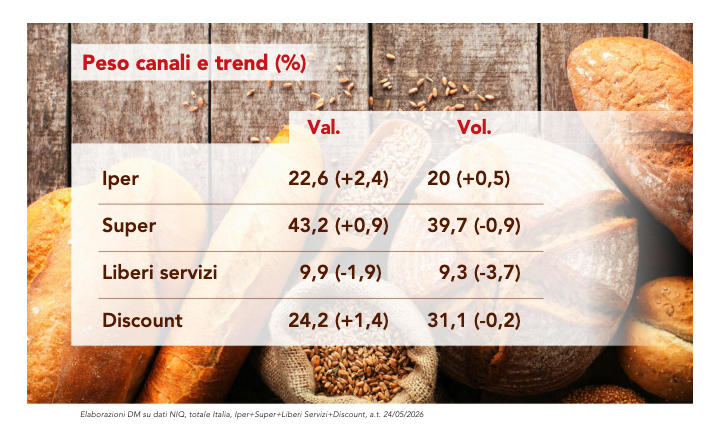
Modern distribution (Hypermarkets+Supermarkets+Free-standing services), which represents 75,8% of total turnover, shows a trend that is broadly aligned with the overall market: value growth of 1% is observed, accompanied by a reduction in volume of 0,9% and an increase in the average price by volume of 1,9%. Looking at the details, supermarkets hold the largest share (43,2%), followed by hypermarkets (22,6%). Both channels record positive value performance, amounting respectively to +0,9% and +2,4%; however, in volume, only hypermarkets show a slightly positive trend (+0,5%). Free-standing services, although representing a smaller share (9,9%), show the weakest performance: they are in fact the only channel to decline in value as well (-1,9%), continuing the trend from the previous year, and record the sharpest contraction in volume (-3,7%), despite an increase in the average price by volume in line with the other channels (+1,8%). As for discount stores, positive value performance is recorded (+1,4%) and volume is essentially stable (-0,2%), although growth has slowed compared with the previous year (+1,1% and +2,1%). Here too, turnover growth is supported by the increase in the average price by volume (+1,6%), in line with the trend observed in the other channels, confirming that inflationary dynamics continue to support turnover in the face of largely static volumes.
Focus on the segments
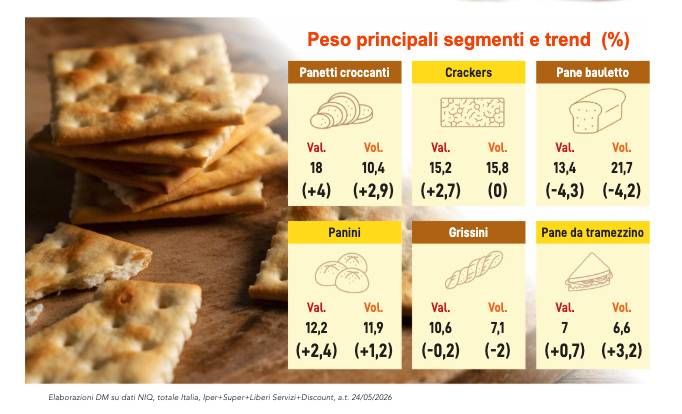 “The bread and substitutes market – continues Filippo Morlini – is highly fragmented and divided into fifteen segments. However, the first six account for 76,4% of total turnover: crispbreads (18%), crackers (15,2%), loaf bread (13,4%), sandwich rolls (12,2%), breadsticks (10,6%) and sandwich bread (7%).” Growth is driven mainly by crispbreads, which continue to show a positive trend, contributing +12,8 million euros to overall growth, with a value trend of +4% and a volume trend of +2,9%. Within the segment, the bruschetta/croutons and bread crisps subsegments are particularly dynamic, together generating almost 11,1 million euros in growth. By contrast, Swedish crispbreads show negative performance, with a decline of 3,7% in value and 3,8% in volume. The crackers category ranks second in importance, with a turnover of 283,1 million euros. Within it, there is a clear polarisation: classic crackers are contracting (-3,7% in value and -4% in volume), while the wholemeal crackers segment is growing strongly (+6,3% in value and +3,6% in volume), confirming the positive trend already seen the previous year. Loaf bread continues to record a decline (-4,3% in value and -4,2% in volume); the classic segment is declining, while wholemeal loaf bread contributes positively with +1,4 million euros. The sandwich rolls segment also reaches a turnover of almost 227 million euros, with value growth of 2,4%, while breadsticks continue to show a negative trend (-0,2% in value and -2% in volume). Finally, sandwich bread, although representing a smaller segment, contributes positively by almost 850.000 euros, driven mainly, once again, by the wholemeal subsegment.
Read more in DM Magazine July–August 2026
This article was translated from the original Italian version with the assistance of artificial intelligence. In case of discrepancies, please refer to the original Italian version.