Juices, nectars and squeezed juices: small sips of nature in response to the health trend
Juices, nectars and squeezed juices: small sips of nature in response to the health trend
- Information
In a contracting market for juices, nectars and squeezed juices, companies in the sector are firmly focused on meeting new trends: from health-oriented segmentation, which highlights the specific benefits of each product, to expanding consumption occasions.
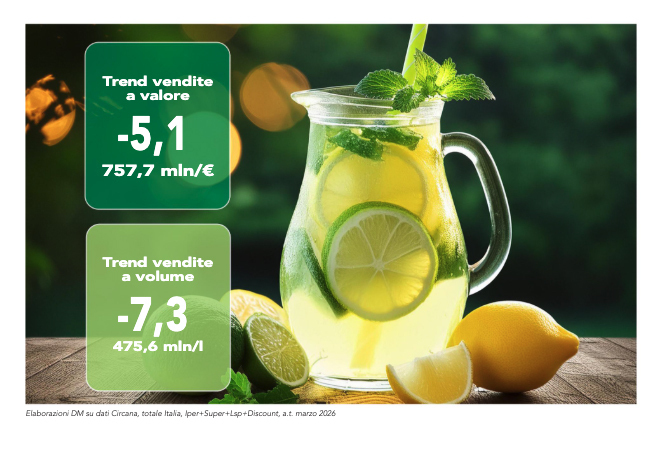 In the year ending March 2026, the sector in Italy showed a contracting trend. Overall, just over 475,6 million litres of product were sold, corresponding to a reduction of 7,3% compared with the volumes sold last year. Total turnover reached almost 757,7 million euros, with a reduction of 5,1%, influenced by the combination of declining consumption and inflationary dynamics (Circana data, total Italy, Hypermarkets+Supermarkets+Lsp+Discount).
Geographical areas and distribution channels
The geographical distribution of sales by volume highlights the highest concentration in north-western Italy, with a share of 28% (28,6% by value). The South follows, accounting for 27,4% by volume and 25,7% by value. Central Italy+Sardinia account for 22,6% of volumes and 23,4% of value, 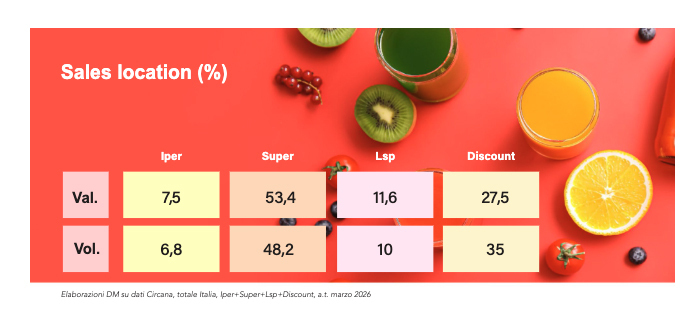 while north-eastern Italy closes with a share of 22% by volume and 22,3% in terms of turnover. As regards distribution channels, supermarkets confirm their central role, handling 48,2% of volumes and 53,4% of total value. Discount stores rank as the second key channel, with a share of 35% by volume and 27,5% by value. Free-service stores, on the other hand, account for 10% of volumes and 11,6% of value, while hypermarkets account for 6,8% by volume and 7,5% by value.
Segment performance
Within the market, the various segments show similar trends. Fruit-based drinks between 65,5 and 3,8% represent the largest part of the sector, with almost 236,3 million litres sold and turnover of just over 366,5 million euros, corresponding to a decline of 5,8% in volume and 3,9% in value. In terms of market share, they are followed by nectars and similar products, which, with just over 124,4 million litres and approximately 202,1 million euros in turnover, show an even poorer performance, with a reduction of 10,9% by volume and 9,3% by value. The only exception in an overall picture of a cont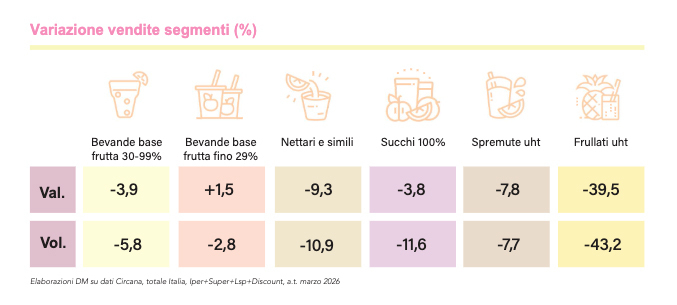 raction is represented by fruit-based drinks up to 29%; with +1,5%, these are in fact the only ones to record slightly positive performance, at least in terms of value, reaching total turnover of 97,4 billion euros. Volumes, however, with -2,8%, remain in decline, reaching almost 74,9 million litres. The performance of juices 100% is decidedly negative, particularly by volume; these reach 32,9 million litres following a decline of 11,6%, while in value terms they reach millions of euros, falling. The last two positions, in terms of turnover, are occupied respectively by UHT squeezed juices, which exceed 5,9 million litres and 18,9 million euros (-7,7% by volume and -7,8% by value), and by UHT smoothies, which record the most significant decline, with -43,2% by volume and -39,5% by value, reaching 1,2 million litres sold for 3,1 million euros. The competitive landscape is characterised by the prevalence of branded manufacturers which, with the first three players – Conserve Italia, Zuegg and Gruppo Lactalis – collectively cover 35,8% of the market by value. Private label nevertheless has a very important position, accounting for 43,4 per cent of the sector.
Read more about DM Magazine May 2026
This article was translated from the original Italian version with the assistance of artificial intelligence. In case of discrepancies, please refer to the original Italian version.