Healthy food: when good rhymes with healthy. The sector's expansion continues
Healthy food: when good rhymes with healthy. The sector's expansion continues
- Information
Far from being just a fad, health-oriented products now constitute a highly varied and extensive sector, capable of meeting the expectations and needs of a broad swathe of increasingly aware and attentive consumers.
The “eating healthily” trend shows no signs of slowing down. The healthy food sector – understood as a basket of gluten-free products, alternatives to cow's milk, plant-based substitutes and functional yoghurt – continues to expand strongly. After the +6,8% recorded last year, in the year ending 26 October 2025, its turnover came close to 1,7 billion euros nationally (NIQ data, total Italy, Hypermarkets+Supermarkets+Free-standing stores+Discount), marking a further +8,7% on the previous year. The momentum is also evident in volumes: almost 842 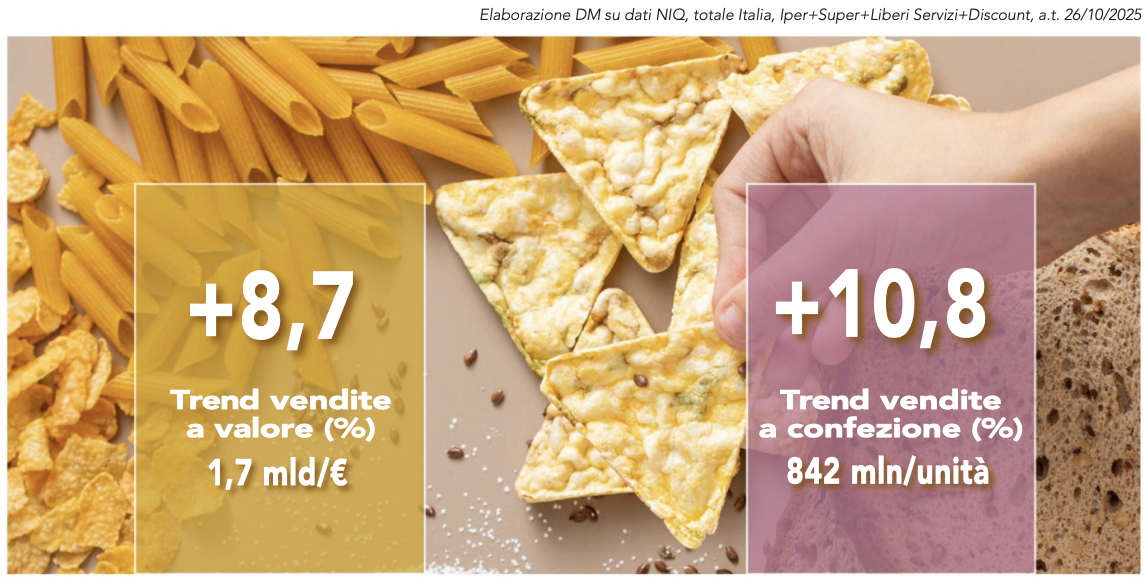 million units sold, equivalent to growth of 10,8%. “More than 40% of this trend is driven by functional yoghurt – explains Matilde Ciroldi of NIQ – which reaches 602,7 million euros in turnover nationally and more than triples last year's growth rate. The macro-segment is therefore expanding at double-digit rates both in value (+10,7%) and by pack (+14,9%). Next in terms of contribution are gluten-free products, which reach 370,7 million in turnover, with a trend of +8,6% in value and +8,3% by pack, and products belonging to the substitute plant-based gastronomy category, which reach 295,1 million in turnover, with an increase of 9,6% in value and 12,2% by pack (after a 2024 that had seen increases of more than 25%). Finally, alternatives to cow's milk come close to 424,8 million euros, with a trend of +5,6% in value and +6,1% by pack.”
Geographical areas and distribution channels
Geographically, Area 4 is leading growth and, despite representing only 20,8% of turnover, contributes around one third of the overall increase thanks to double-digit performance (+12,6% in value and +14,2% by pack), the only one above the national average. It is followed by Area 1, which records a below-average trend (+7,4% in value and +9,8% by pack), but contributes to growth to a similar extent as the South, as it is the area with the greatest weight (31,9% of total turnover). 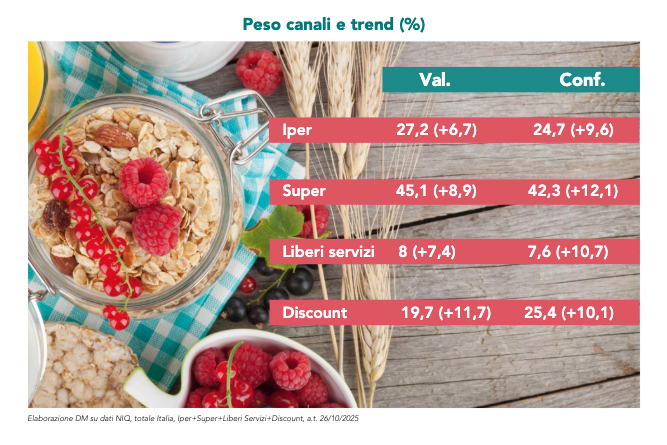 In third and fourth place respectively are Area 3, which accounts for 25% of the market and grows in line with the national average (+8,5% in value and +10,8% by pack), and finally Area 2, which generates 22,4% of turnover and records more moderate increases (+7,4% in value and +9,1% by pack). Among distribution formats, supermarkets confirm their leading role: alone they generate 45,1% of total turnover, exceeding 763,4 million euros in the last year, with growth of +8,9% in value and +12,1% by pack. They are followed by discount stores, which contribute around a quarter of overall growth and reach a 19,7% share, thanks to an above-average trend (+11,7% in value and +10,1% by pack). Within modern distribution, hypermarkets also remain significant, accounting for 27,2% and increasing by 6,7% in value and 9,6% by pack. Finally, free-standing stores, with a share of 8%, return to growth in line with the average (+7,4% in value and +10,7% by unit), after a subdued 2024 (+0,6% in value and +3,2% by unit).
Segment performance
“Within functional yoghurts, the core macro-segment accounting for 35,6% of the sector – Matilde Ciroldi elaborates –, growth is driven almost entirely by the other functionalities segment: products that do not focus on specific benefits such as intestinal regularity, cholesterol reduction or immune defences, but tap into broader trends through rich in propositions (in particular, high protein content) and free from/low in propositions (lactose-free, reduced calorie content, easy to digest). This segment captures a 15,4% share (+2,5 points) and more than doubles its growth rate compared with last year, with +29,5% in value and +26,5% by pack. Performance is supported by rising demand and an increasingly broad offering: an average of 16,6 references nationally. Among the other functional yoghurt segments, more contained increases are recorded for the regularity segment (+1,3% in value but -0,6% by pack) and the cholesterol-reduction segment (+2,6% in value and +1,4% by unit), while the strengthening/defence segment continues to contract (-3,4% in value and -1,5% by unit).” The macro-segment of gluten-free products, which represents 21,9% of the sector, sees more than half of the contribution to the trend coming from gluten-free bakery products and cereals (+16,4% in value and +16% by pack), which reach a 6,8% share of total turnover. Within this macro-category, snacks stand out, with turnover of more than 16 million euros and outstanding performance (+45,6% in value and +30,6% by pack). Among gluten-free products, the next most important performance is that of gluten-free pasta, a market worth approximately 69,3 million euros that closed with +7,8% in value and +6,7% by pack, and the macro-category of frozen products, which reaches 78,8 million euros and increases by 3,2% in value and 4% by pack. Among frozen products, the greatest contribution is determined by pizze.Bene; the performance of fresh bases (+12,5% in value and +18,2% by pack), which exceed 11,8 million in turnover, soft breads, seasonal products and, finally, crackers also contributes.
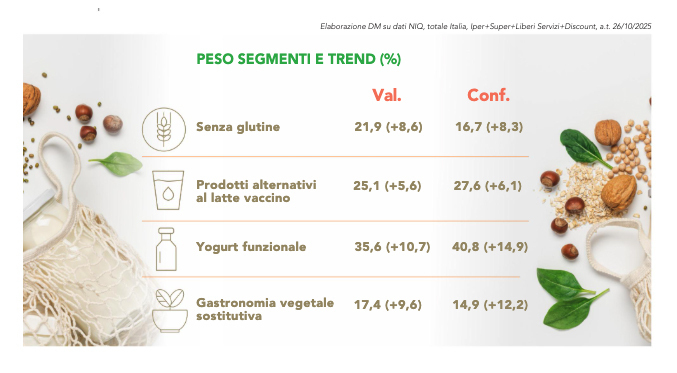
As regards the macro-segment of substitute plant-based gastronomy, which represents 17,4% of the sector, more than half of the growth comes from the category of plant-based ready meals (+6,8% in value and +9,9% by unit), which, with a 11,9% value share, grows in line with the sector average, after last year's double-digit trends, and continues to expand its range (11,1 references sold on average across Italy, +0,8 points). The greatest contribution to ready-meal performance comes from burgers and croquettes, which exceed 121 million in turnover and grow by 4,5% in value and 6,8% by pack. Also within substitute plant-based gastronomy, the category of ready-made fresh sauces – which includes hummus – ranks next in terms of contribution to turnover (+19,8% in value and +16,1% by pack), reaching 2,3% of market share, while ready-made fresh pasta sauces record a contraction. Another category that continues to grow while maintaining double-digit trends is plant-based cured meats, which reach almost 21,2 million euros and increase by 22,3% in value and 29,8% by unit. Basic plant-based ingredients, including tofu and seitan, are also growing continuously, reaching 18,4 million and 9,1 million respectively in turnover across Italy. The macro-segment of alternatives to cow's milk, which represents 25,1% of the sector, concentrates more than 65% of growth in UHT milk substitutes (+4,7% in value and +5,2% by unit), which account for 19,4% of market turnover. Oat milk stands out among them. Next in terms of positive contribution are almond-based products and coconut-based products, while soy- and rice-based products continue to contract. Within the macro-category of references with basic ingredients that are alternatives to cow's milk, the second-largest contribution to growth comes from cheese substitutes, which generate 21,4 million euros in turnover and record a strong trend: +20,6% in value and +20,4% by pack. The performance of yoghurt substitutes is also positive (+5,5% in value, +7% by unit), representing 4% of the sector. Within this category, sheep's- or goat's-milk yoghurts stand out, with exceptional growth (+32,9% in value and +38,3% by pack) and turnover of more than 9,8 million, followed by plant-based yoghurts (excluding soya), up +14,2% in value and +18% by unit. By contrast, soya-based yoghurts show weaker performance (-0,8% in value and +0,8% by pack).
Read more about DM Magazine January 2026
This article was translated from the original Italian version with the assistance of artificial intelligence. In case of discrepancies, please refer to the original Italian version.