Sweet snacks, inflation curbs consumption in the sector

Sweet snacks, inflation curbs consumption in the sector
- Information
Within the sweet snacks sector, chocolate remains the leading product, and the industry is responding to the crisis in volumes by focusing on wellbeing, ethical supply chains and sensory innovation.
In the last year, ending on 26 October 2025, the Italian sweet snacks market generated a turnover of 1,6 billion euros, recording a positive trend of +10,1%. Sales by volume, on the other hand, fell (105,4 million kilograms, -5,2%) as did sales by pack (815,9 million, -3,4%). There was significant growth in the average price (+16,2%), while the promotional pressure index and the average number of references remained stable (NIQ data, Total Italy, Hypermarkets+Supermarkets+Free-service stores+Discount stores).
Geographical areas and distribution channels
«The general market situation is repeated across all geographical areas – says Alberto Pincelli of NIQ – with an increase in sales by value accompanied by a contraction in volume. Area 21,1% remains the most significant in terms of sales location (9,6%), despite recording the lowest growth by value (2,9%) in total sales, which amount to 1,7% million euros, alongside a 11,5% decline in volumes and a +7,1% contraction in sales by pack». It is followed by Area +13,6%, with a market share by value of -5,7%, which simultaneously records the highest growth by value (-5%) and the sharpest contraction in volumes (24,3%) among all areas. The average price, on the other hand, increases by 9,5%. Area +23%, with a sales location of 23,8%, records growth by value of 9,9%; at the same time, there is a 5,2% contraction in volumes and a 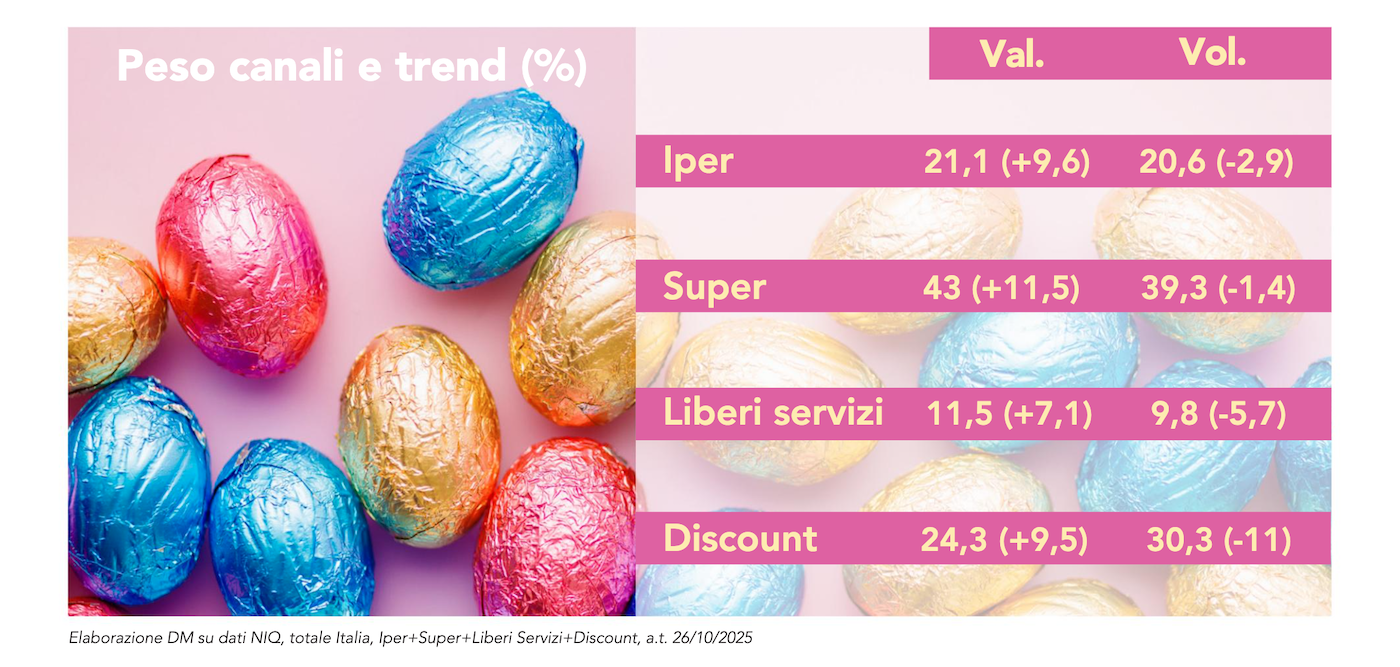 decrease in sales by pack of 3,3%. Finally, Area 2, with a sales location of 22,2%, records growth by value of 10,5%, while volumes contract by 4,7% and sales by pack decrease by 3,4%. At channel level, 43% of sales value is generated in supermarkets, where the highest percentage growth by value is also recorded (+11,5%); at the same time, however, volumes decline (-1,4%) and sales by pack fall (-0,6%). Hypermarkets record growth by value but a decline in volumes and a decrease in sales by pack. «Free-service stores, with the lowest sales location among the channels, also record the smallest increase in sales by value – continues Alberto Pincelli –. The increase in the average price is associated with a contraction in volumes and a decrease in sales by pack. Finally, discount stores record growth by value, supported by the highest increase in the average price among the channels. Against this increase, the sharpest contraction in volumes (-11%) and a decrease in sales by pack (-8%) are observed».
Performance of the segments
The segment with the highest share by value (47,6%) is represented by chocolate tablets and bars. Despite overall growth in sales by value (+16,5%), there was a contraction in volumes (-6,6%) and sales by pack (-4%). This trend was driven by an increase in the average price (+24,8%), which offset the reduction in quantities sold. In addition, the average number of references declined (-1,6%) compared with the previous year, signalling a rationalisation of the range. Within the sector, dark chocolate tablets and bars held the largest share by value (17,5%) compared with white chocolate bars (1,7%). Dark chocolate also stood out for the highest average price variation (+30,8%), accompanied by the most significant growth in sales by value (+31,7%) and positive volume performance (+0,8%). The only product to record an increase in the number of references (+2%) was the segment of milk chocolate tablets and bars, signalling an expansion of the range in this category. As for the sweet snacks segment, this was the second most important in terms of share by value (42,6%). Here too, sales by value increased (+4,7%), against a contraction in volumes (-2,7%). The trend was supported by an increase in the average price (+7,6%), while the average number of references grew (+1,7%) compared with the previous year, indicating an expansion of the available range. «Within the segment – explains Alberto Pincelli –, cereal-based sweet snacks hold the largest share by value (12,2%), but also record the poorest performance in terms of sales by volume (-4%). On the contrary, fruit-based sweet snacks represent the segment with the lowest share (2,1%), characterised by a decrease in the average price (-1,7%) and a contraction in the average number of references (-4,8%). 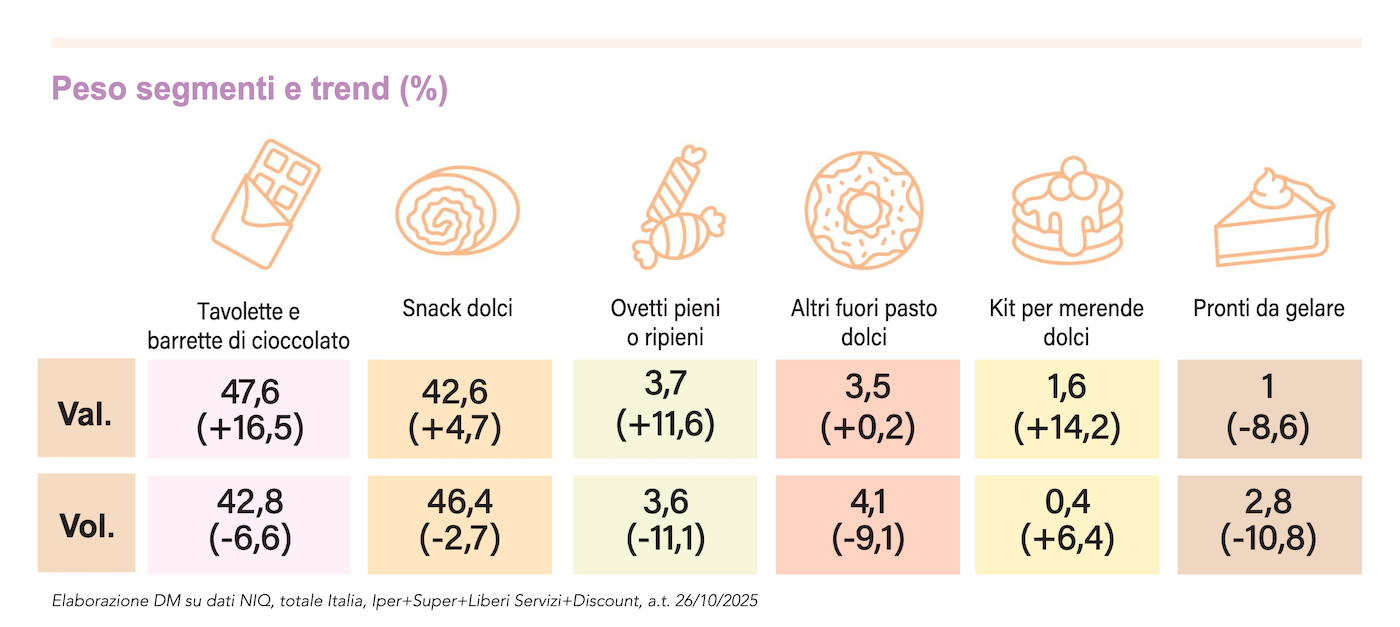 The other products, on the other hand, show an increase in the available references. In terms of performance, wafer-based sweet snacks stand out for the strongest growth in value (+8,6%), confirming a more positive trend than the other subsegments». This is followed by the segment of filled or stuffed eggs, which holds a share by value of 3,7%. This is the segment that recorded the sharpest contraction in volume (-11,1%), accompanied by a strong increase in the average price (+25,6%). The other sweet snacks segment, on the other hand, ranks fourth in terms of share by value (3,5%). Here too, the significant decrease in sales by volume (-9,1%) and a minimal increase in sales by value (+0,2%) had an impact. The trend was supported by an increase in the average price of 10,3%. It is followed by the sweet snack kits segment, which holds a share by value of 1,6%. This is the sector that recorded the highest variation in sales by value (+14,2%), accompanied by growth in sales by volume of 6,4%, an increase in the average price of 7,3% and an increase in the average number of references (+1,1%). Finally, the ready-to-freeze segment, which has a share by value of 1%, is the only one to record a negative variation in sales by value (-8,6%) and a contraction in volumes (-10,8%), against a limited increase in the average price (+2,4%). It also represents the segment that reduced the average number of references the most (-6,8%), highlighting a strong rationalisation of the range and an overall weak performance compared with the other segments.
Read more about DM Magazine January 2026
This article was translated from the original Italian version with the assistance of artificial intelligence. In case of discrepancies, please refer to the original Italian version.