NielsenIQ takes stock of the transport crisis: Gdo at +1,4%
NielsenIQ takes stock of the transport crisis: Gdo at +1,4%
- Information
While everyone's attention is now turned to a new threat – cyber attacks on refrigerated cabinets – NielsenIQ takes stock of the October transport crisis.
The 4 area under NielsenIQ's scrutiny
The picture that emerges is far less dramatic than one might think.
Incidentally, Niq analysed the performance of modern-channel sales in Area 4 (Abruzzo, Basilicata, Calabria, Campania, Molise, Puglia, Sicily), comparing the weeks of 12-18 October (the start of the protests) and 19-25 October (the start of the end of the strike).
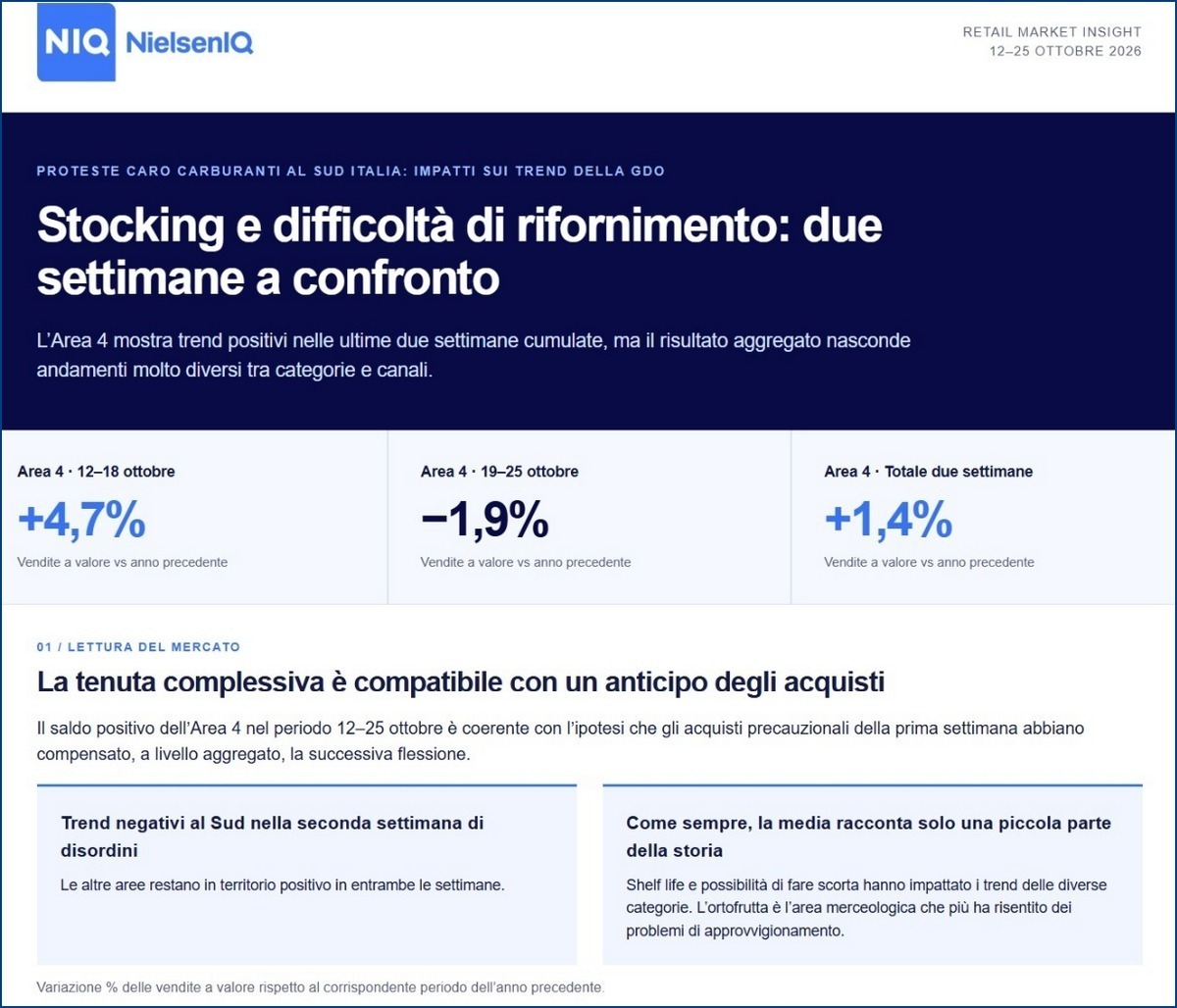
The lorry blockades over high fuel prices, adding together the various regions, did not have a devastating impact at all on Gdo, which, on the contrary, held up, showing a +1,4% increase in value.
But what actually happened to household purchases, and what behaviours did consumers adopt?
Consumers got ahead of the curve
The data first show a precautionary bringing forward of purchases. Faced with fears of supply difficulties, consumers may initially have increased the size of their baskets and their household stocks.
Indeed, in the period 12-18 October, growth, always in value terms, of 4,7% was recorded, followed by a year-on-year decline of 1,9% in the immediately following week.
Thus, overall, the South maintained a positive result, on the order, as mentioned, of 1,4%.
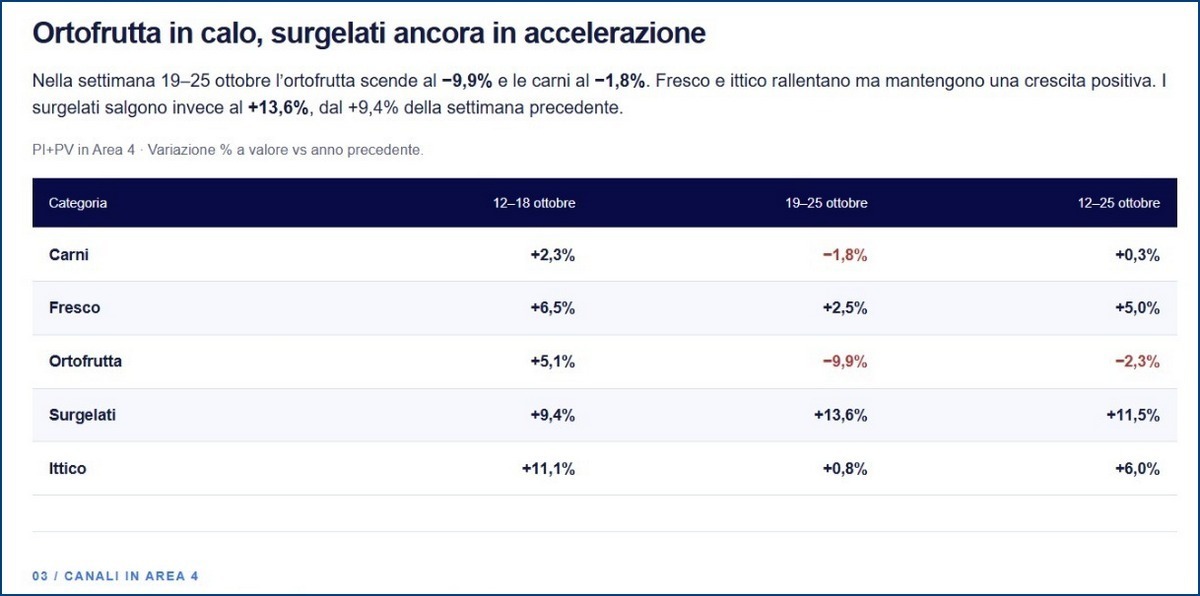
While particular logistical difficulties were reported for 19 to 25 October for fresh products, fruit and vegetables recorded, consistently, a decline of 9,9% and meat of 1,8 per cent.
Conversely, more easily stored goods showed the opposite trend: frozen products, for example, grew by 13,6%, after +9,4% the previous week.
Supermarkets grow, while discounters and hypermarkets decline
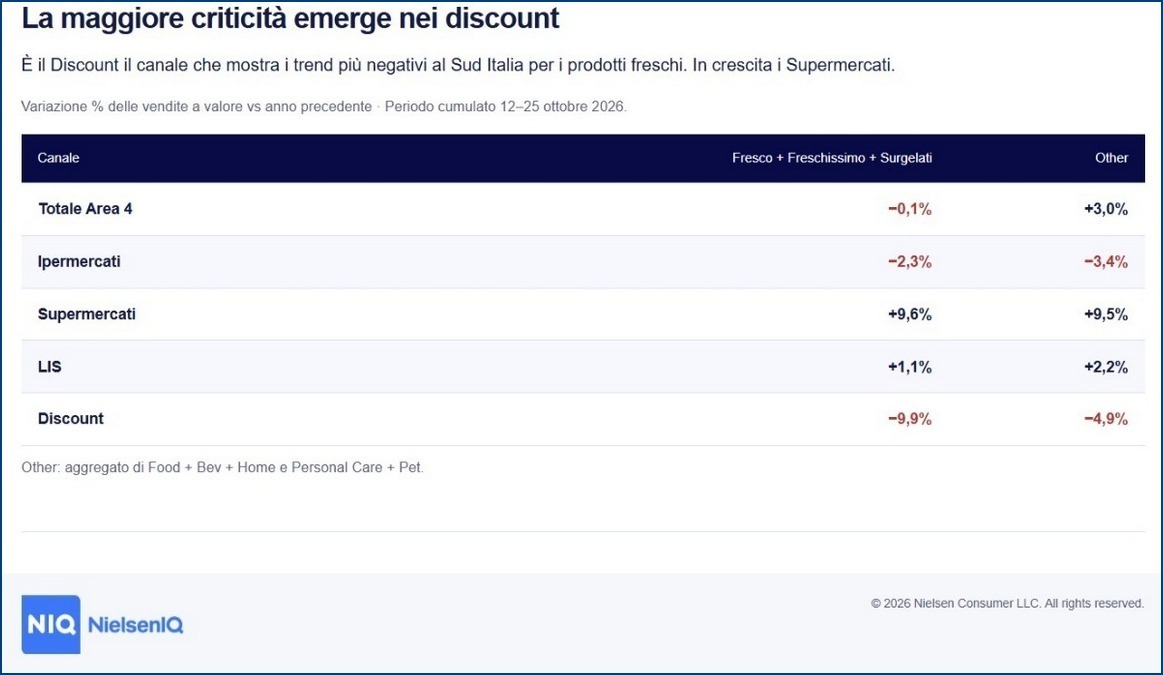
The various channels also reacted differently. In the 15-day cumulative period, considering fresh, very fresh and frozen products, supermarkets benefited from an increase of 9,6%, while discounters fell by 9,9% and hypermarkets by 2,3%.
The NielsenIQ data thus provide a more nuanced reading of the effects of the demonstration: not only an overall change in the pace of sales, but also a possible redistribution of spending between weeks, categories and channels. All of this was conditioned by the actual availability of the products, their shelf life and the possibility of stocking up.
Niq's observations appear to contradict, but only apparently, those made by YouGov. This source observed that the South is, in any case, more exposed to potential cyclical shocks because of various factors: greater economic fragility, a higher purchasing frequency, a lower average basket value, a more fragmented sales network, with a relative prevalence of normal trade.
All factors that largely make major purchases less “natural”. But evidently the sense of danger ultimately prevailed.
This article was translated from the original Italian version with the assistance of artificial intelligence. In case of discrepancies, please refer to the original Italian version.