FMCG worth 164 billion euros: for NIQ, it is the “mirror of the country”
FMCG worth 164 billion euros: for NIQ, it is the “mirror of the country”
- Information
FMCG is worth 164 billion euros, 2,5% more than the previous year, and accounts for 19,1% of Italian households’ consumer spending (actual purchases). These are the NIQ figures for the year ending in August 2026, presented by Enzo Frasio, CEO of NIQ Italy, in the slides for Centromarca’s FMCG Forum 2026.
One euro in four comes from fresh products sold by variable weight
 The sector enters every home: 100% of households buy these products, with 4,4 purchasing occasions per week and average annual spending of more than 5.500 euros. Supermarkets generate 33% of turnover, while hypermarkets and discount stores account for 18% each. According to Frasio, however, economic weight does not tell the whole story: “Its importance goes beyond these figures: it is a mirror of the country.” And again: “Through consumption, we can in fact understand how families’ priorities are changing, how needs are evolving and what expectations citizens place in companies.”
Sales areas of +8,6% and assortment of +8,3%: the response to three needs
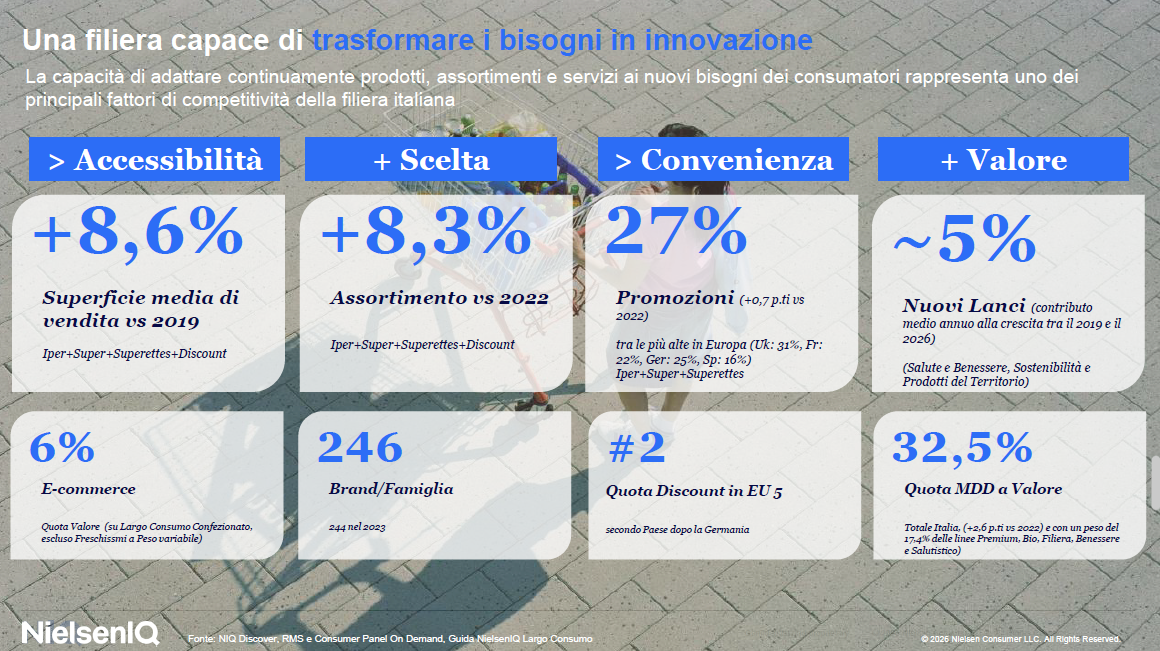
NIQ Italia’s managing director identifies three demands that have emerged strongly in recent years: well-being, understood as quality of life; time, meaning economic efficiency; value, namely quality consistent with the price. “The supply chain’s ability to respond to these demands was not long in coming – says Frasio – and it responded with concrete, measurable effects.”
The evidence, shown in the slides, is as follows: the average sales area of hypermarkets, supermarkets, small supermarkets and discount stores grew by 8,6% compared with 2019, while the assortment grew by 8,3% compared with 2022. Promotions account for 27% (+0,7 points compared with 2022), the second-highest share among the markets compared, after the United Kingdom (31%) and ahead of Germany (25%), France (22%) and Spain (16%). Private-label products rise to 32,5% of value, +2,6 points compared with 2022. New launches contribute approximately 5% annually to growth between 2019 and 2026, e-commerce accounts for 6% of packaged goods, and discount stores rank second by share among the five largest European markets, after Germany.
Inflation at 0,3% in 2026, compared with 3% in the United Kingdom
The NIQ observatory measures a price increase on packaged products of 11,9% in 2023, followed by 1,3% in 2024 and 1,9% in 2025. Between January and July 2026, the Italian figure fell to 0,3%: over the same period, the United Kingdom recorded 3%, Germany 1,6%, Spain 1,2%, while only France, at 0,2%, remained lower. NIQ’s analysis links the result to consumers’ strong price sensitivity, which fuels competition. Unit sales grew by 1% in 2025 and by 0,8% in the first half of 2026; in value terms, the increase was 2,1% and 1,6%.
Over 65 to 34,5% in 2050: demand is becoming more nuanced
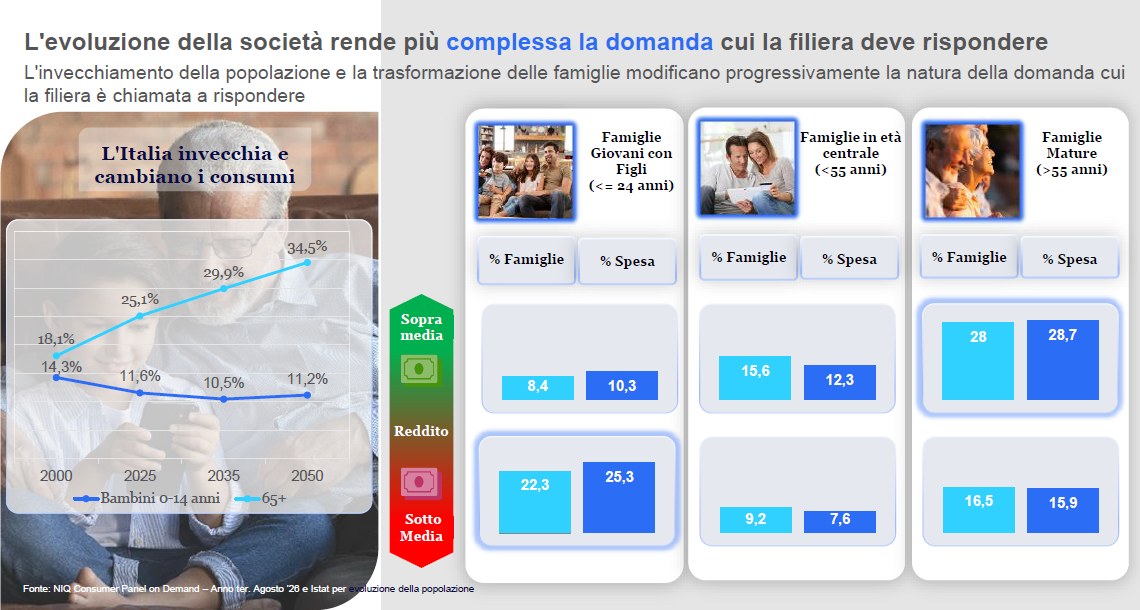
The demographic picture complicates the equation. According to NIQ calculations based on Istat data, people over 65 will rise from 25,1% of the population in 2025 to 34,5% in 2050, while children aged 0 to 14 will fall from 11,6% to 11,2%. Families with more than 55 years are 11,5 million, compared with 7,9 million households with children up to 24 years old and 6,4 million in the central age group: three groups with distinct needs, from value and functionality to quality and trust.
Beyond national borders, the focus is on made in Italy, which the slides describe as “a growth driver even beyond national borders”. 73% of the top one hundred Italian brands are present in at least one of the other four major European markets, where they generate 31% of turnover; 66% of brands active abroad are growing faster than in their home market.
In the conclusions, Frasio summarises the balance sheet as follows: “The ability to offer affordability, breadth of choice, innovation and accessibility has enabled the sector to strengthen its role not only as an economic engine, but also as a privileged observatory of social changes and new consumption patterns.”
This article was translated from the original Italian version with the assistance of artificial intelligence. In case of discrepancies, please refer to the original Italian version.