Mediobanca: wine revenues decline. Recovery during 2026
Mediobanca: wine revenues decline. Recovery during 2026
- Information
What scenarios lie ahead for Italian wine? This year too, Mediobanca’s research department responds with a survey of 255 leading Italian joint-stock companies.
The sample’s minimum threshold is set at revenue exceeding 20 million euros. Aggregate revenues amount to 12 billion euros, half of which comes from abroad.
It should be noted that, for the first time, the report also includes a contribution from Fondazione Qualivita, dedicated to the DOP and IGP wine sector and the role of protection consortia.
Italy remains first in the Mediobanca analysis
In 2025, world wine production is estimated at 227 million hectolitres (+0,6% on 2024), while consumption stands at 208 million hectolitres, down by 2,7%.
Italy remains the leading producer, with 44,4 million hectolitres (19,7% of the total), not far from the level of 2024 (+0,7%); the decline in domestic consumption (-9,4%) is more evident, falling from 38 litres per capita in 2022 to 35,6 litres in 2025.
In surplus, on the other hand, is our trade balance: over 20 years it grew at an average rate of 5%, rising from 2,7 billion euros in 2005 to 7,2 in 2025. Italy is also the leading wine exporter by volume (21 million hectolitres in 2025) and the second by value (7,8 billion euros, behind only France’s 11,2 billion).
Over the last five years, 80% of Italian producers have reported a decline in consumption; for around two thirds, the trend is expected to continue in the coming years. Despite this, 70% continues to consider the sector attractive, viewing it as destined for a stricter selection process.
Quality and price for recovery
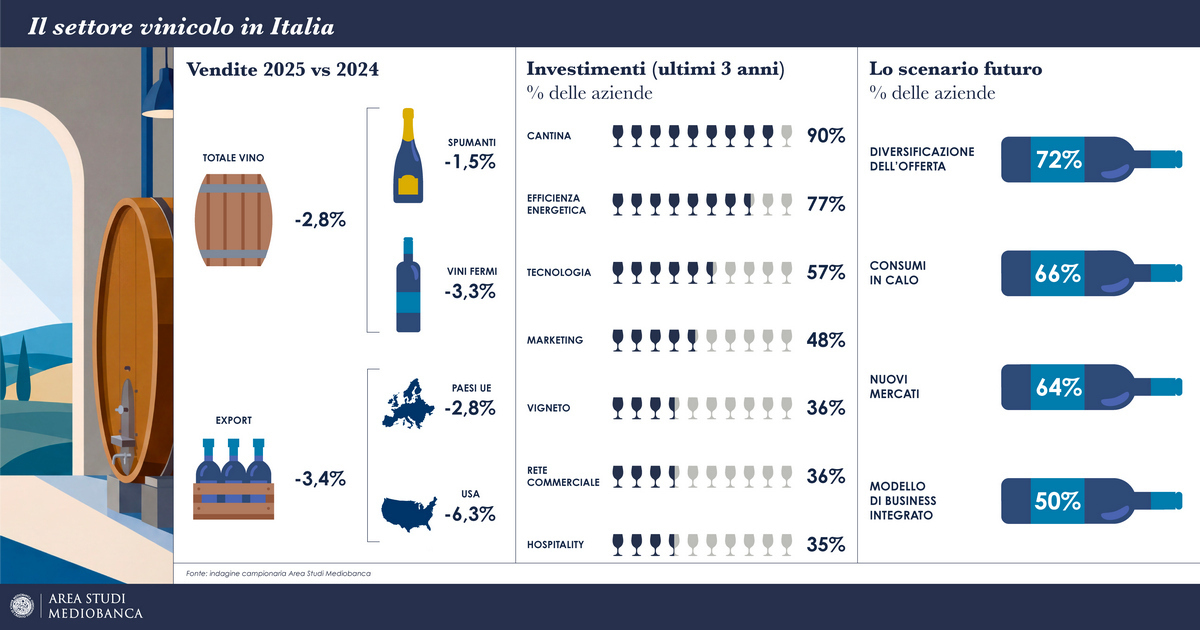
Diversification of the offering is considered the main lever for addressing changing demand (this is the view of 72% of companies), followed by opening up or developing new markets (64%).
In this context, strengthening marketing and communication activities is essential for 60% of companies; this is followed by the development of new distribution channels and greater attention to sustainability (around 45% of responses).
Oversight of the entire production and commercial chain is considered the most suitable organisational model (preferred by 50% of respondents). M&A transactions are also moving in this direction, together with initiatives aimed at local consolidation needs.
The focus remains on quality, considered decisive for consumers by around half of companies, immediately after price (fundamental in two thirds of cases).
Challenges are addressed through new investment: over the last three years, the investments of the largest producers have mainly concerned wineries (90% of cases), energy efficiency (77%) and technology (57%).
In 2025, total appropriations were up by 3,5% on 2024, while advertising expenditure fell by 5,4% to 2,6% of sales. 58% of the major wine producers expects its sell-out to grow in 2026.
Sparkling wines still on Mediobanca’s podium
At product and market level, in 2025 sparkling wines showed greater resilience (sparkling wines (-1,5% overall sales versus -3,3% for the others).
Organic wines have reached, according to R&S Mediobanca, 6,2% of the market (-0,8% sales), while remaining below 0,5% are no- and low-alcohol wines.
The mid-price segment is suffering more, down by 3,1%: -2,7% basic wines and -2,2 premium wines.
In 2025, wine exports also declined: they stood at -2,8% in EU countries (37,2% of the total), and at -6,3% in the US; the United Kingdom was more or less stable (-0,7%).
Revenues of the major operators
Leadership of sales in 2025 remains with the Cantine Riunite-Giv group, with revenues of 635,1 million euros (-4,6% of 2024).
The wine group Argea remains in second place (462,9 million, -0,3%), followed by Italian wine brands, with 395,9 million (-1,5% of 2024).
Revenues 2024 above 300 million euros were also recorded by the Romagna cooperative Caviro (351,3 million), down by 8,8% on 2024.
Eight companies fall within the revenue bracket between 200 and 300 million euros: the Tuscan Antinori (revenue 2025 amounting to 259,7 million euros, down by 0,7% on 2024), the Veneto-based Herita Marzotto Wine Estates (246,7 million euros, -0,6%), the Trentino cooperative Cavit (242,8 million euros, -4,1%), La Marca, specialising in sparkling wine production, with turnover of 234,7 million euros (-6,5%), the cooperative Terre Cevico (213,2 million, +3,4%), the Trentino-based Mezzacorona (213 million, +0,3%), Mack & Schühle (205,7 million, +0,1%) and Gruppo Collis (202,7 million euros, -7,6%).
Some companies have a very high export share, in some cases almost total: Fantini Group reaches 95,7%, Argea 93,8%, while Ruffino and Fratelli Castellani exceed 90%.
Other articles:
Wine sales decline in large-scale retail
Wines, spirits and vinegars: a gratifying 2025, despite everything
Exports to the United States plunge
This article was translated from the original Italian version with the assistance of artificial intelligence. In case of discrepancies, please refer to the original Italian version.