Agri-food consumption reaches 305 billion (+3,2%). Ismea’s big picture
Agri-food consumption reaches 305 billion (+3,2%). Ismea’s big picture
- Information
Ismea takes stock of Italian agri-food in all its components over the course of 2025, with insights that also look at the first 6 months of 2026.
The substantial document (106 pages in the “light” version), namely the “Report on Italian agri-food 2026”, released on 12 November, paints a picture of a sector that remains very strong: according to Istat data updated to September, in 2025 value added, considering the primary sector and processing, reached 89 billion euros, equal to 4,4% of GDP, with real growth (+1,2%) more than twice that of the national economy (+0,5%).
Agri-food exports rise to 72,5 billion euros
The weight in the Italian economy is even more significant when the entire supply chain is taken into account. Current estimates, including distribution and catering, put its share at 8% of gross domestic product, rising to 15%, when logistics, transport and intermediation are added.
The picture is also positive for exports, which in 2025 achieved yet another record, at 72,5 billion euros, up 5% on 2024.
This result consolidates a now-structural expansion trend: over the past decade, agrifood exports have maintained an average annual rate of +7,3%, higher than that of total national exports, increasing their share of Italy’s total exports from 9 to 11%.
Domestic consumption: at home and out-of-home compared
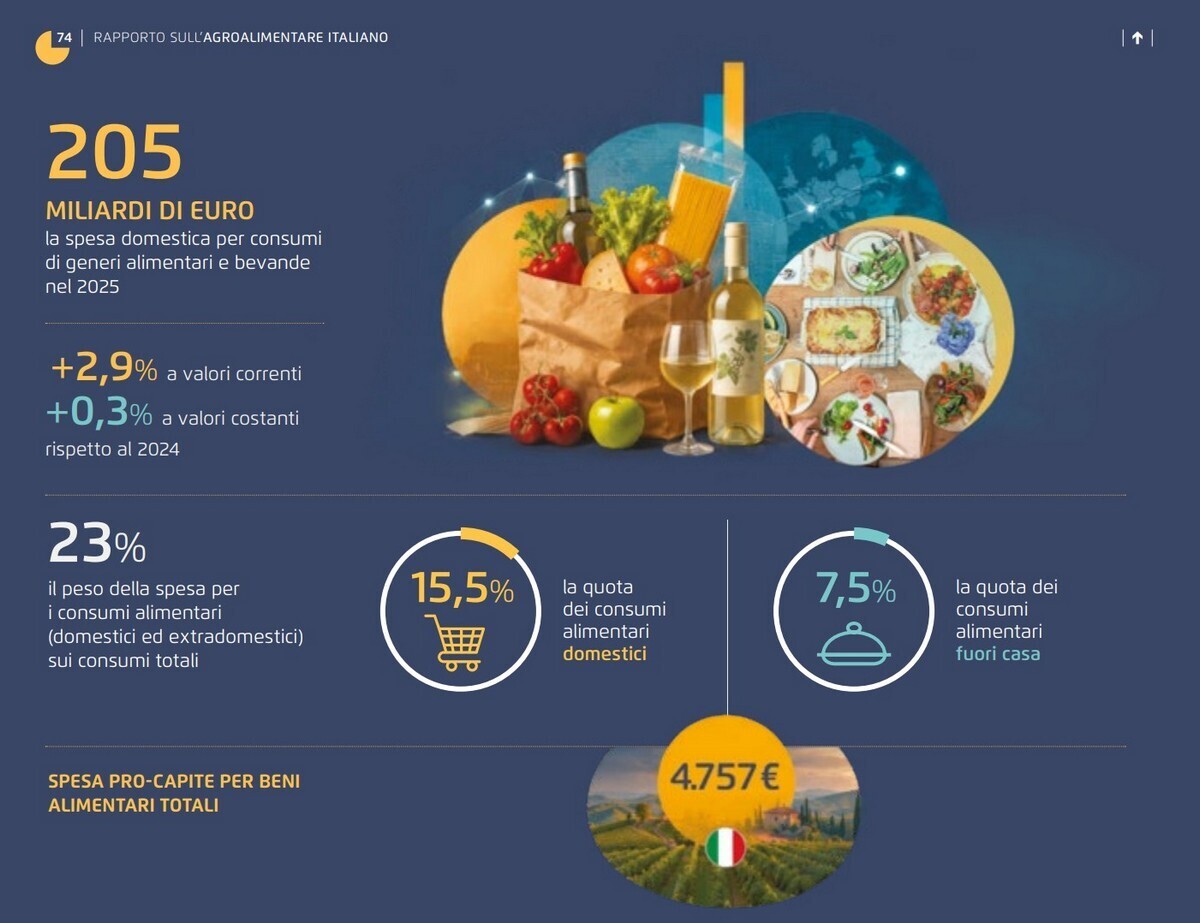
The chapter on domestic consumption brings good news, as household spending on food and drink reached 205 billion euros at current prices, up +2,9% on the previous year (+0,3% in real terms).
At the same time, out-of-home consumption benefited from an increase of 3,8% (+0,5% in real terms), reaching 100 billion euros.
“Thus, the total value – the report says – reached around 305 billion euros last year, an increase of 3,2% compared with 2024 (+0,3% in real terms).”
Italians spend more than Europeans, but less than Spaniards
Not only that. Italians like to treat themselves, so the annual budget – at home and out – accounts for 23% or so (21,7% the EU figure at 27) of household consumer spending, a figure lower only than Spain’s (27,3%), with the difference due to a very substantial share for Horeca (13,4% compared with 7,3% in our country).
“Likewise – writes Ismea – it is not surprising that Italy is the EU country where per capita food consumption is highest, with a value that, on average in 2022-24 (the latest available data for comparison), stands at 4.757 euros, above the 4.287 euros for the EU as a whole. Looking only at the domestic component, the annual figure per person in our country reaches 3.223 euros (2.920 EU average).”
Regionally, there are marked differences: Calabria stands out, where food & beverage accounts for 28,2%, of total expenditure, while the highest-income areas fall, in some cases, to below 15 per cent.
Prices: an increase was recorded here, but it was not particularly strong. In 2025, the year-on-year trend measured by the HICP (which compares inflation across the EU) stood at +1,7%, up from +1,1% in 2024.
Supermarkets lead distribution. What about the others?
Within the report, the Ismea-NielsenlQ Food Consumption Observatory provides a picture of distribution channels, having monitored 16.000 households representative of the Italian population.
By far in the lead, also thanks to its more extensive network, is the supermarket, with a market share of 41% and turnover growth of 4,7%. Next comes the discount store: 22% and +2,3%, respectively. Hypermarkets saw total sales increase by 1,5 per cent.
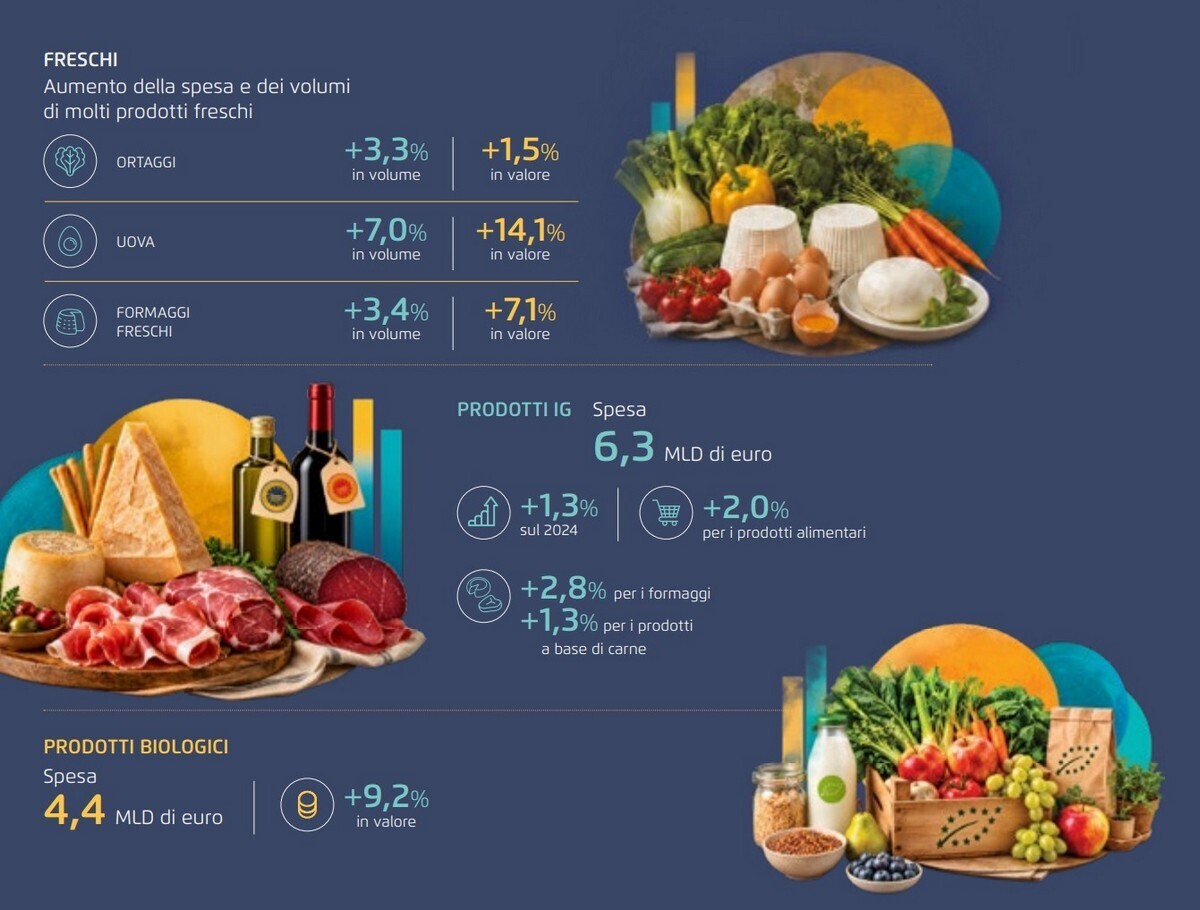
“In this context, it is important to note that the most dynamic channel proved to be traditional retail, where purchases of very fresh products (meat, bread, fruit and vegetables, and fish) predominate.” For example, in the organic sector alone, normal trade is up 13,4 per cent.
A few words about promotions: their share has fallen over the course of a year, from 26,7 to 24,3 per cent.
The final finding concerns the first 6 months of 2026: “Spending on food consumption – says Ismea – continued to grow, increasing by 2,3% compared with the same period of the previous year. This change was driven mainly by animal protein products (meat, ed.), which, despite rising prices, have maintained good volumes.”
This article was translated from the original version in Italian with the assistance of artificial intelligence. In case of discrepancies, please refer to the original version in Italian.