The “Little Encyclopaedia of Pasta” by Bignami arrives with the support of Barilla
The “Little Encyclopaedia of Pasta” by Bignami arrives with the support of Barilla
- Information
The “Little Encyclopaedia of Pasta”, the new publishing initiative by Edizioni Bignami created with the support of Barilla, brings the world of pasta inside Bignami’s historic educational format for the first time.
The project also represents a new departure for the Bignami publishing catalogue: it is the publisher’s first compendium devoted entirely to pasta and, more generally, the first volume dedicated to the world of food. It is a work designed to condense, in an agile format with a vintage character, a subject that spans Italian history, culture, technology, science and everyday life.
A journey of 7.000 years
Written by Parma journalist Emanuela Vibi, with graphic design by Lucia Strada, the volume opens with an exploration of the rich history of pasta: a journey spanning more than 7.000 years from the earliest processing of wheat to the emergence of dried pasta, from its spread throughout the Mediterranean to the transformation of production into a modern industry. The account also retraces some of the milestones that marked the product’s evolution, such as the introduction of artificial drying and the gradual mechanisation of production processes.
The science
The volume’s second section is devoted to the science of pasta, with in-depth coverage of raw materials, the structure of the wheat grain, milling and the characteristics that make durum wheat particularly suitable for producing dried pasta. The book then examines the different production stages in detail, from mixing and shaping through to drying, explaining how technology and knowledge of the material have transformed the way pasta is produced over time.
The cultural phenomenon
The journey goes beyond the production dimension to present pasta as a cultural phenomenon and part of the Italian imagination: from advertising to literature, from cinema to comics, also thanks to the images and documents preserved in the Barilla Historical Archive and at the Pasta Museum in Giarola, Collecchio.
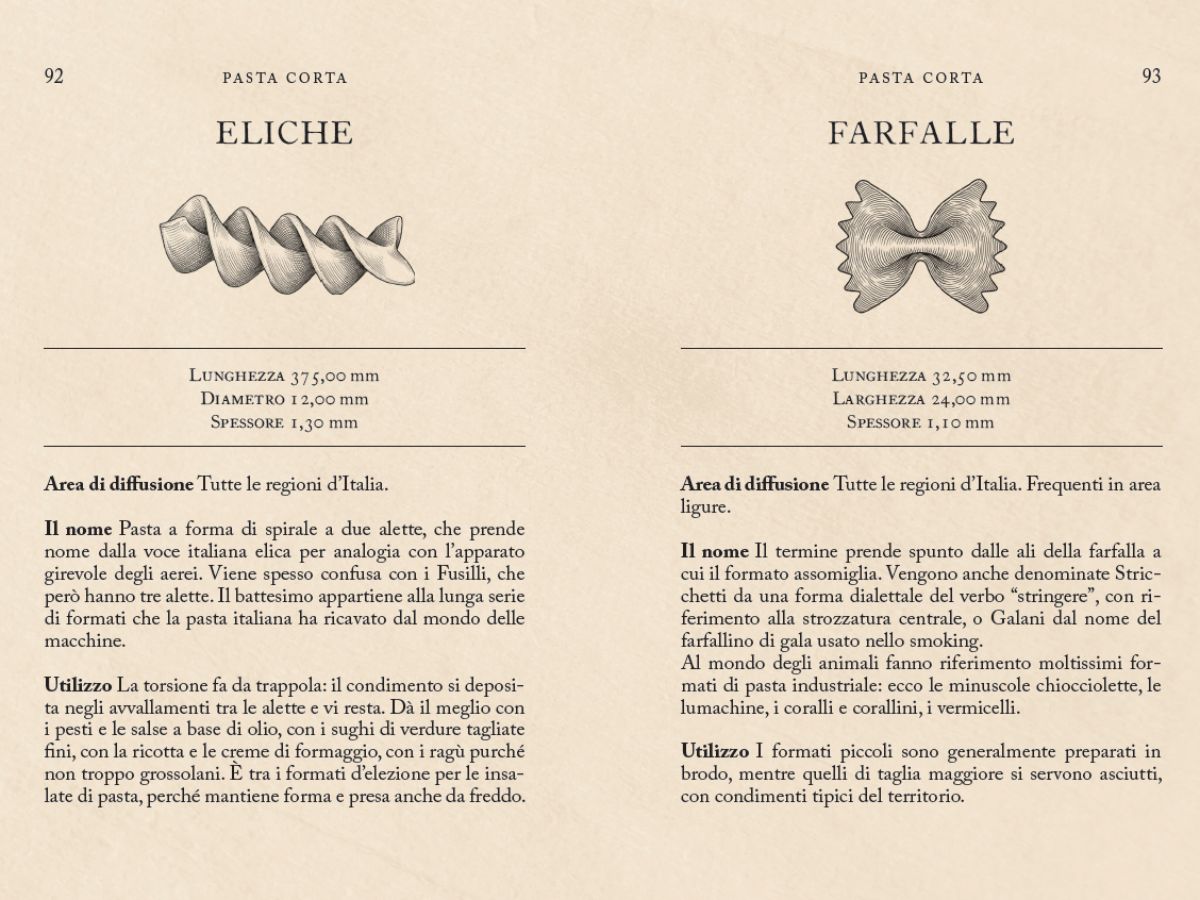
The work is completed by 100 cards dedicated to an equal number of pasta shapes, with characteristics and technical information: a repertoire that transforms the variety of shapes into a true guide to understanding Italian pasta.
This article was translated from the original Italian version with the assistance of artificial intelligence. In case of discrepancies, please refer to the original Italian version.