Conad Adriatico, over 270 million euros in investments over three years
Conad Adriatico, over 270 million euros in investments over three years
- Information
At the Autumn Meeting 2026 of Conad Adriatico, technology and human relationships point the way towards more efficient retail. A path supported by over 270 million euros in investments between 2026 and 2028.
The ability to support customers, explain product quality and build relationships will become increasingly decisive for Gdo. Artificial intelligence will make processes and organisations more efficient, but competitive advantage will depend on people’s skills. For Conad Adriatico, the transformation involves strengthening cooperative roots and the growth of employees. A new phase of development that includes over 270 million euros of investment between 2026 and 2028, with applications already in operation: the number of stores using AI to plan orders has doubled, said CEO Antonio Di Ferdinando.
Innovation grows from the roots of cooperation
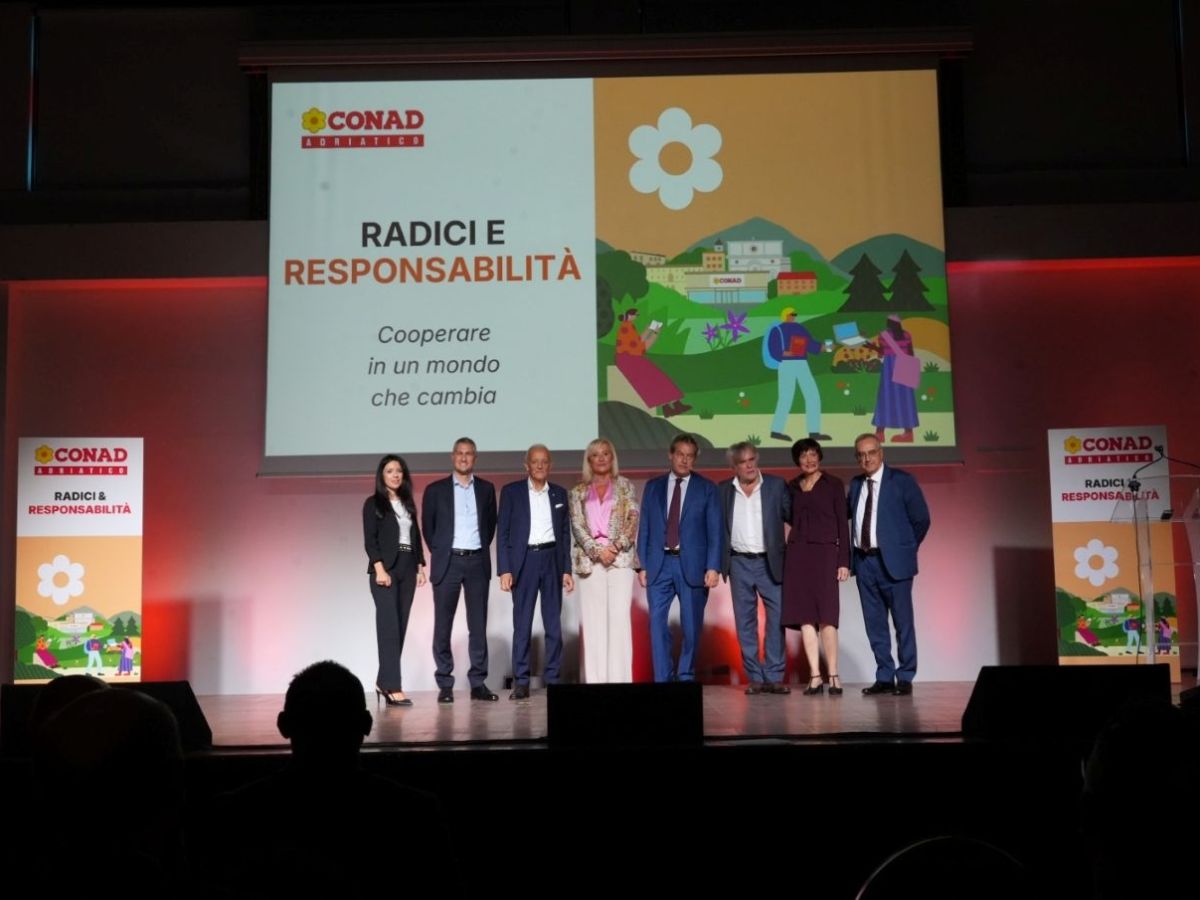
This was the message that emerged from the 2026 Autumn Meeting, "Roots and responsibility. Cooperating in a changing world", organised on 8 October at the Hotel Casale di Colli del Tronto (Ascoli Piceno). Moderated by Maria Cristina Alfieri, director and secretary general of Fondazione Conad ETS, the discussion brought together economics, consumption and innovation, on the eve of the cooperative’s programming decisions.
President Emiliano Ciaschetti, in his opening remarks, highlighted the assets represented by 261 entrepreneur members, 446 outlets and around 9.000 employees, spread across five regions along the Adriatic ridge and in the Balkans. "The cooperative certainly draws nourishment from results, figures and objectives achieved, but above all it lives through relationships, dialogue and participation," he emphasised. "Roots, naturally, are not there to keep us still. They are there to help us grow."
Sebastiano Barisoni, Deputy Executive Director of Radio 24, spoke of revolution, distinguishing crises, which require resilience, from changes that permanently alter the context. The technological revolution under way concerns every sector, is irreversible and has unpredictable outcomes. Algorithms and digital tools have expanded consumers’ opportunities for comparison, reducing the information advantage of sellers. For the physical store, the answer is consultancy: "The only way to beat the algorithm is through a human, consultative and empathetic relationship." What will distinguish companies is the quality of their human capital.
The sociologist Francesco Morace proposed transforming outlets into "experience points": places where people can identify with others, receive information and enjoy opportunities for discovery. Timeliness does not mean speed alone: it means responding at the right moment while maintaining depth, quality and creativity.
The market picture was provided by Alfonso Giuliano, Trade Manager at Circana. In the first eight months of 2026, fast-moving consumer goods grew in value by around 1,7 billion euros compared with the previous year, with growth driven above all by volumes and private-label brands. Fresh products, up 4,8% in value, are the leading segment. Consumers are protecting their purchasing power, avoiding waste and visiting an average of nine retail chains a year. 70% of Italians are reducing consumption away from home, transferring part of it within the home: opportunities are opening up for supermarkets and delicatessens linked to offerings focused on enjoyment, service and quality.
The relationship with local areas and the ability to interpret change found testimony in the story told by Roberta Fileni, Vice President of the Fileni Group, who stressed the need to work in synergy with large-scale distribution, whose indications help industry respond to consumer needs. Among the Group’s choices, Fileni highlighted organic production and a way of doing business attentive to communities, animals and people.
Daria Ebano, Enterprise Manager Retail at Microsoft Italia, illustrated the applications of AI in Gdo. The first area is the back office: connecting fragmented data, automating stock management, flagging products nearing their expiry date, reducing waste and creating personalised promotions. The time saved can be devoted to value-creating activities, while virtual assistants can help staff respond to customers. The objective is collaboration between people and agents, in which human interpretative ability continues to guide processes.
For Antonio Di Ferdinando, CEO of Conad Adriatico, the discussion confirms the fundamentals of the cooperative’s positioning. Value for money and quality remain central: the experience of "Low and fixed" prices, expanded to one thousand product lines, has shown how increasing volumes can recover the margin sacrificed to reduce prices. But what distinguishes products needs to be explained better, by telling the story of the supply chain, controls and local production: "It is not enough to say that a product is better: why is it better?" According to the CEO, success depends 50% on the brand and 50% on the management of the outlet, from the organisation of departments to the quality of the welcome.
AI enters this strategy to free up time for study, training and relationships. "It will make us more efficient; it will not replace us. It will help us with repetitive tasks." The evolution of checkouts and departments will require staff to be gradually supported towards new duties: "We must support this process, step by step, preparing these people to become increasingly effective assistants to our customers."
Employees’ participation in the stores’ financial results is another central element of the strategy outlined by Di Ferdinando. "Today the team wins, not the individual," he stressed, urging members to listen to and train people and involve them in objectives and results. "We must also involve them in the store’s financial results," he said, referring to human resources. The resources generated can help those facing difficulties, starting with young people. "The financial result is important, but it is not the only thing": the cooperative can weather less profitable years when it invests in the future.
Conad Adriatico’s figures
This outlook is underpinned by growing performance. In 2025, Conad Adriatico’s turnover exceeded 2,35 billion euros (+4,83%); over the five-year period, growth was 27%. Its market share is 17,64%, with leadership in Abruzzo, Marche and Molise. The three-year plan allocates resources to the development and modernisation of the network, logistics, technologies and skills. In 2025, collaboration with 529 local suppliers generated over 475 million euros in turnover: an economic link with local areas that gives substance to the cooperative roots.
The Autumn Meeting thus brought out a challenge running throughout the supply chain: understanding a more demanding consumer, making quality recognisable and using technology to add value to the shopping experience. For Conad Adriatico, cooperative roots provide direction amid change whose outcomes are still uncertain. Their strength will be measured by their ability to help people grow together with the business, turning efficiency into time for listening, skills into trust and ties with local areas into shared opportunities. It is on this ground that the future of distribution will take shape.
This article was translated from the original Italian version with the assistance of artificial intelligence. In case of discrepancies, please refer to the original Italian version.