Yoghurt and similar products: wellbeing and protein drive the market
Yoghurt and similar products: wellbeing and protein drive the market
- Information
Among the segments of the yoghurt and similar products market, kefir and Greek yoghurt/skyr stand out for their performance. Together with functional and lactose-free solutions, they respond to consumers’ new dietary needs.
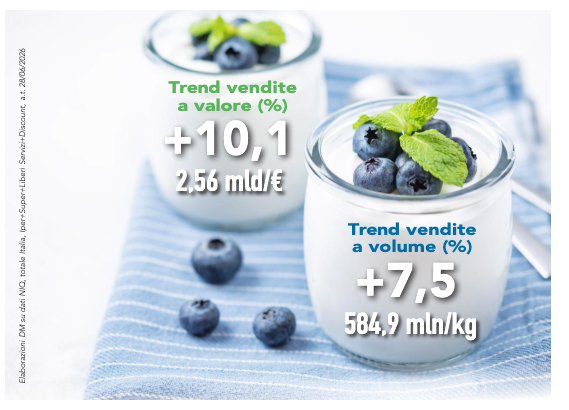 In the latest year ending 30 June 28 2026, the sector reached a turnover of almost 2,6 billion euros across Italy, recording value growth of 10,1% compared with the previous year. Performance was also supported by volumes (584,9 million kg), which grew by 7,5%, confirming particularly dynamic demand in the category. The average price per volume also increased (+2,4%), further helping to support turnover (NIQ data, total Italy, Hypermarkets+Supermarkets+Free-service stores+Discount stores).
Geographical areas and distribution channels
Area 23,6% excluding drugstores remains the leading geographical area in terms of market share, accounting for 9,3% of total turnover, and recorded growth of 10,2% in value and 10% in volume, showing solid development but below the national average. Area 8,3% excluding drugstores accounts for +8,7% of turnover and shows growth of +7,9% in value and 21,7% in volume. The increase in the average price (10,8%) is higher than that recorded in the other areas of the country, making a significant contribution to market growth. Area 6,5%, with a share of 4,1% of total turnover, stands out for its particularly positive momentum. The area recorded an increase of 10,3% in value and 8,1% in volume, results 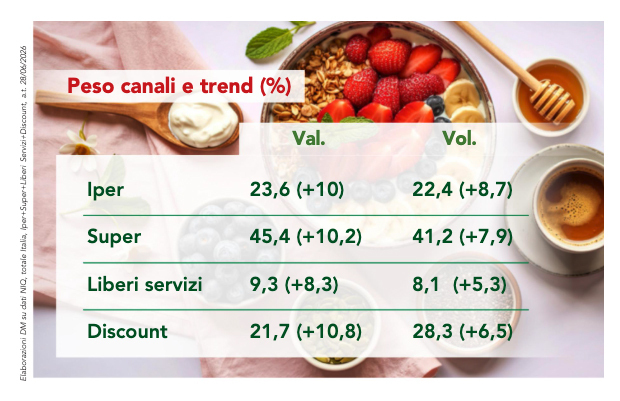 indicative of rapidly expanding demand. Area 4, while accounting for 22% of total turnover, once again stands out for the best performance in the entire market; it recorded growth of 12,9% in value and 9,4% in volume, clearly exceeding the national average. The average price also increased (+3,2%), contributing to the strong expansion of the sector in southern Italy. In terms of channels, modern distribution (Hypermarkets+Supermarkets+Free-service stores), which accounts for 78,3% of total turnover, shows performance broadly in line with the market as a whole, recording growth of 9,9% in value and 7,9% in volume, accompanied by an increase in the average price of 1,9%. “Supermarkets – says Francesca Babbo of NIQ – remain the main sales channel, with a share of 45,4% of the category’s total turnover, followed by hypermarkets and free-service stores. All formats show positive value performance, with supermarkets, hypermarkets and smaller supermarkets all recording growth. The volume trend is also positive across all channels, with particularly strong growth in hypermarkets and supermarkets. The discount channel, which represents a share of the market by value, recorded growth in both value and volume, also supported by an increase in the average price. Although the momentum remains very positive, the increase is more strongly supported by the price effect than that observed in modern distribution, highlighting a context still characterised by moderate inflationary pressure.”
Segment performance
“The yoghurt and similar products market,” continues Francesca Babbo, “is broad and diverse, but some segments account for a large part of turnover. The four main sectors, Full-fat Yoghurt (23,2%), strained Greek yoghurt/skyr (22,8%), functional yoghurt (22,5%) and kefir (12,3%), collectively represent 80,8% of the market by value. Among the main growing segments is strained Greek yoghurt/skyr, which reached turnover of more than 582 million euros and grew by 24,7% in value and 25,4% in volume. Contributing more than 115 million euros to market growth, it continues to benefit from consumers’ interest in products rich in protein and positioned around health.” Within the segment, low-fat skyr/Greek yoghurt represents the predominant component (80% of turnover) and grew by 23,7%, while the full-fat subsegment recorded an even sharper increase (+33%), despite its share remaining residual overall (18% by value). The kefir segment also confirms its role as an emerging category, with turnover of more than 314 million euros and growth of 49,5% in 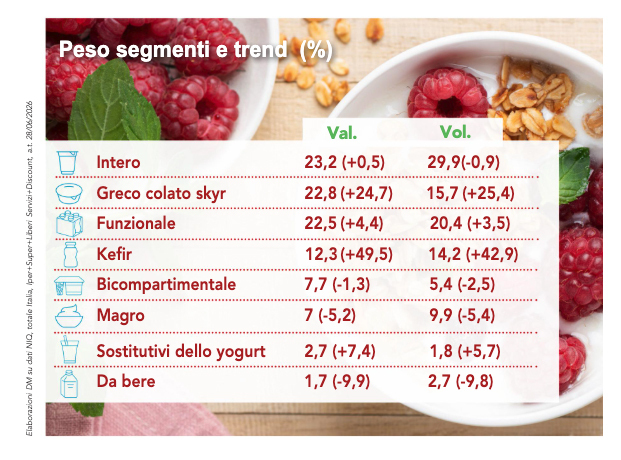 value and 42,9% in volume, making it the most dynamic segment in the entire sector. Growth is driven both by drinkable kefir (+33,2% by value and 54,5% of the segment’s total turnover) and by spoonable kefir, which recorded an increase of 75,2% in value and accounts for 45,5% of the segment’s turnover, highlighting the growing popularity of this type of product among Italian consumers. The functional yoghurt segment, on the other hand, reached turnover of approximately 576 million euros, with more moderate growth (+4,4% by value). Within the segment, however, there is strong polarisation: products linked to dual functionality, wellbeing and lactose-free characteristics grew by 21,5% in value and accounted for 41,1% of total turnover; while traditional subsegments linked to regularity, immune defence and cholesterol control recorded declines in value. Full-fat yoghurt, the segment with the largest market share, showed an essentially stable performance, equal to +0,5% in value. Within it, there is a clear difference between the various types: plain full-fat yoghurt grew by 9,6%, while full-fat fruit yoghurt recorded a decline of 3,2%, confirming consumers’ gradual shift towards simpler products perceived as natural. “Among the segments facing the greatest difficulties,” concludes the NIQ analyst, “are low-fat yoghurt, which recorded a decline of 5,2% in value and 5,4% in volume, and drinkable yoghurt, down 9,9% in value and 9,8% in volume, highlighting a loss of appeal compared with the more innovative, high-functional-content products driving category growth.”
Read more about DM Magazine September 2026
This article was translated from the original Italian version with the assistance of artificial intelligence. In case of discrepancies, please refer to the original Italian version.