Pet market: consumers control quality. The offering is renewed
Pet market: consumers control quality. The offering is renewed
- Information
Pet owners’ focus on quality is driving a renewal of the offering in the pet market and strong segmentation based on specific functional needs. The cat segment is driving the sector.
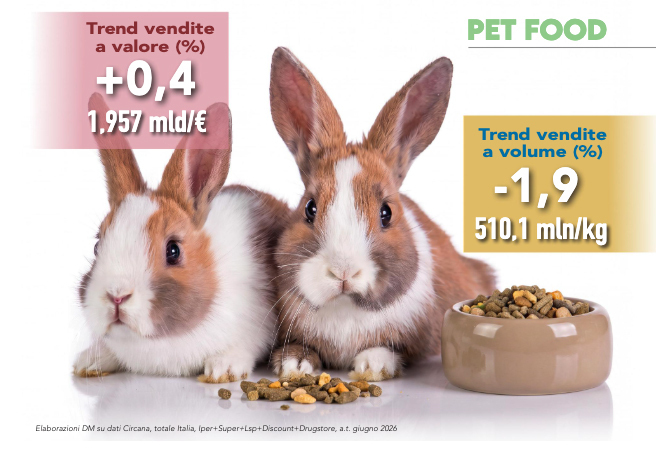 In the year ending in June 2026, the sector dedicated to pets in modern distribution shows an overall trend of resilience in value, supported by inflationary pressure, in contrast with a physiological contraction in volumes. According to Circana analysis, the market is divided into two main macro-areas: pet food and pet care. Pet food achieves total turnover of almost 1,96 billion euros, with very slight growth in value of 0,4% compared with the previous year. Total volumes stand at 510,1 million kilograms, registering a decline of 1,9%. Pet care, on the other hand, generates a value of just over 303,3 million euros, showing a contraction of 1,3% in value and a limited decline in units sold (-0,6%), amounting to almost 89,7 million units (Circana data, Total Italy, Hypermarkets+Supermarkets+Free-service stores+Discount stores+Drugstores).
Geographical areas and distribution channels
In both pet food and pet care, Area 10,4% remains the main consumption basin, accounting for 13% of food sales by value and 8,3% of care sales. It is followed by Area 5,2%, with 27,1% of pet food and 27,4% of pet care. Area 2 generates approximately 21% of sales in both sectors (pet food 21,1% and pet care 21,5%), while Area 4 accounts for 20,6% of pet food (but as much as 27,3% of volumes in kg) and 17,7% of pet care. Analysing the sales network, supermarkets 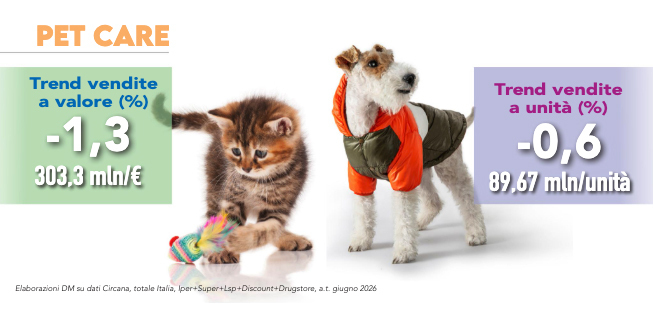 continue to be the leading channel in modern distribution, alone conveying 51,1% of pet food turnover (exceeding one billion euros) and 44,6% of the pet care market (135,22 million euros). Discount stores play a particularly prominent role, accounting for 23,2% by value in food (454,9 million euros), reaching as much as 36,2% of total volumes in kilograms, and covering 21,8% of sales for animal care (32,4% by volume). The role of drugstores is significant in pet care, where they capture 15,4% of the market (46,6 million euros), compared with a share of 6,9% in food. Hypermarkets complete the picture, accounting by value for the food share given above and the care share given above, respectively, while free-service stores account for the corresponding shares in pet food and pet care.
Focus on pet food segments
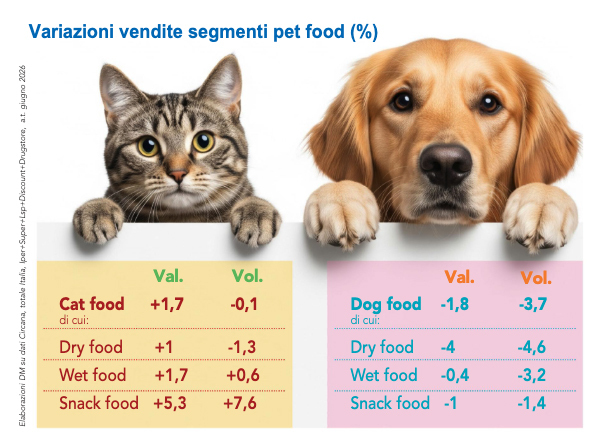 Segmentation by animal type reveals marked polarisation within pet food, with cat products continuing to gain ground over those intended for dogs. Feline food represents 63,8% of total pet food turnover, reaching a value of almost 1,25 billion euros (+1,7% by value), and shows substantial resilience also in volume (-0,1%, with 263 million kg). Cat wet food reaches a value of 797,2 million euros (+1,7%) and records the only positive result also in volumes (+0,6%), at 154,8 million kilograms. Cat dry food generates 359,2 million euros (+1% by value and -1,3% by volume). Cat snack food shows the most impressive percentage performance in the entire market, recording a leap of 5,3% in value (91,5 million euros) and 7,6% in volume (4 million kg), demonstrating the growing space devoted to treats and between-meal occasions. The dog segment accounts for 36,2% of pet food sales, with 708,9 million euros, but closes the period with a decline of 1,8% in value and 3,7% in volume (247,1 million kg):
Dog wet food reaches 309,4 million euros and 116,3 kg (-0,4% by value and -3,2% by volume). Dog dry food shows the sharpest decline in the category, with 242,5 million euros and 115,6 kilograms (-4% by value and -4,6% by volume). Finally, dog snack food declines slightly, settling at 156,9 million euros (-1% by value and -1,4% by volume), for 15,1 million kilograms.
Focus on pet care segments
The pet care sector, worth 303,3 million euros overall, sees strong concentration of sales around 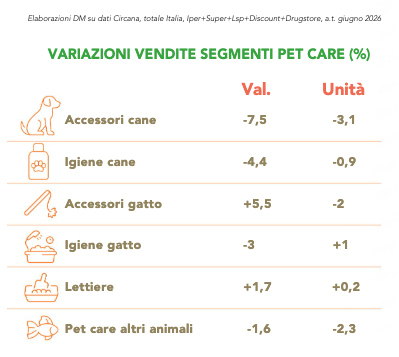 daily feline care. Cat litter accounts for more than half of the entire pet care market (51,9% share by value), approaching 157,4 million euros. The segment shows positive dynamics in value (+1,7%) and resilience in units sold (+0,2%), with 49,5 million packs. The second-largest sub-segment in terms of importance is dog hygiene, at 90,3 million euros (29,8% of the sector), although recording a decline of 4,4% in value and 0,9% in units (24,7 million units). Dog accessories generate 27,7 million euros (-7,5% by value and -3,1% by units), while pet care for other animals stands at 18,2 million euros (-1,6% by value and -2,3% by units). Cat hygiene and accessories represent smaller niches, worth 5,5 million and 4 million euros respectively, but cat accessories show a very strong value trend (+5,5%).
Private label and competitive landscape
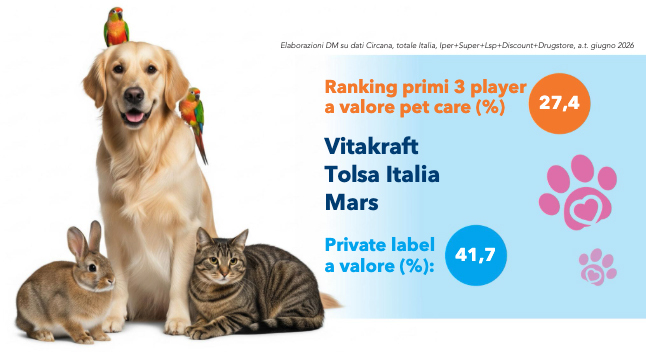 Market data highlights the central and steadily strengthening role of private label, which in pet food alone reaches a value share of 32,1%, while the three leading players (Nppi, Mars and Monge) collectively account for 48,6% of total value. In pet care, private-label penetration is even more pronounced, reaching 41,7% of total turnover. Among industry players, the top 3 is led by Vitakraft, Tolsa Italia and Mars, which together concentrate 27,4% of the market by value.
Read more about DM Magazine September 2026.
This article was translated from the original Italian version with the assistance of artificial intelligence. In case of discrepancies, please refer to the original Italian version.