Soft drinks: the focus is on innovation and new consumption occasions
Soft drinks: the focus is on innovation and new consumption occasions
- Information
Healthier lifestyles, the search for new flavours and new consumption occasions are driving Italians’ choices about what to drink at home and away from home. Among teas, colas and other carbonated drinks, demand is growing for functional beverages and drinks with natural flavours.
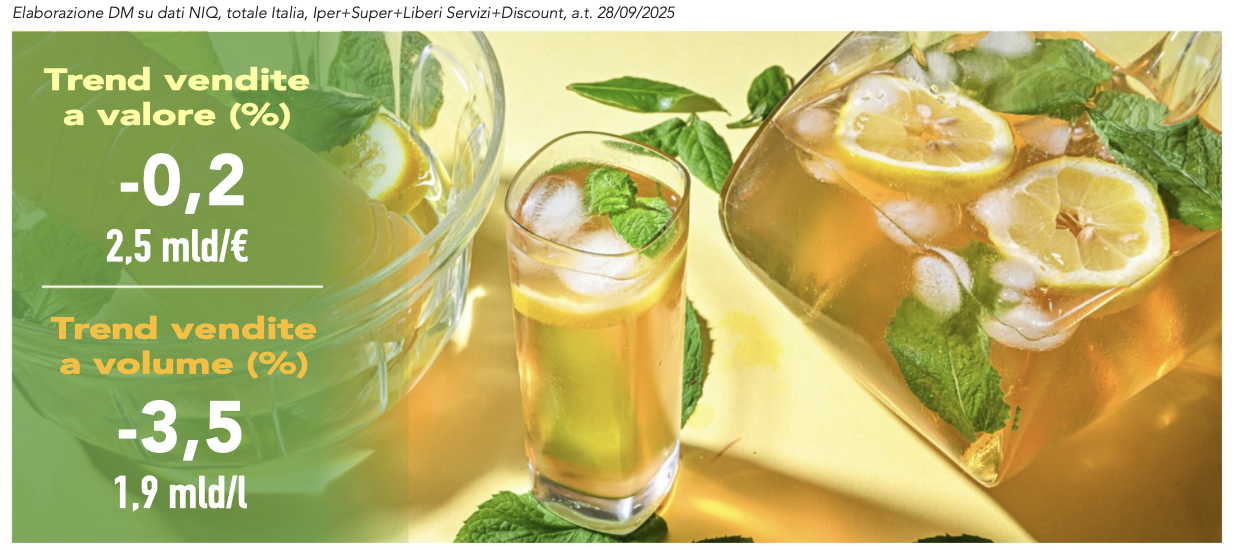 The soft drinks sector generated total sales of 2,5 billion euros in the year ending 28 September 2025, down -0,2% on the previous year. In volume terms, the market continues to decline, contracting by -3,5% to 1,9 billion litres sold (NIQ data, Total Italy, Hypermarkets+Supermarkets+Free-service stores+Discounters). “The decline in volume is partly due to a general fall in demand – says Matilde Ciroldi NIQ – linked to consumers’ lower purchasing power, together with greater attention to adopting a lifestyle more mindful of foods containing sugar, caffeine, preservatives, colourings and artificial flavourings.”
Geographical areas and distribution channels
The decline in volumes is led by Area 4 (-4,6% in volume and -0,8% in value), which accounts for 29,8% of total volumes, followed by Area 2 (-3,6%) and Area 3 (-3,5%). Area 1, which represents 27,8% of volumes sold, is declining less than average, down 2,1%, but with sales growing (+0,4%). Among distribution formats, the contraction in volumes is driven by the discount channel, which accounts for 31,2% of total volumes and records a trend of -6,2% (-1,5% in value). The second channel in terms of its negative contribution to 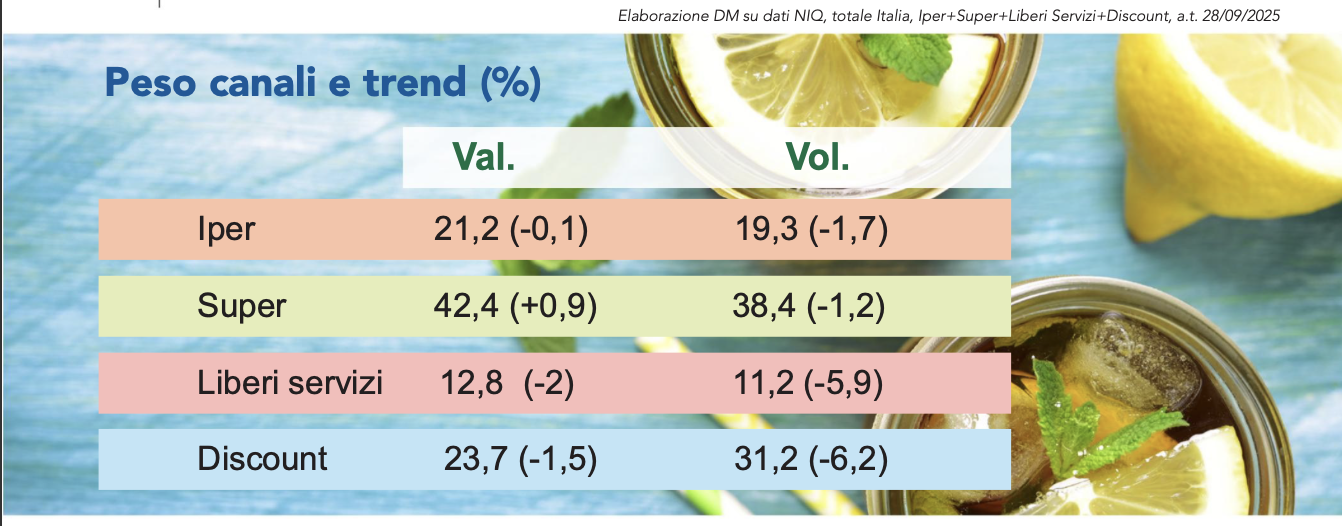 volume is free-service stores (-5,9% in volume and -2% in value), despite accounting for only 11,2% of total volumes. “Within modern distribution, supermarkets continue to play a significant role (they account for 38,4% of volumes and 42,4% of sales), which – Matilde Ciroldi points out – despite declining below the average in volume terms by -1,2%, maintain a positive value trend (+0,9%) and mitigate the negative performance of the other channels. Hypermarkets also perform less negatively than average, with a trend of -1,7% in volume and a slight decline in value (-0,1%).”
Segment performance
Within the soft drinks sector, volumes are declining across all the main categories, with the exception of energy drinks, which continue to gain importance (value share of 9,5%, +0,8 points up on the previous year); this performance is supported by a very strong increase in both value and volume (respectively +9% and +10,1%). “Their success – Matilde Ciroldi continues – is driven by increased demand, due both to an increase in the consumer base and to a higher purchase frequency. The growing demand is also supported by the widening range, which reaches an average of 10,3 references sold per outlet (+0,7).” Among the categories in decline are tea-based drinks, which account for 18,7% of sales and 21,2% of volumes, recording a decrease of 3,6% in value and -7,3% in volume. Among tea-based drink segments, sugar-free tea is growing (+2,9% in value and +2,3% in volume), but this is not enough to mitigate the sharp decline in the core segment, regular tea (-4,7% in value and -9,6% in volume). In terms of negative contribution to volume, the next category is orangeades, which account for 6,9% of sales (9,4% in volume terms) and are down -3,6% in value and -5,6% in volume. Within this category, the negative performance is driven by 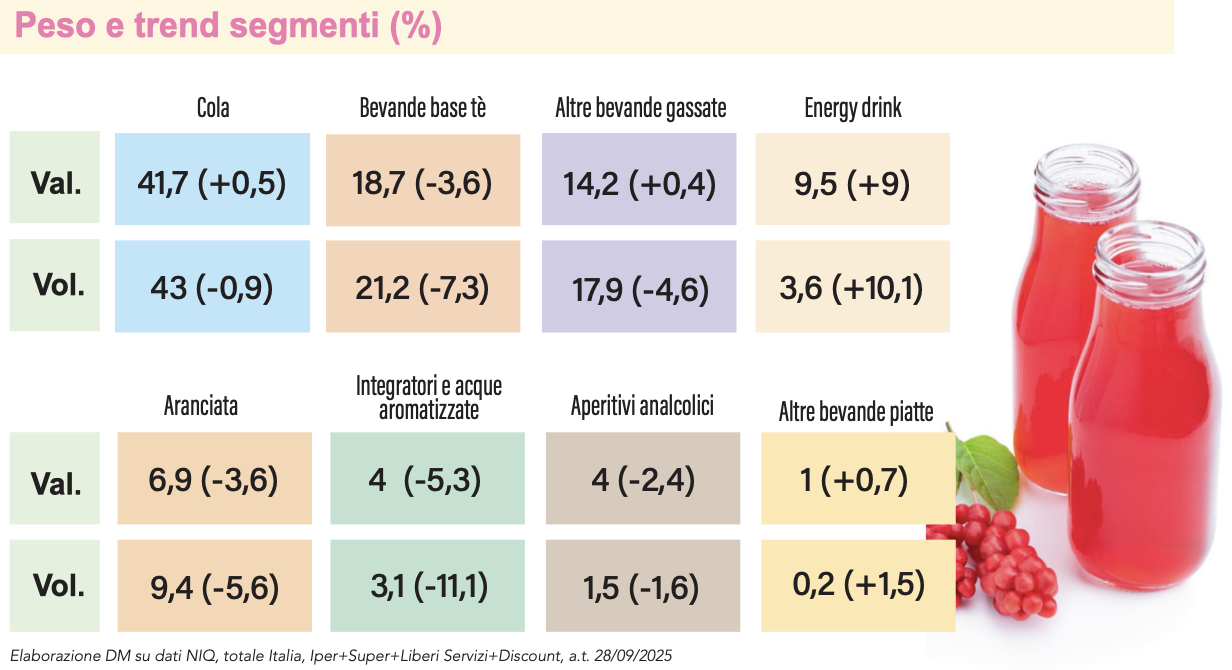 the performance of the main segment: sugared orangeade (-3,4% in value and -5,1% in volume), which is not offset by the performance of the sugar-free orangeade segment, which records a contraction both in value (-4,9%) and in volume (-7,5%). The main soft drinks sector, third in terms of impact on volumes, is colas, which account for 41,7% of sales and 43% of volumes. Although their negative trend is better than average (-0,9% in volume), colas contribute 7,8 million fewer litres than in the previous year. In value terms, however, sales are growing (+0,5%), thanks to the positive performance of smaller formats (the so-called single-serve products), which have a higher price positioning per litre. Within colas, the sugar-free segment continues to gain importance in the sector (a value share of 12,2%, up +1% on the previous year), increasing sales by 8,6% in value and 8,4% in volume. In this case, the sugar-free offering is doing more to mitigate the negative volume trend of the regular segment and is increasing sales for the category as a whole. Also penalised in volume terms are saline supplements, or rather the world of sports drinks: a category subject to significant seasonal effects that suffered a major setback during the summer, also due to less favourable temperatures in July and August compared with the previous year. In the last year, sports drinks declined by double digits in volume (-12,8%) and by -6,8% in value, despite the widening range (7,9 references sold on average, +0,3 outlets). “Even smaller categories, such as chinotti and fizzy drinks, are experiencing difficulties in volume terms (respectively -8,6% and -6,1%), following negative signals already recorded last year. The aperitif sector is also performing equally negatively in absolute terms, especially tonic drinks (-5,3% in volume), while non-alcoholic aperitifs are seeing a more limited contraction of -1,6%,” concludes Matilde Ciroldi.
Read more about DM Magazine December 2025
This article was translated from the original Italian version with the assistance of artificial intelligence. In case of discrepancies, please refer to the original Italian version.