Pasta: consumers favour the premium segment. The focus is on traceability
Pasta: consumers favour the premium segment. The focus is on traceability
- Information
The sector, contracting both in value and volume, is seeing shoppers increasingly interested in traceability and Italian identity, without overlooking authentic flavours. The focus is on promotional pressure and the premium segment.
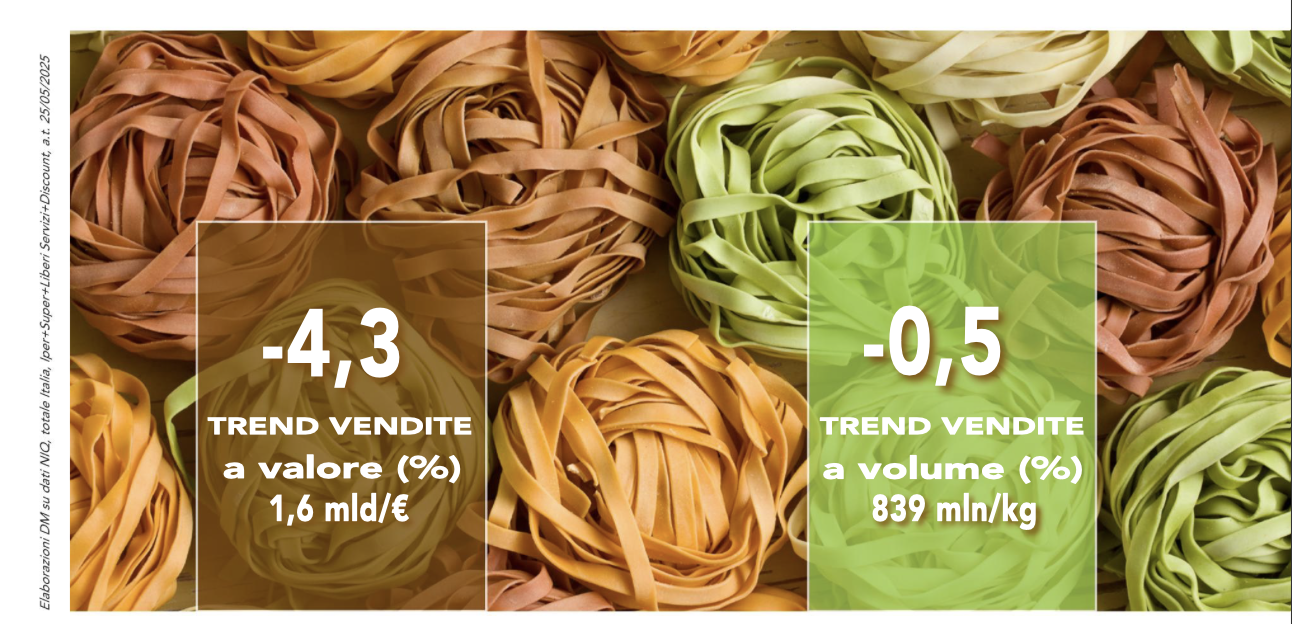 In the year ending 25 May 2025, across Italy, the dry pasta category generated turnover of more than 1,6 billion euros, marking a decline of 4,3% compared with the previous year. The sector also recorded slightly negative trends in volume sales (-0,5%) and packs (-0,3%), totalling 839 million kilograms marketed and 1,55 billion packs sold, respectively. The average price per kg fell by 3,7%, settling at 1,91 euros (NIQ data, Hypermarkets+Supermarkets+Free-service stores+Discount stores).
Geographical areas and distribution channels
The market shows a generalised contraction, with all NIQ areas contributing to the decline in turnover. The poorest performance is observed in Area 3, responsible for 25% of value sales, where turnover fell by 5%, accompanied by a decline in volumes of 1,9%. “The other areas also performed negatively,” shares Benedetta Ballabio of NIQ. “Area 4, which holds the largest value sales location (31,9%), recorded a decline of 4,2%; Area 1, with a share of 24,6%, posted a decrease of 3,9%. Finally, Area 2, with the smallest sales location (18,5%), fell by 4%.” Among the channels, modern distribution generates 82,6% of turnover. Within this sphere, supermarkets remain the dominant channel, with a value sales location of 47,3%. They are followed by hypermarkets, which account for 22,5%, and free-service stores, with a share of 12,8%. Discount stores, meanwhile, account for 17,4%. All channels show a decline in value (in particular hypermarkets -4%, supermarkets -2,7%, free-service stores -8,9%, discount stores -5,2%). In terms of volumes, however, supermarkets stand out as the only channel moving against the trend, with growth of 1,7%.
Segment performance
In the dry pasta market, semolina pasta accounts for 77,4% of the total value. This segment recorded a negative trend both in value (-5,7%), volume (-0,8%) and packs sold (-0,8%), contributing significantly to the category's decline. “It is followed by egg pasta,” continues Benedetta Ballabio, “with a value share of 9,9%. Despite a slight decline in value (-0,2%), the segment shows positive signs in terms of volume (+1,6%) and packs sold (+2%). The offering is completed by several smaller segments: wholemeal pasta/spelt/kamut/pulse-based pasta, gluten-free pasta, filled pasta/gnocchi and enriched/flavoured semolina pasta.” During the reference period, the six segments recorded the following average number of SKUs: semolina pasta 101,7 (+0,5 compared with the previous year), egg pasta 17,4 (-0,1%), wholemeal pasta/spelt/kamut/pulse-based pasta 12,5 (+0,4%), gluten-free pasta 8,2 (+5,2%), filled pasta/gnocchi 2,4 (+3,3%) and enriched/flavoured semolina pasta 2,3 (-1,4%). As for prices, semolina pasta stood at 1,66 euros (-4,9% compared with the previous year), egg pasta at 4,44 euros (-1,7%), and wholemeal pasta/spelt/kamut/pulse-based pasta at 2,59 euros (-1,9%). Gluten-free pasta recorded an average price of 5,38 euros (-0,7%), filled pasta/gnocchi 7,12 euros (+1,1%) and enriched/flavoured semolina pasta 3,97 euros (-1,2%). Finally, in terms of promotional efforts, semolina pasta recorded a volume intensity index of 42,5 (+1,4%), followed by wholemeal pasta at 38,1 (+2,6%) and egg pasta at 26,5 (+2,3%).
Read more about DM Magazine September 2025
This article was translated from the original Italian version with the assistance of artificial intelligence. In case of discrepancies, please refer to the original Italian version.