Free from and intolerances: no... compromises on taste
Free from and intolerances: no... compromises on taste
- Information
In the free-from products market, there is one aspect that all companies strongly emphasise: consumers must not have to make compromises when it comes to organoleptic characteristics.
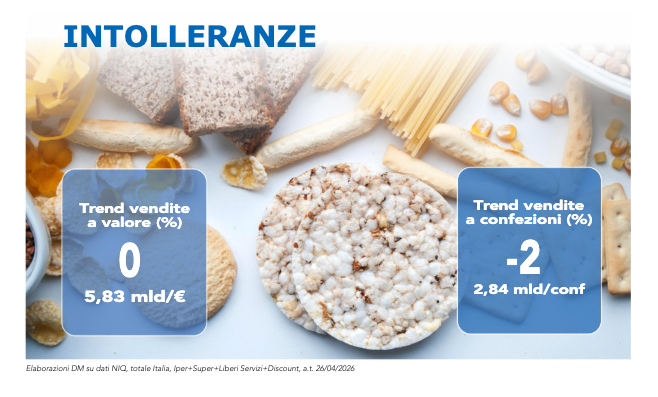
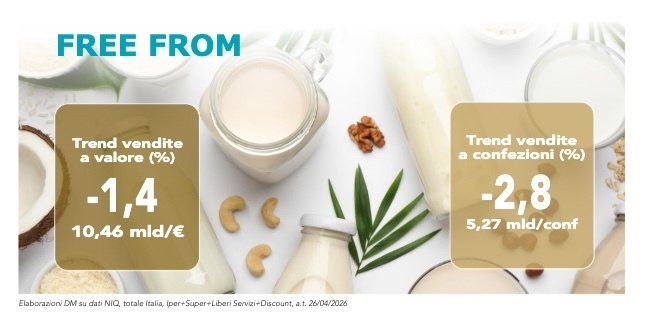 The sector is highly differentiated, and its performance will be analysed here by separating the segments generally defined as free from and those dedicated to intolerances (gluten and lactose). Looking first at free from, in the year ending 26 April 2026 (NIQ data, total Italy, Hypermarkets+Supermarkets+Free-standing services+Discount stores), the category recorded turnover of almost 10,5 billion euros, down 1,4%. The contraction in packages sold is even more significant, falling to 5,27 billion, a decrease of 2,8%. The discrepancy between value and volume is explained by the average price trend, which rose by 1,5%, reaching 1,99 euros per pack. “Limiting the analysis to the I+S+LS scope,” states Ludovica Zarba of NIQ, “the free-from market is worth just under 9,81 billion euros, down 1,4%, while packages are down 2,7%, standing at 4,9 billion, and the average price is up 1,3%. Promotional pressure is declining (-0,5%) and there is a slight contraction in the assortment, with references per outlet down 2,8%, signalling a rationalisation of the offering.” Turning to the market for products for intolerances, across Italy excluding drugstores, the sector reaches a value just below 5,83 billion euros, stable compared with the previous year. Packages, on the other hand, are down 2%, settling just below 2,84 billion, while their average price rises by over 2,1%, reaching 2,05 euros and confirming a premium positioning. If we focus instead on the I+S+LS scope, value exceeds 5,51 billion euros, with growth of just 0,1%, against a contraction in packages of 1,9%.
Analysis of geographical areas
 We now turn to an analysis of the areas. As regards products simply defined as free from, across the total market (excluding drugstores), Area 1 remains the leading area by turnover, with 3,24 billion euros, but records a decline of 2,3% in value and a loss of packages exceeding 3,3%. “The average price,” Ludovica Zarba continues, “rises by around 1%, contributing to the decline in volumes, which are also affected by a reduction of over 3,8% in references per outlet. A similar picture also emerges in Area 2, where turnover falls to 2,24 billion euros (-1,7%), with packages down 3,4% and the average price up 1,7%, with a unit value of 1,99 euros. Here, the reduction in the assortment is marked, with references cut by close to 4,3%. Area 3 shows a more limited decline: the market is close to 2,68 billion euros, down 1,3%, while packages decrease by 2,9%. The average price rises by 1,6%, reaching 1,97 euros. In contrast, Area 4 stands out as the only area not in decline (+0%), ending the past year with almost 2,31 billion euros. In this case, packages fall
 by 1,7%, while the increase in the average price is around 1,8%. Assortment depth is reduced (-2,5%), followed by promotional intensity, at -0,7%.” The geographical analysis of the market for products for intolerances, on the other hand, shows greater solidity. In Area 1, the market is worth over 2,04 billion euros, down 1,8%, and sales by package also record a decline of 3,4%, with the average price rising by 1,6%. In Area 2, turnover rises to 1,19 billion euros, with an increase of 0,6%, while packages decline by 1,8%; here, the average price rises by over 2,4%. Area 3 is close to 1,42 billion euros, up 1,1%, with sales by package down 0,7% and average prices rising by around 1,8%. The most dynamic area remains Area 4 in this case too, recording an increase in value of over 1,6%, reaching almost 1,18 billion euros despite the slight decline in packages, thanks to an increase in the average price of more than 3,3%.
Segment performance
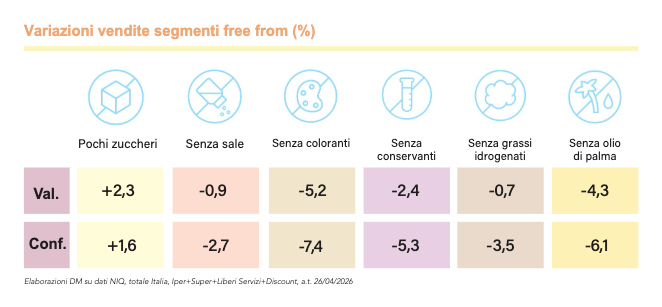
Dividing the segments according to the claims on the packaging, we can see that, in terms of sales by value, products labelled “gluten-free” have the greatest economic size, with over 3,65 billion euros, down around 2,2% compared with the previous year. The contraction also affects packages, which fall to just under 1,67 billion, with a reduction of more than 5,4%. The average price rises, from 2,12 to 2,19 euros (+3,3%), and the assortment shows a decline reaching almost 2,8% of references per outlet. Immediately afterwards in terms of economic size are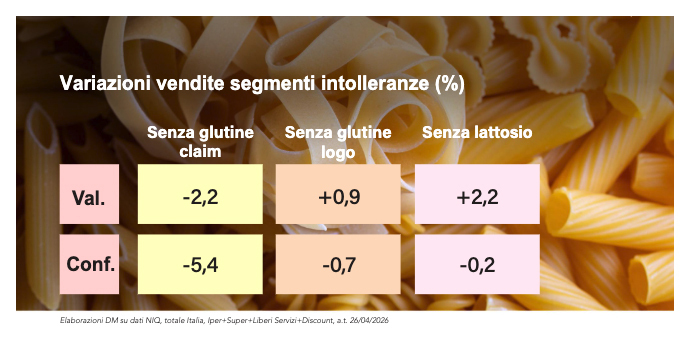 products bearing the claim “preservative-free”, with turnover of 3,39 billion euros, showing a slight decline (-2,4%). However, packages sold undergo the sharpest reduction, down 5,3%, bringing them below 1,53 billion. The average price, by contrast, rises from 2,15 to 2,22 euros, an increase of almost 3%. The assortment remains extensive, despite a reduction of over 3,4%. Among the economically significant segments, “lactose-free” also stands out, reaching turnover of 2,46 billion euros, up 2,2%. Packages, whose sales are down 0,2%, stand at almost 1,31 billion, while the average price rises by 2,4%, from 1,83 to 1,88 euros. The “low sugar” segment is more dynamic, exceeding 2,11 billion euros in turnover, with growth of 2,3%. Unlike the other major claims, sales by package are also positive here, rising by 1,6% to exceed 1,21 billion. The average price is essentially stable, with growth limited to 0,6% (from 1,74 to 1,75€). The assortment remains relatively broad, despite a slight decline (of less than 0,8%). The picture is more critical for other established claims, such as “colourant-free” and “palm-oil-free”, both above one and a half billion euros but characterised by negative trends. “Colourant-free” falls to almost 1,39 billion euros, with a decline of 5,2% in value and a loss of packages of 7,4%, only partially offset by an increase in the average price (+2,4%). “Palm-oil-free”, on the other hand, falls back to 1,68 billion euros, with a decline of 4,3% in value and a reduction in packages of more than 6,1%.
Read more about DM Magazine June 2026
This article was translated from the original Italian version with the assistance of artificial intelligence. In case of discrepancies, please refer to the original Italian version.