Cured meats market: between service content and high-quality offerings
Cured meats market: between service content and high-quality offerings
- Information
While premium cured meats are particularly appreciated at the service counter, the take-away chillers are seeing an explosion of innovative solutions capable of enhancing the service content inherent in these flavoursome cured meats.
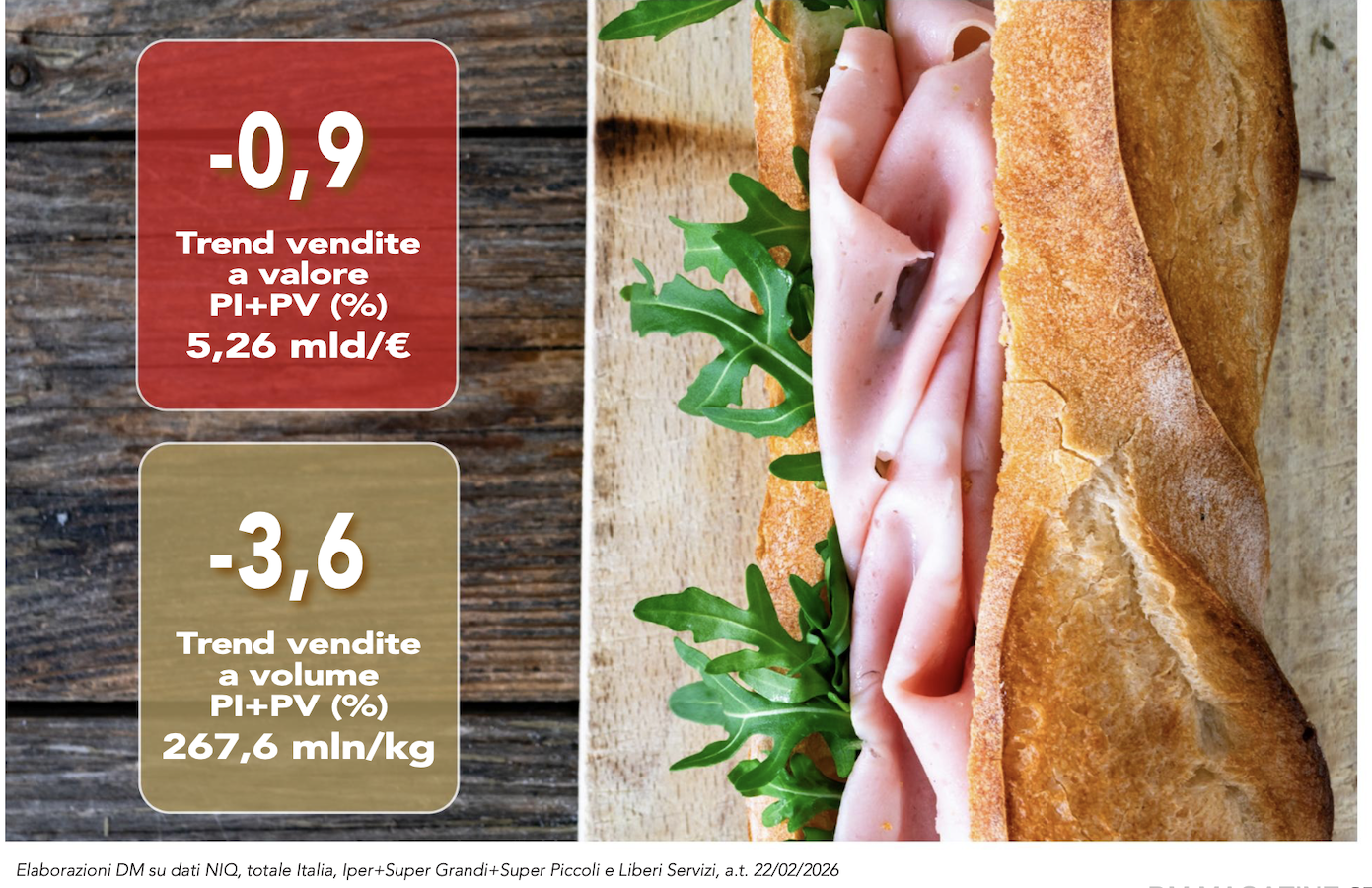 In the year ending on 22 February 2026, the sector recorded a slight decline in value (-0,9%), alongside a more marked contraction in volume (-3,6%), while the average price continued to rise (+2,8%). In other words, the resilience of turnover was largely a reflection of favourable price-mix dynamics, which mitigated the decline in units sold. In absolute terms, turnover is close to 5,26 billion euros, with a total of 267,6 million kilograms and an average annual price of 19,65 euros per kilo (NIQ data, Total Italy, large hypermarkets+large supermarkets+small supermarkets and free-service stores; fixed weight + variable weight).
Geographical areas and distribution channels
Looking at the areas in detail, the picture is heterogeneous. “Area 4 – points out Matteo Diaferio of NIQ – is 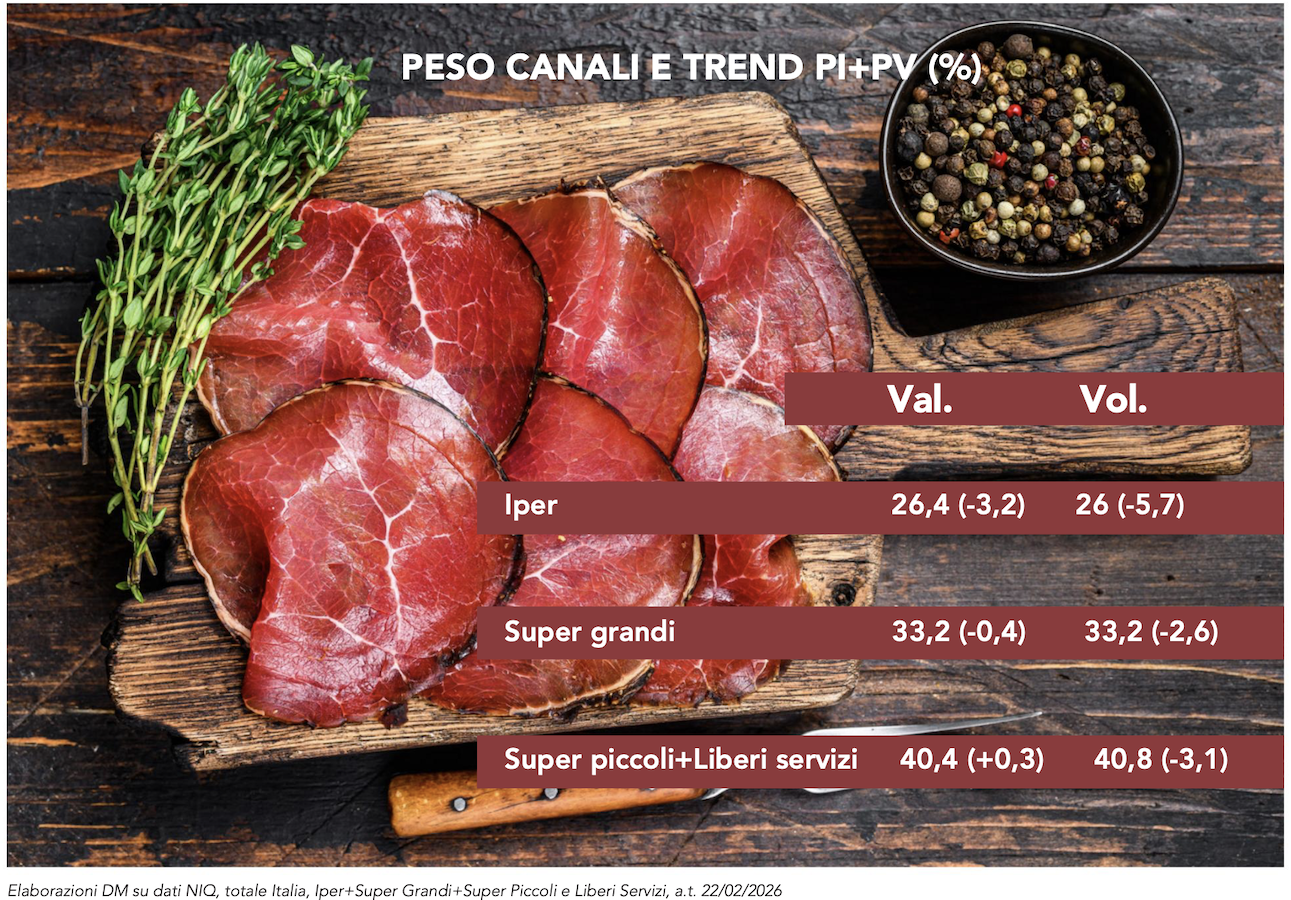 the only one to grow in value (+1,8%) despite a slight decline in volume (-2%): here, the surge in the average price (+3,8%) more than offset the lower quantity sold. Area 1 ends broadly stable (-0,9% in value and -3,3% in volume), while Area 3 shows a contained contraction in turnover (-1,5%) but a more pronounced one in volume (-4,6%), once again with price supporting the area (+3,2%). The most visible slowdown is recorded in Area 2, where value falls by 3% and volume declines by 5%; here too, price rises (+2,1%), but not enough to close the gap.” Channel performance confirms the same forces at work. Hypermarkets show the sharpest decline in value (-3,2%) and volume (-5,7%), while large supermarkets contain the damage: -0,4% in value and -2,6% in volume, supported by a rising price (+2,3%). In the small supermarket and free-service store channel, by contrast, the sector grows in value (+0,3%), despite the decline in volume (-3,1%), thanks to an average price that advances by 3,5%.
Segment performance
Looking at the modern distribution basket, the segment map describes a market that protects value by shifting towards “richer” products, while losing ground where demand is more price-sensitive. “Across the overall perimeter combining fixed weight and variable weight, it is cured ham that is leading the resilience – explains Matteo Diaferio –: it is growing in value (+2%) despite a slight decline in volume (-1,1%), supported by an accelerating average price (+3,1%). Speck is also moving in a positive direction, achieving the best progression among the main drivers thanks to combined growth in value (+3,5%) and, above all, volume (+3,3%), with a broadly stable price: here, demand has genuinely broadened 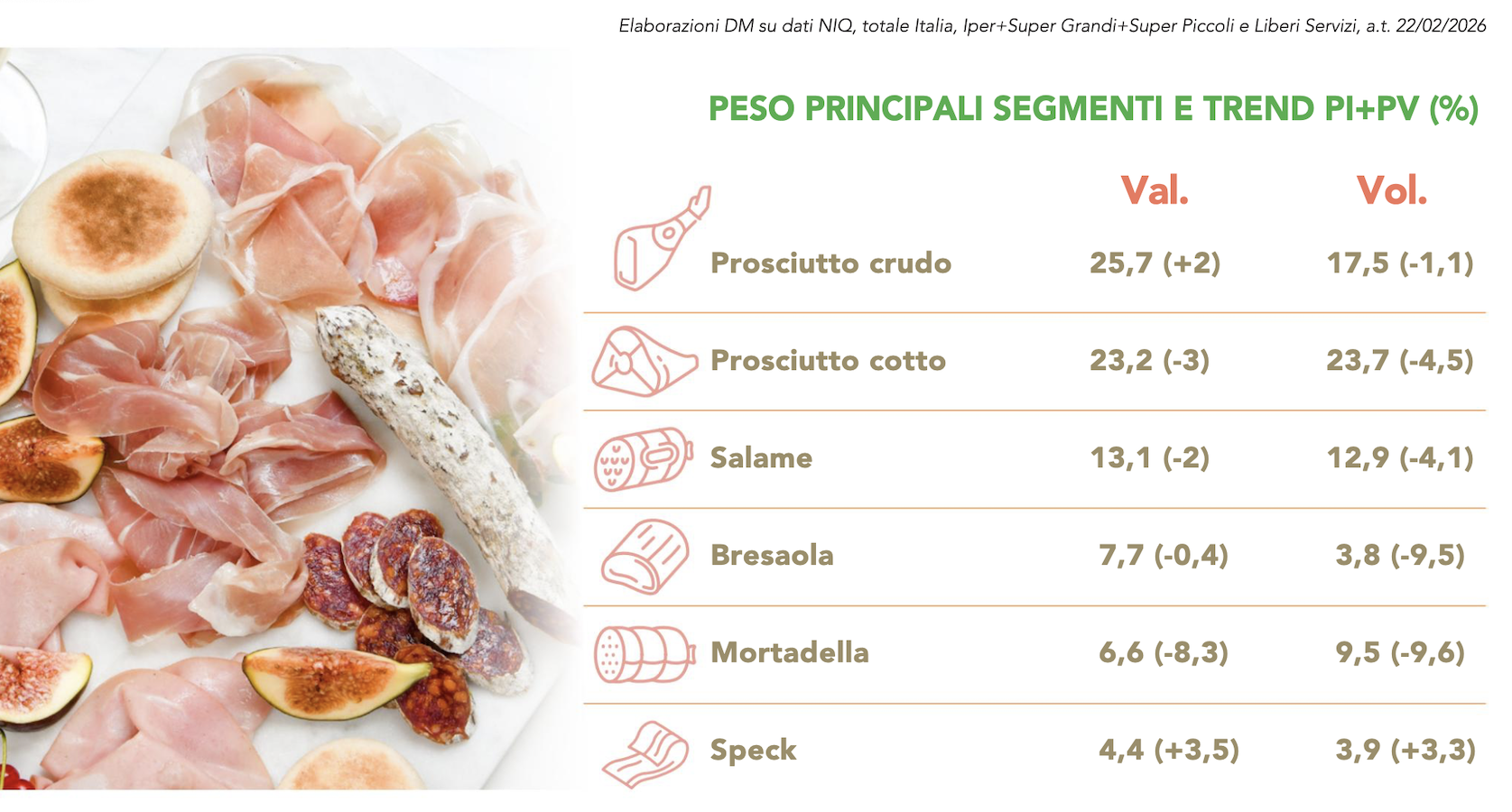 , not merely as a result of the mix effect. At the other extreme, mortadella records the sharpest decline (-8,3% in value and -9,6% in volume), while both cooked ham and salami decline in value (-3%) and volume (-4,5%), penalised by volumes falling more sharply than the price trend. Bresaola continues its premiumisation journey, with a sharply rising price (+10,1%) and a clear decline in volume (-9,5%).” The divide between fixed weight and variable weight remains evident. Fixed-weight cured meats end with value growth (+1,7%), volumes that are almost stable (-0,9%) and a moderately rising average price (+2,6%): a virtuous balance in which the price-list increase does not stifle units sold. Within this perimeter, cured ham stands out (+3,5% in value with slightly positive volumes), as does cooked ham (+1,3% in value with broadly flat volumes) and speck, which accelerates both in value (+5,8%) and volume (+6,3%); bresaola, finally, replicates the premium pattern, with a strong price push and a contraction in volume. The trajectory of variable-weight cured meats is very different, declining in value (-3,1%) and volume (-6,3%), against a rising average price (+3,3%). Here, the combination of smaller quantities purchased at the counter and lower frequency particularly penalises the “pillars” of tradition: cooked ham (-6,5% in value and -7,8% in volume), salami (-4,1% in value and -6% in volume) and, most of all, mortadella (-12,1% in value and -12,8% in volume). The exceptions are cured ham, which holds up (+1,5% in value), and speck, which makes slight progress (+0,6% in value): a sign that, where distinctiveness exists, the traditional counter can still tap into consumers’ willingness to spend, with pressure remaining high.
Read more about DM Magazine April 2026
This article was translated from the original Italian version with the assistance of artificial intelligence. In case of discrepancies, please refer to the original Italian version.