

Agrintesa inaugurates Europe’s kiwi hub: innovation, digitalisation and sustainability
Agrintesa inaugurates Europe’s kiwi hub: innovation, digitalisation and sustainability
- Information
Agrintesa has inaugurated the renovated and expanded facility in Castel Bolognese (Ra), a reference point for the cooperative’s fruit production management for over 35 years, particularly for kiwifruit.
The project
The result of an industrial investment of 25 million euros and co-financed through two PNRR funds (the supply chain project Integra.Agri and Agri.Log), theproject profoundly redesigns the site, active since 1990 and enhances its storage, processing and logistics capacity through new facilities, advanced automation systems and digital, interconnected management of processes. The renewal project, presented at the event
“Beyond The evolution that creates value” – , is designed to support the growth of members’ production and enable the cooperative to further increase quality, efficiency and its ability to serve the markets.“Beyond is a word that aptly describes what our cooperative wants to do: not merely respond to today’s needs, but build the conditions that will enable member farms to continue producing, growing and competing in the markets tomorrow as well,” declares
Aristide Castellari, president of Agrintesa . “This investment originates with our members and returns to them in the form of greater capacity to enhance the value of their produce: behind these facilities are thousands of farms and families, communities and people who have chosen to believe in cooperation. Our responsibility is to turn this trust into tangible prospects. For us, this is the most authentic meaning of innovation.”
Kiwifruit at the heart of the growth strategy
The project starts with a strategic supply chain for Agrintesa. The kiwifruit currently accounts for approximately 30% of the cooperative’s entire fruit and vegetable portfolio, with an average annual volume of approximately 55.000 tonnes, 3.200 hectares under cultivation and 747 member farms involved in Italy’s main suitable growing areas: Emilia-Romagna, Lazio, Calabria and Veneto.
The growth recorded in recent years, including the significant boost from new varieties, has established Agrintesa as a European reference point for this product but, at the same time, has made it necessary to decisively expand the storage and management capacity of the facility in Romagna, the cornerstone of an outstanding supply chain. The new configuration of Castel Bolognese makes it possible to raise the storage and warehousing capacity to 308.000 quintals, an increase of 54% compared with the past.
The new facilities
The centrepiece of the project is 44 new controlled-atmosphere storage rooms, distributed over a total area of 8.100 sq m and capable of holding 108.000 quintals of produce. The facilities allow particularly advanced storage conditions to be managed, controlling oxygen, ethylene and the main environmental parameters in order to preserve the fruit’s quality characteristics over time. For yellow kiwifruit the planned processing capacity will increase from 230.000 to 340.000 quintals per year (+48%), while for green from 100.000 to 150.000 quintals (+50%).
“We have not simply expanded the facility: we have rethought how this site must operate in the coming years,” points out Cristian Moretti, general manager of Agrintesa. “Production, storage, handling and information now interact within a single system. This enables us to be more efficient, precise and safe, but above all to better protect the quality of the produce entrusted to us by our members and respond more effectively to customer demands. The objective is to make Castel Bolognese a platform capable of supporting the growth of our production base and operating twelve months a year, creating value throughout the supply chain. Our industrial plan is already looking to the next step: by 2030 the site is designed to manage a total of 600.000 quintals of produce per year, expanding its specialisation beyond kiwifruit to include plums, apricots and Williams pears as well.”
An intelligent, interconnected and sustainable warehouse
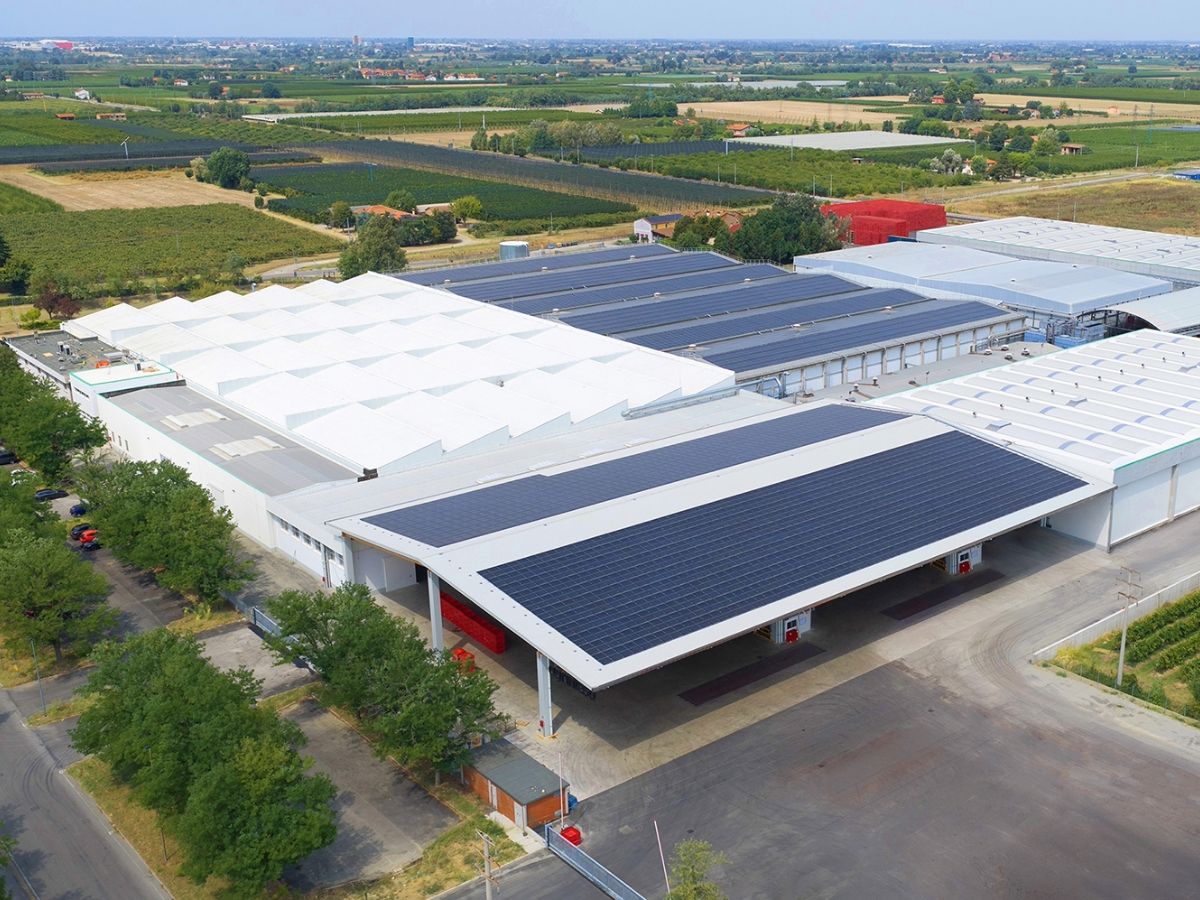
The transformation concerns the entire organisation of the site. The external area has been expanded and rationalised through the redevelopment of 23.000 sq m of yards and the creation of 10.000 sq m of new surfaces, while the new area for receiving produce includes a wooden canopy of 4.200 sq m to protect incoming produce, as well as three new computerised weighbridges.
Within the facility are three new technological and innovative core systems: production and logistics now feature the integration of state-of-the-art systems that enable real-time monitoring of the lines, process traceability and the automatic collection of data from the processing plants (MES – manufacturing execution system) as well as warehouse management that optimises receiving, storage, picking, inventory and shipping while ensuring the traceability of bins or pallets (WMS – warehouse management system). These are complemented by a system (RTLS – real-time locating system) that enables the real-time location of vehicles and materials, analyses internal routes and the most congested areas, optimises forklift missions and increases safety, also through systems for detecting and preventing collisions between vehicles and people. In addition, racking with automatic shuttles has been installed for finished-product storage, with a total capacity of 3.000 pallets.
Industrial innovation and sustainability go hand in hand. The project also includes a photovoltaic system of 2.307 kWp, with expected annual production of 2,86 GWh, as well as improvements to refrigeration systems and the optimisation of logistics flows. Overall, the new solutions adopted enable a reduction of 15% in the facility’s energy consumption and estimated savings of 1.148 tonnes of CO2 per year. Finally, the new refrigeration technology also makes it possible to reduce ammonia use by more than 70% ammonia use.
The focus on sustainability, moreover, does not stop at the environmental dimension: the growth of the facility will also produce effects on employment. According to projections for 2030, the number of days worked at the site will rise from the current approximately 45.000 to 70.000 per year (+55%) while the total number of employees may grow from 280 to 450 (+60%). Specific investments have also been made for the people working at the site, including a new two-storey building dedicated to staff services and a substantial expansion of offices, service rooms and the canteen, together with new technical and operational spaces.
Comments
“Agrintesa represents a virtuous supply chain model, capable of combining tradition and innovation to create value and income for farmers. Farmers themselves are at the heart of our production system and safeguard the quality, safety and food sovereignty of the Nation,” stressed the Minister of Agriculture, Food Sovereignty and Forestry, Francesco Lollobrigida. “The support provided by the PNRR also demonstrates the Government’s commitment in practical terms. Agrintesa has secured funding that enables investments to strengthen the logistics, efficiency and competitiveness of the supply chain. It is the result of teamwork between businesses, institutions and the Government, which continues to stand alongside cooperatives such as Agrintesa. Along these lines is also the allocation of 136 million euros, co-financed by Italy and the EU, to support the purchase of fertilisers and strengthen the resilience of our supply chains.”
“The innovative scope of Agrintesa’s investment,” comments Raffaele Drei, president of Confcooperative Agroalimentare e Pesca “is proof of a cooperative’s ability to bring hundreds and thousands of producer members together around common strategic objectives. Agrintesa is among the most virtuous cooperative examples of a business capable of uniting producers operating from the far north to the south of Italy around the same objectives, generating income not only for themselves but for entire communities.”
“The Castel Bolognese facility is tangible proof of what it means to run a cooperative business: putting innovation and technology at the service of producer members, not the other way around,” comments Maurizio Gardini, president of Confcooperative. “Agrintesa demonstrates that Agriculture 4.0 does not erase tradition but strengthens it, returning value to those who work the land every day. Cooperatives are the link that transforms delivered produce into widely distributed wealth in local communities, into employment and a future for rural communities. This is the model of economic, social and environmental sustainability that Confcooperative continues to defend and develop.”
This article was translated from the original Italian version with the assistance of artificial intelligence. In case of discrepancies, please refer to the original Italian version.