The European Commission introduces the 3-euro tax on small parcels from outside the EU
The European Commission introduces the 3-euro tax on small parcels from outside the EU
- Information
After much thunder, the rain has come: Brussels has decided to follow the position of most Member States, including Italy, and introduce a tax of 3 euros on so-called small parcels.
Affected, from July 2026, will be all shipments arriving from areas outside the EU with a value below 150 euros.
The French accelerator
The European Commission has brought forward a decision already scheduled, on paper, for 2028, and clearly accelerated to the extreme by the long and complex stand-off between the French authorities and Shein, although the EU institutions have taken care to reiterate that this is not an anti-Chinese measure.
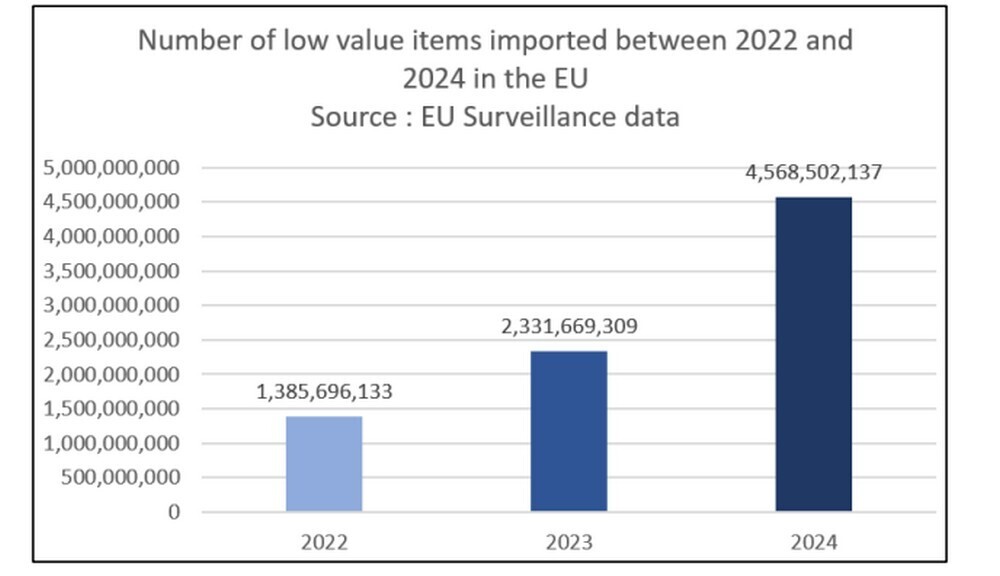
The fact is that, according to what the EU itself reports, in 2024, something like 4,56 billion small parcels entered the territory of the twenty-seven Member States (twice as many as in 2023), of which 91% came from China. With a simple, very rudimentary calculation based on the values from a year ago, this brings the tax burden, in total, to approximately 13,7 billion euros.
Moreover, Italy was already strongly oriented in this direction, having planned a tax of 2 euros to be included in the 2026 Budget Law, a position marked in recent months by expressions of support, both political and otherwise.

According to Brussels, the tax is a transitional measure pending customs reform (Photo: dimitrisvetsikas1969, via Wikimedia Commons)
What will happen in 2028
The European Commission’s defensive rationale is not concealed. It is, as stated in the official press release, “to protect the competitiveness of continental businesses by levelling the playing field between e-commerce and physical retail. Given the rapid increase in imports of goods into the EU through e-commerce, the Commission itself and the Member States have jointly recognised the need for an urgent solution”, which will bridge the gap until 2028, that is, until the launch of the Eu Customs Data Hub, the single customs centre.
The latter should fully integrate transaction data relating to e-commerce, providing public services with a complete picture of goods entering or leaving the EU’s territory.
The customs-duty exemption issue
But there is another, much larger issue on the table, for now deferred to negotiations between the Council and the European Parliament.
Currently, parcels worth less than 150 euros, sent directly from a third country to an EU consumer, are exempt from customs duties.
The European Commission proposed removing the concession in May 2023, as part of the customs reform. And the Council came out in favour of abolishing it as early as 13 November 2025 and requested its early application in 2026.
In summary, the stop should take effect in November 2026, but the conditional wording is essential.
The 3-euro tax essentially represents, in the authorities’ view, a transitional measure that will help offset the rising costs incurred by the customs system for all the necessary checks (security, compliance, anti-counterfeiting and so on).
An official comment
At present, the only comment is more than official. Maroš Šefcovic, EU Commissioner for Trade, Economic Security, Institutional Relations and Transparency, states that "the work to modernise the way the flow of goods is managed at our borders is well advanced. We are close to completing the most ambitious customs reform since the creation, in 1968, of the Customs Union itself. Our objective is clear: to establish a modern, digital environment that keeps international trade flowing smoothly while protecting the strength and integrity of our Single Market. With e-commerce expanding rapidly, the world is changing quickly and we need the right tools to keep pace. That is why the decision on duties for small parcels arriving in the EU is so important, helping to ensure fair competition".
Other articles:
This article was translated from the original Italian version with the assistance of artificial intelligence. In case of discrepancies, please refer to the original Italian version.