Mandatory environmental labels: how far has packaging come?
Mandatory environmental labels: how far has packaging come?
- Information
Good news for packaging. The labels demonstrate growing transparency towards consumers, in line with the regulatory obligations in force from 1 January 2023.
Obligations that are, moreover, still only partially being met, both because of regulatory complexities and because of the additional costs.
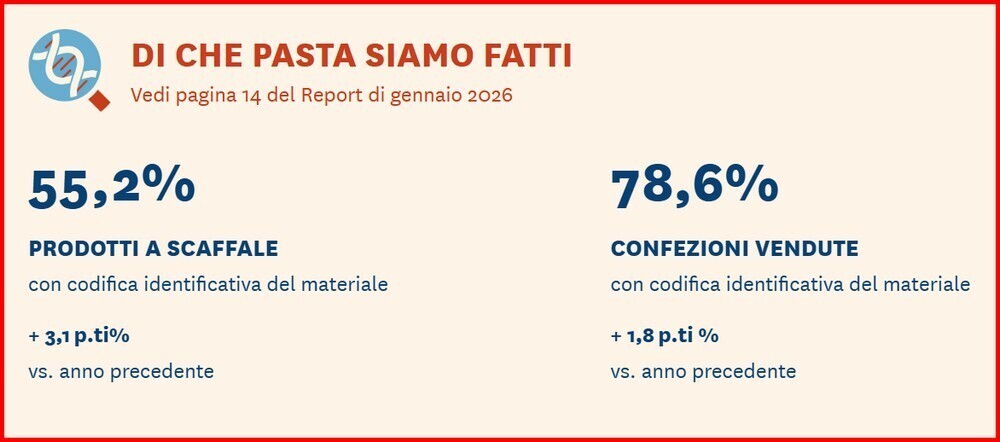
According to the new, eighth edition of the Observatory IdentiPack by Conai and GS1 Italy, however, the glass is more than half full and more than 55% of goods on the shelves – found in hypermarkets, supermarkets and self-service stores – reported, during the period under consideration—the year ending in June 2025—the material coding, while more than 83% of the packages sold indicate how to sort them for separate collection.
These are, specifically, 82.306 grocery products, showing a trend increase of 3,1 points.
Looking at volumes, the share of goods that provide the composition of materials increases considerably, exceeding 21,5 billion purchased items and reaching 78,6% of sales, an increase of 1,8 points year on year.
The most exemplary labels
The chilled sector is the most exemplary (67,2% of references), followed by meat (61,3%), fresh products (61,2%) and grocery products (60,4%).
On the other hand, below average are beverages (38,8%), pet care (41,7%) and personal care (47,5%), although there are some signs of recovery.
The presence on labels of information combining the type of packaging with instructions on how to dispose of it correctly in the bins (both mandatory) is even more widespread.
These are found on 62,1% of goods (92.474 references) and on more than 22,8 billion purchased packages (83,6% of the grocery total).
Compared with the previous year, the overall share rises by 2,2 points when looking at the range, and by 1,2 points when considering what has passed through the tills.
The most advanced departments once again have chilled products at the top (83,9% of references), followed by fresh products (75,6%) and meat (73,8%), while personal care, pet care and beverages are still underperforming.
Voluntary declarations slowing down
More limited, but slightly increasing, is the presence of brands and voluntary environmental declarations, reported by 8,9% of references and by 11,5% of packages sold (more than 3,1 billion units).
In this case, personal care, home care, grocery products and chilled products stand out, while fish and pet care bring up the rear.
Still marginal is communication about the compostability certification of packaging, also because there are still very few materials in this category: we are talking about 0,2% of products, with no change from the previous year. The cases are concentrated mainly in the chilled, home care and fruit and vegetable departments.
Digital labels... still at rock bottom
Despite the opportunities offered by digital tools, such as standard GS1 QR codes, only 3,6% of products invite consumers to consult environmental information online, a share that falls to 3,2% when sales are considered (883 million units).
The home care sector is the most advanced in this respect (28,1% of references), while in many departments the use of information technology is sporadic or absent.
Simona Fontana, general manager of Conai, comments: "The data confirm that companies are investing in transparency. Directive 825/2024 (anti-greenwashing) and future European rules on green claims reinforce the importance of providing credible and scientifically demonstrable information. This is why correct environmental communication will no longer simply be good practice, but an obligation. It is a decisive step towards the circular economy".
Methodological note: the eighth edition of the IdentiPack Observatory is based on more than 148.000 products digitised by GS1 Italy Servizi's Immagino service in June 2025, combined with NielsenIQ sales data. Promoted by Conai and Gs1 Italy, for the first time the report combines the annual snapshot with a historical analysis of developments over six-month periods and broadens the scope of analysis to include, in addition to hypermarkets and supermarkets, the self-service channel (supermarkets with a sales area of less than 400 sq m, for a total of 9.615 outlets).
IDENTIPACK: IDENTIFICATION CODING IN RELATION TO THE RANGE AND SALES
Other articles:
Gs1: circular practices increase in the fast-moving consumer goods sector
Gs1, how much sustainable spending is worth
Identipack: the seventh edition
This article was translated from the original Italian version with the assistance of artificial intelligence. In case of discrepancies, please refer to the original Italian version.