Food holding up, but with tighter margins: what the Unisig-Ceresio Observatory says
Food holding up, but with tighter margins: what the Unisig-Ceresio Observatory says
- Information
The Italian food industry is demonstrating a clear ability to hold up, even in a complex macroeconomic context: but profitability is under pressure.
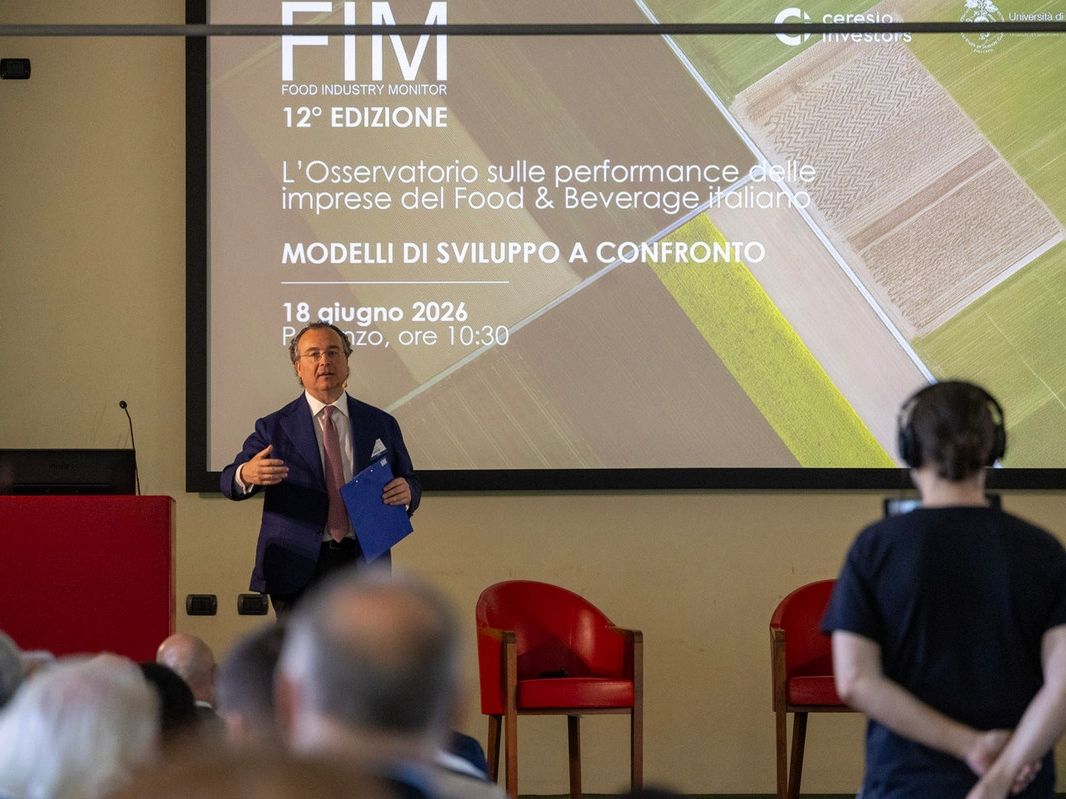
This is the main finding to emerge from the 12th edition of the Food industry monitor, an annual observatory produced by the University of Gastronomic Sciences of Pollenzo in collaboration with Ceresio investors.
ROS and ROIC decline
In 2025, revenues in the sector increased by 3,3%, a figure below expectations, but in line with the performance of the national economy.
ROS (return on sales) fell from 6,6% to 4,6% and ROIC (return on invested capital) slipped from 8,9 to 5,2%, reflecting margin compression and companies’ greater financial commitment. In essence, more was invested to offset the slowdown, but the results were less than expected.
It is worth noting that the financial strength of the food and beverage sector remains high, but there is a slight increase in the level of indebtedness.
Food exports fluctuate but remain strategic
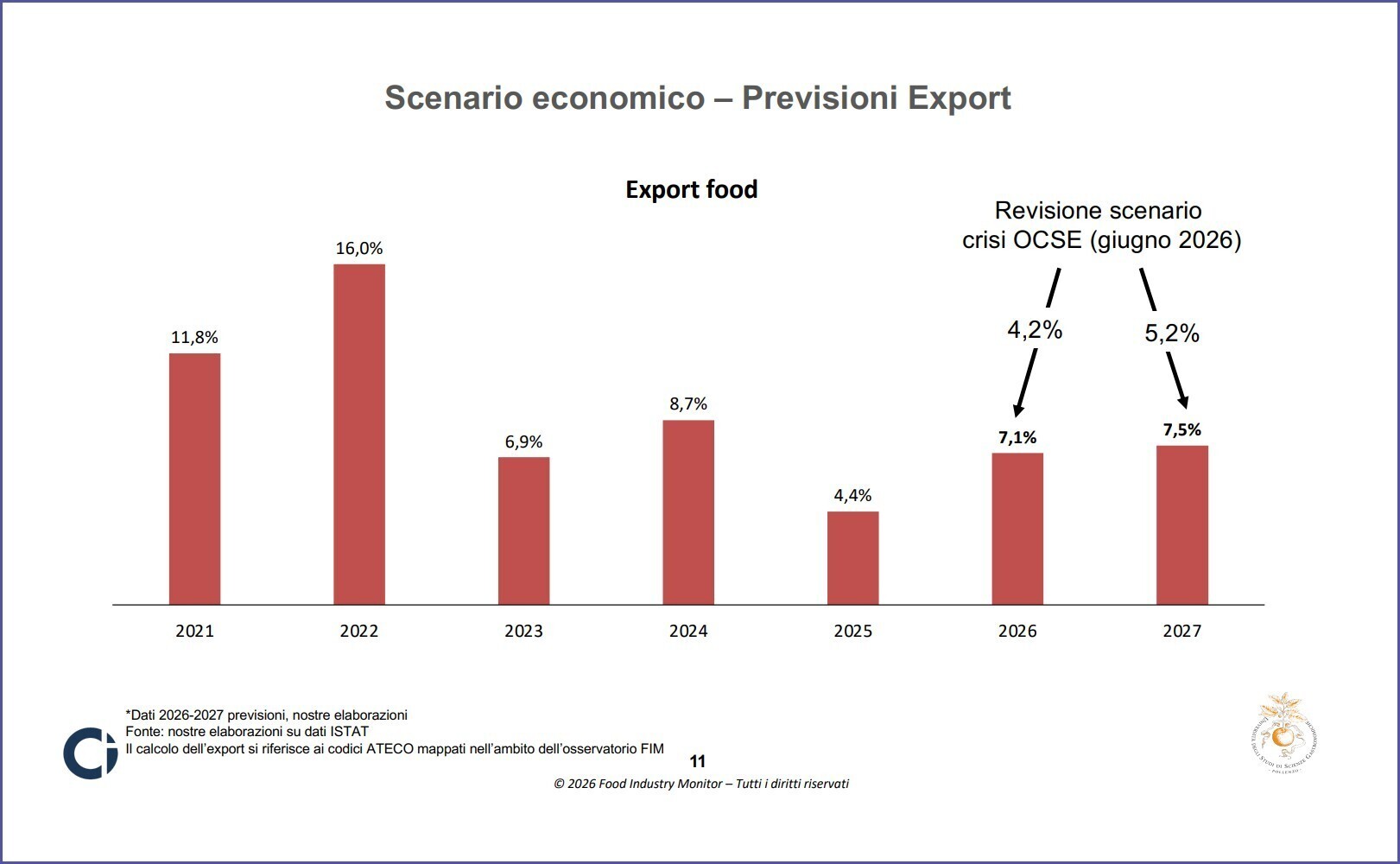
Food exports are also slowing, but remain a strategic lever: after +8,7% in 2024, flows heading overseas increased by 4,4% in 2025, which is nevertheless the lowest figure of the post-pandemic period.
For the two-year period 2026-2027, the Unisig-Ceresio Observatory instead estimates growth above 7% annually, provided that the US-Iran crisis is resolved by the end of June, resulting in lower energy prices.
The recovery of 2026-27 is in turn linked to the contribution of international markets and often of new destination countries, as well as to the possible ability of Italian food products to maintain a strong competitive position beyond our national borders.
At sector level, this year’s forecasts point to interesting export performance, especially for flour (+5,9%), oil (+6,3), coffee (+4,8), frozen foods (+3,8) and wines (+3,6), driven in particular by demand for sparkling wines and, above all, Prosecco.
Is growth in the food sector merely nominal?
Returning to revenues: this year’s forecast indicates, as mentioned, growth in line with 2025, amounting to 3,3%, while for 2027 the expected increase is 3,4%.
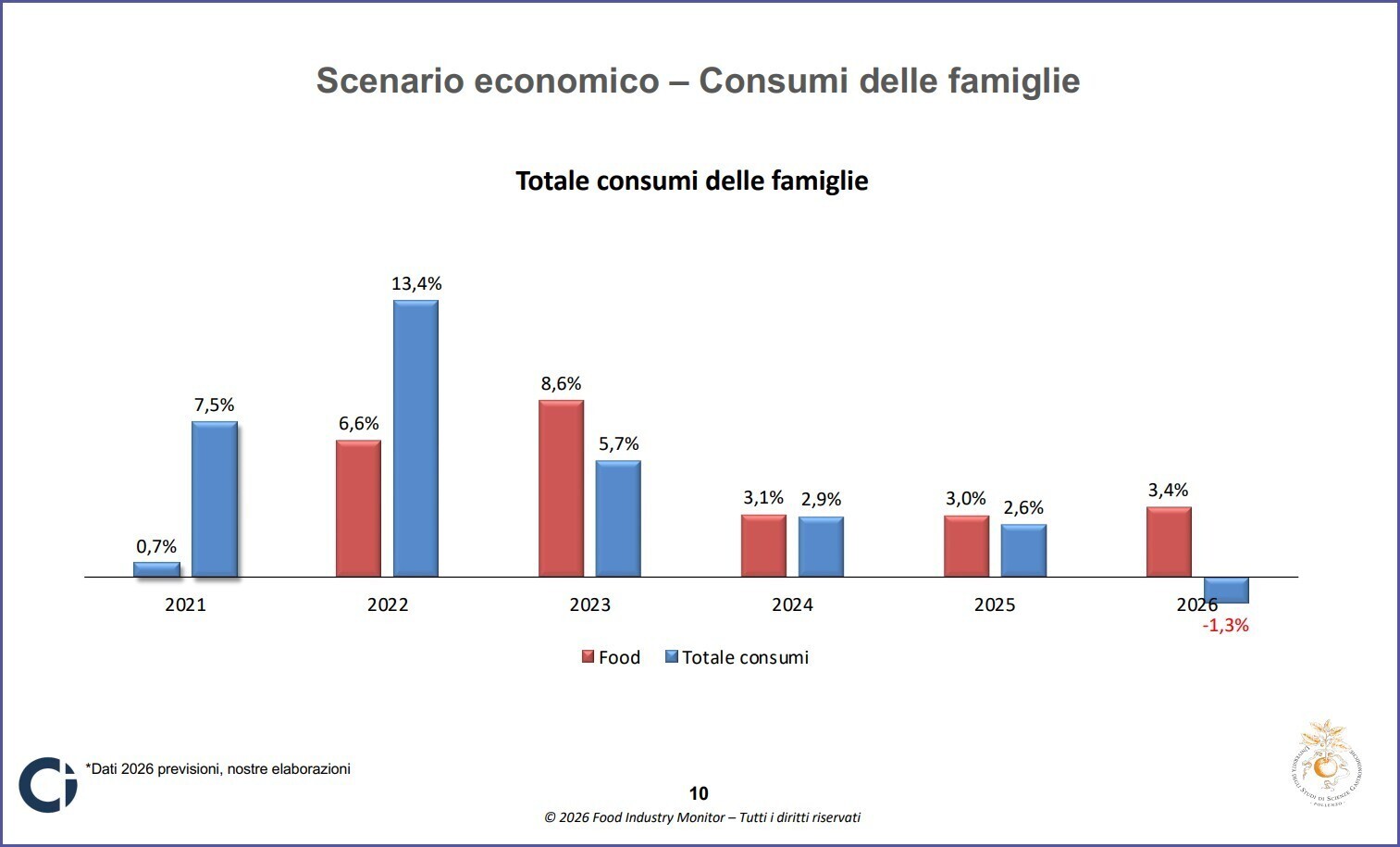
However, these figures must be interpreted with caution: in Italy, inflation is expected to exceed 3% in 2026, also as a result of tensions affecting energy costs, risking absorbing much of the increase, with the result being a positive change in nominal terms only.
For 2027, on the other hand, the Observatory expects inflation dynamics to return to more normal levels, around 1,9%, making sector trends more acceptable and easier to interpret.
In this scenario, the food sector continues to prove countercyclical, but not immune to macroeconomic tensions, which affect household purchasing power and domestic spending.
Is specialisation better in the food sector?
Could the strategic response lie in greater segmentation of the offering? Perhaps so, but analysis of business models shows that just under 60% of the companies sampled have an offering organised across several product lines.
In several markets, such as milk and cheese and wine and spirits, diversification is very widespread, but even in these cases it is not necessarily synonymous with better performance.
Considering revenue performance between 2018 and 2024, a slight advantage actually emerges for businesses focused on a single product line.
These are ultimately contradictory findings, but they suggest that, in various cases, greater concentration on a single business line can provide more effective coverage, thanks to deeper specialisation and more targeted use of investment.
This also appears consistent with the structure of the sample, characterised by a large representation of family-owned SMEs, often oriented towards more cohesive models and with strong roots in a specific category.
The importance of governance
One of the most significant findings of this edition of the Food industry monitor concerns the link between governance and corporate performance.
Companies with more open, inclusive and structured management models show higher profitability levels, confirming that the quality, but also the quantity, of management is now one of the main enabling factors for competitiveness and the creation of lasting value.
The analysis also highlights a positive effect of the presence of female CEOs on both investment profitability and return on equity.
Shared leadership, through the presence of several CEOs with strategic responsibilities, is also associated with higher returns, especially when co-CEOs include women.
The food sector continues to be strongly characterised by a family-owned structure: companies of this type represent 70% of the entities considered in the monitoring.
Within this universe, multi-family businesses achieve better results than single-family businesses both in terms of return on investment and return on equity, suggesting that more advanced governance and a more diversified ownership structure can foster the ability to address strategic and generational challenges.
Methodological note: the Observatory analyses more than 820 companies, with aggregate revenues of approximately 85 billion euros, representing 14 segments of the food sector, and offers an integrated view of the main economic, financial and strategic trends, with a forward-looking perspective on the two-year period 2026–2027.
Other articles:
Last year’s Food industry monitor
Exports: according to Sace, the route leads East
This article was translated from the original version in Italian with the assistance of artificial intelligence. In case of discrepancies, please refer to the original version in Italian.