Being a benefit is good for business: turnover increases by 13%
Being a benefit is good for business: turnover increases by 13%
- Information
Being a benefit is also good for business because, for example, turnover, added value and the resilience of the supply chain increase. The figures speak clearly.
Benefits pay better
This is stated, with a great deal of data and an extremely robust methodology which, for the sake of brevity, we cannot detail, by the 'National research on benefit companies 2026', conducted by Nativa (itself an SB and a regular collaborator of Banca Intesa Sanpaolo), by the Research Department of Intesa itself, with contributions from Assobenefit, InfoCamere, University of Padua and Brindisi-Taranto Chamber of Commerce.
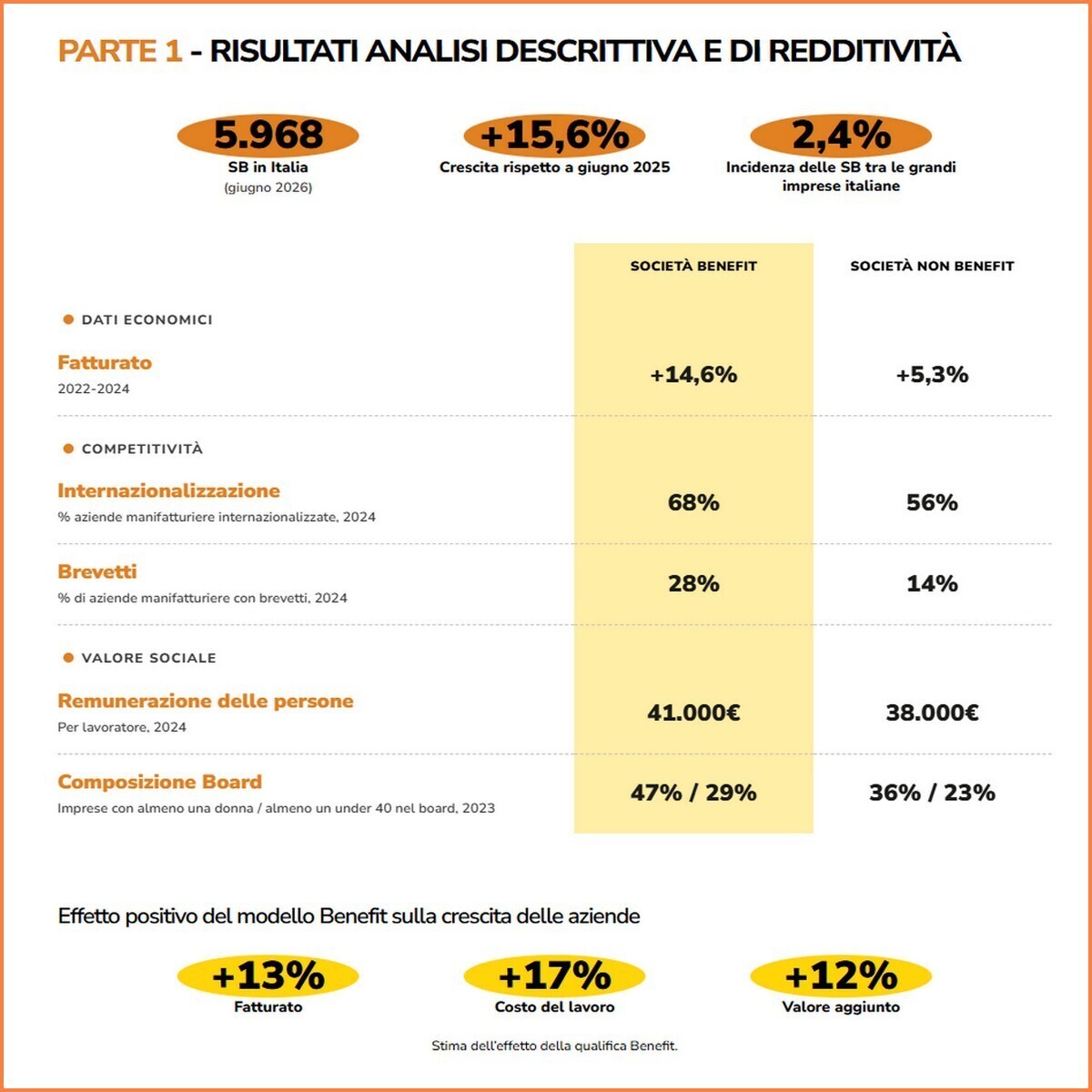
The analysis highlights a positive association between this corporate status and growth: the estimated effect is +13% for turnover, +17% for labour costs (which means that employees are paid better) and +12% for added value.
And, from the analysis of commercial exchanges 2024 involving 4.376 companies—half SBs and half not, homogeneous in terms of sector, size and province—it emerges that the former appear in the supply chains of their counterparts more frequently than in the economy as a whole.
The 38% of benefit companies have commercial relationships with other benefit companies, while non-benefit companies have benefit suppliers in only 24% of cases.
An ongoing relationship with suppliers
This inclination to build relationships with benefit partners concerns all size categories, from micro to large companies: as company size increases, so does the likelihood of having at least one benefit supplier (among large SBs, it reaches 86%), but the highlighted advantage remains systematically present.
The supply chains of benefit companies are more stable: 27,4% of purchases are made from suppliers with whom there has been an ongoing relationship over the last nine years, compared with 21,8% for non-benefit companies. These figures offer serious food for thought on the greater resilience of supply chains.
The research therefore compared the spread of benefit companies across Italian provinces with the economic and social conditions of the areas, measured using Istat indicators on equitable and sustainable well-being (BES Report, 2025 edition).
It emerges that the greater presence of SBs does not correspond to a greater presence of more intense social needs and/or shortcomings in the context in which they operate. The map of the model follows, instead, that of innovation and income: benefits are thus more prevalent in areas that file more patents and where people’s earnings are higher, with an incidence ranging from 2,7 per thousand companies in the North-West to 0,8 per thousand in the Islands.
As regards the purposes of common benefit, it emerges that the choices of priorities in the various articles of association are linked more to the company’s activities than to the place where it is based.
How many Italian benefit companies there are and how they are growing
The research also provides an update on the scale of the benefit phenomenon. As at 30 June 2026, there were 5.968, 7,7% more than at the end of 2025 and 15,6% more than a year earlier.
They employ approximately 260.000 employees and generate a production value of 71,3 billion euros, equal to 2,5% of the national total.
Micro-enterprises are the most numerous (4.342), but the model is more established among large companies, with more than 250 employees, where its incidence reaches 2,4%.
The spread of this distinctive corporate status appears in all sectors, particularly in telecommunications (11,7 per thousand), professional activities (9,4) and education (7‰). And, incidentally, the cases, as also documented by Distribuzione moderna, are growing exponentially in the world of consumer goods.
The research also updated the analysis of the statutory dimension, categorising the concrete and public commitments that benefit companies make towards people, communities and the environment.
The ESG classification, obtained through a detailed examination of 5006 statutory documents, confirms a strong focus on social purposes (55%), followed by environmental purposes (28%) and governance (17%).
This article was translated from the original Italian version with the assistance of artificial intelligence. In case of discrepancies, please refer to the original Italian version.