Banks and businesses: credit returns... but for many, only the credit crunch returns

Banks and businesses: credit returns... but for many, only the credit crunch returns
- Information
Over the past year, banks’ lending to businesses has recovered after a long period of contraction, first marked by the pandemic and then by the ECB’s monetary tightening.
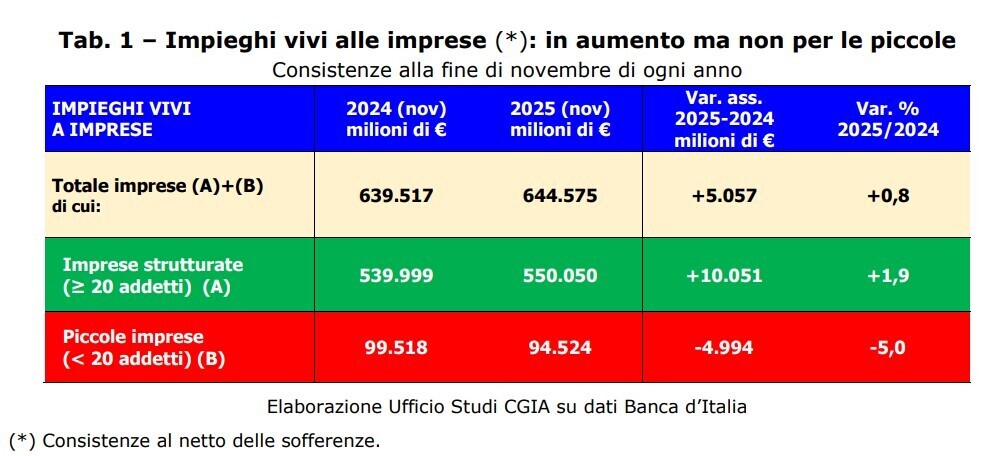
Between 2024 and the same month of 2025, outstanding lending to legal entities increased by 5 billion euros (+0,8%).
5 billion fewer for the smallest businesses
The large ones excluded – according to a survey by Cgia Mestre – it is micro and very small businesses that remain: those with fewer than 20 employees, in fact, suffered a further cut in lending amounting, correspondingly, to -5 billion euros (-5%), demonstrating, if any further evidence were needed, a structural divide in our credit system.
And yet, in Italy businesses with fewer than 20 employees (mainly made up of craftspeople, shopkeepers, traders, small business owners and VAT-registered self-employed workers) account for 98% of all companies operating in the national economy and employ — excluding public-sector employees, agriculture and financial/insurance services — 52% approximately of the workforce.
This difference in treatment, notes the Cgia Mestre Research Office, is significant because it undermines the optimistic narrative often associated with banks’ “return to lending” .
Bank lending falls in half of the regions
In reality, the growth in lending is concentrated mainly, and unsurprisingly, among medium-sized and large businesses, which have stronger capital bases and greater connections at every level.
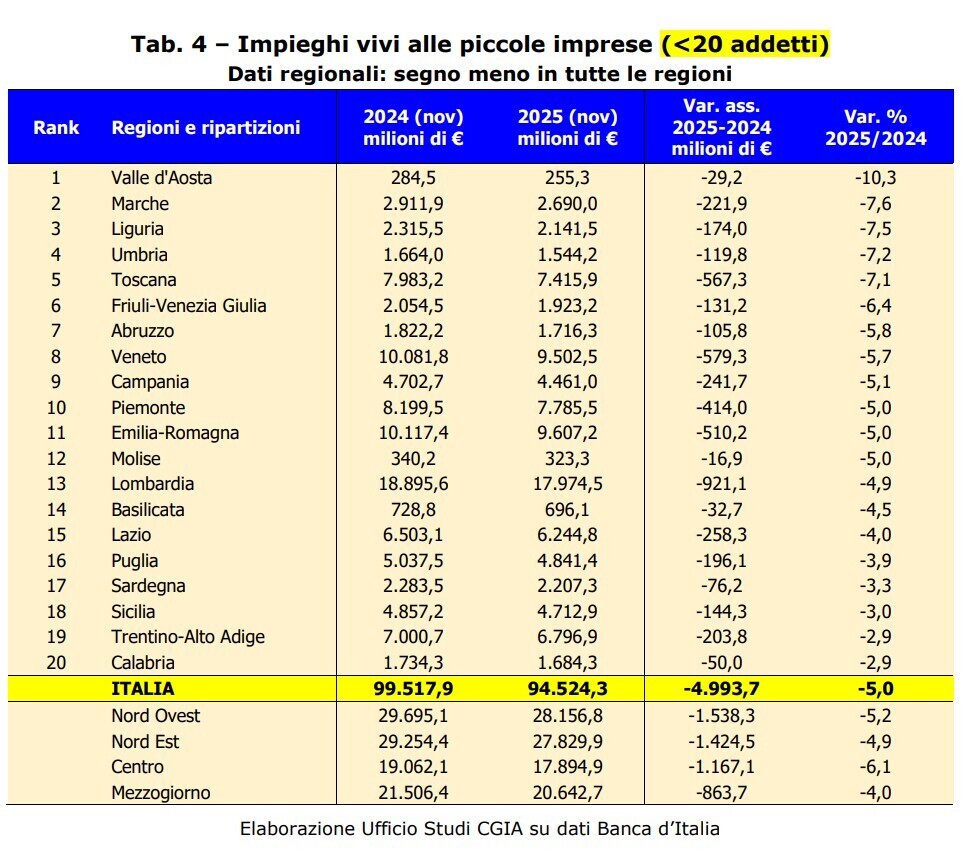
If we analyse the situation territorially, we see that almost half of Italy’s regions continued to experience a decline in lending, while, among SMEs alone, the loss affected all 20 areas.
The most significant contractions affected Sardinia, with -370,9 million euros (-4,7%), Umbria, with -335,8 million (-3,9%), and Basilicata, with -94,8 million (-3,6%).
In absolute terms, the most substantial reduction hit Veneto, where lending fell by 1,8 billion euros (-2,9%).
By contrast, lending to Calabrian businesses increased, by +278,6 million euros (+5,4%), as did lending to businesses in Lazio, by +4,1 billion (+6,6%), and businesses in Valle d’Aosta, by +158,6 million (+10%).
The continuing contraction in outstanding lending to very small businesses is neither episodic nor linked to individual commercial choices, but is the result of structural transformations.
The reasons for the credit crunch
The first factor that disadvantages the smallest businesses is risk assessment. On average, micro and small businesses have more volatile revenues, lower capitalisation and greater dependence on the economic cycle.
A second decisive factor concerns prudential regulation, which is intended to protect banks from imbalances and missteps.
More technically, with the introduction and strengthening of the Basel III rules, institutions must allocate more capital against loans considered risky, as loans to SMEs normally are.
The issue of operating costs also matters. Assessing, monitoring and managing a loan involve largely fixed costs. For a microbusiness, the amount borrowed is often limited, but the work required of the bank is similar to that needed for a larger business.
And there is more: banks now operate with standardised models, heavily based on accounting data and automated scoring, which tend to penalise SMEs, which are less formalised.
A final factor is lower financing needs, namely the decline in demand for credit from small businesses: many of them have, in fact, reduced investment in fixed capital following the period of public support linked to the pandemic, and/or have used internal resources to cover short-term needs.
Read also:
Retail and finance: industrial investors beat private equity
This article was translated from the original Italian version with the assistance of artificial intelligence. In case of discrepancies, please refer to the original Italian version.