

Ferraris Agricola: turnover +6% and sales of Ruchè +15% in the first half of the year 2026
Ferraris Agricola: turnover +6% and sales of Ruchè +15% in the first half of the year 2026
- Information
Ferraris Agricola, a company in Castagnole Monferrato that has brought Ruchè back among the leading names on the Italian wine scene, closed the first half of the year 2026 up 6%.
Ruchè continues to grow
The Ruchè is the only denomination in Monferrato to exceed one million bottles a year while continuing to grow: bottling in the first half of the year 2026 +1%, comfortably exceeding half a million bottles, sales up 15% and stocks down from June 2025 to June 2026 by almost 1.200 hectolitres (-12%).
The positive trend in turnover and the 100.000 bottles sold in the first 6 months 2026 confirm Ferraris’ leading position within the Monferrato denomination.
“The ongoing work we are doing is producing the hoped-for results,” commented Luca Ferraris, who heads the company, “despite the economic, geopolitical and industry outlook remaining uncertain. This confirms that, thanks to far-sighted and careful management, the wine sector can perform positively.”
An overview of the sector
Regarding the broader scenario and how the wine sector is currently evolving, Ferraris offers his interpretation of recent developments.
“More generally,” continues Ferraris “, I believe that the wine sector needs a structural review of its management model. Today, many businesses, particularly in certain regions, continue to be run according to an approach that is no longer up to date. In all agri-food and industrial sectors, business management has shifted towards models in which marketing, sales and finance have become the tools used to interpret markets and shape companies’ futures. In wine, this evolution has in many cases taken place too slowly and with an approach skewed towards the technical function. Production, however, has no future without strategy. For this reason, I believe that emergency measures such as distillation or other measures for managing stocks may be useful as a short-term response, but do not represent the solution to the problem. Likewise, a general reduction in yields of 5-10% simply risks increasing the unit cost of production, shifting the financial burden onto winegrowers without addressing the market’s real needs. What is needed instead is a cultural and managerial change in the sector. The denominations performing best today are often those that have succeeded in adopting modern governance focused on the market and on building brand value. The case of Prosecco is probably the clearest: its success stems from having built a brand that consumers perceive first and foremost as a drink associated with a specific occasion, rather than simply as a wine. In my view, this is the approach that should also guide the evolution of many other denominations, particularly in Piedmont.”
The connection with the territory
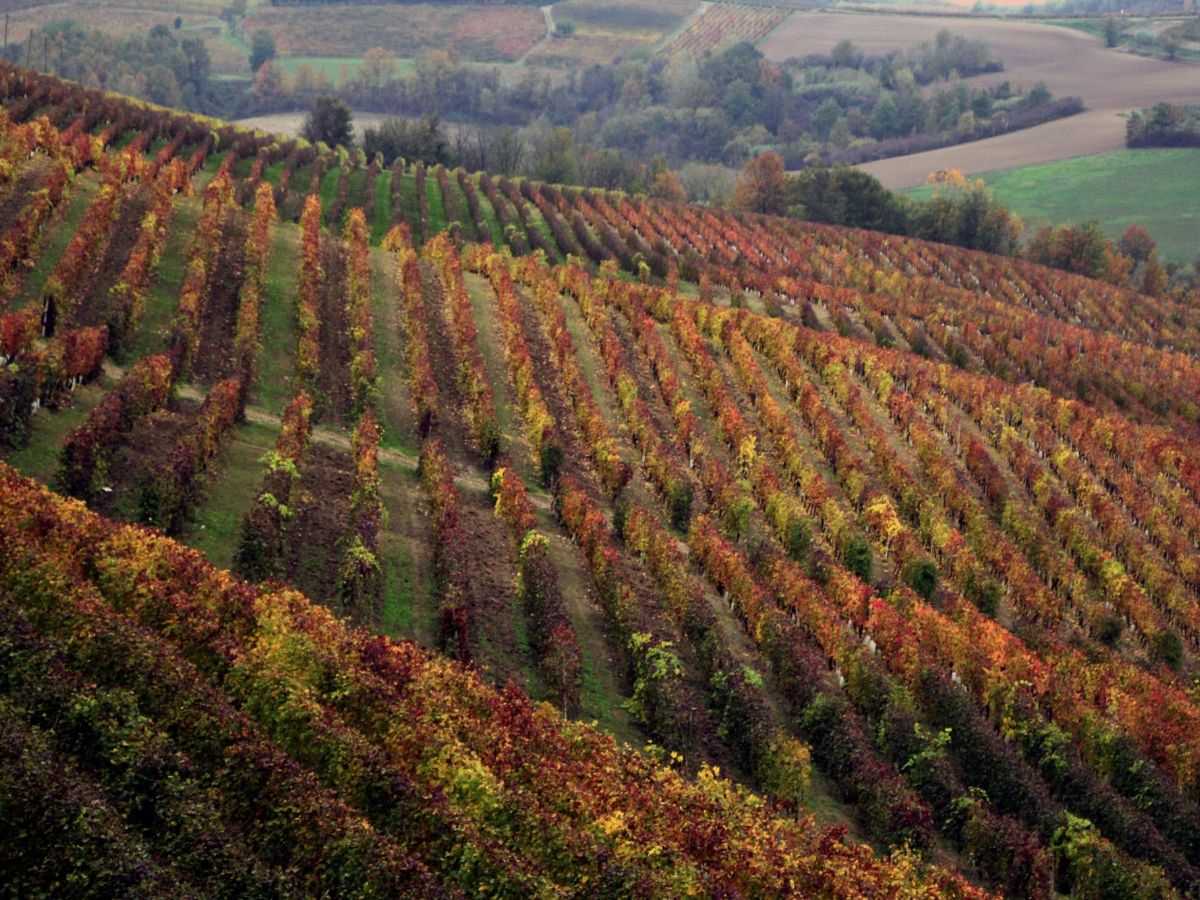
Ferraris also emphasises that the value of Ruchè lies not only in the denomination’s financial results, but in its ability to represent a territory. “For years, my work has not simply been to produce Ruchè, but to tell its story: to convey its pleasantness, quality and deep connection with the hills of Monferrato. Promoting Ruchè means promoting the territory where it originates. We see it every week at the winery: visitors arrive from all over Italy and abroad, choosing Monferrato as their destination and, at certain times, helping accommodation providers and restaurants to record full occupancy—an unimaginable scenario until just a few years ago. Those who come here are looking for an authentic, more relaxed, more human-scale experience, far removed from the pace of mass tourism. I believe that this very authenticity is making Monferrato one of the most interesting wine-tourism destinations in Piedmont, and that Ruchè is one of its most representative expressions.”
This content was translated with the assistance of artificial intelligence.