

Apofruit calls for structural measures to address the heat and drought emergency from north to south
Apofruit calls for structural measures to address the heat and drought emergency from north to south
- Information
At meetings with members held in recent days by Apofruit in the cooperative’s various production areas, growing concern among farmers is emerging over the effects of climate change.
Drought is affecting crops from north to south
From Nomi, in Trentino, to the Gioia Tauro Plain, the issue of water availability andrising temperatures is in fact becoming increasingly central to the future of fruit and vegetable production as well.
Mirco Zanotti, president of Apofruit, explains: “At the beginning of August, we held two meetings, one in northern Italy and one in the south, and drought is on the agenda in all the production areas. Northern Italy was not historically accustomed to dealing with these problems, but climate change is also becoming apparent here, with growing difficulties in water availability and because of the high temperatures. The Po is a mere trickle of water these days, and the lakes in the north are also in crisis.”
The lack of infrastructure is exacerbating the difficulties
The regret is that we had a generous spring in terms of rainfall, but the lack of infrastructure meant that it could not be stored and made available when needed.
The general manager Ernesto Fornari then stresses: “Our impression was that producers were very concerned about climate change. There are apple varieties, such as Gala, which are harvested in August and which could become increasingly difficult to grow at this time of year in the years ahead because it is too hot. So much so that several producers are already considering grubbing up their orchards. This year, in fact, we saw a large quantity of sunburnt produce, almost a 20% of the harvest of this variety.”
The president and general manager also observe: “In new orchards, approximately 50% of producers have installed nets, but the other 50% have not. In the years ahead, this could become an additional problem. Until ten years ago, hail nets were in fact considered mainly for their function of protecting against hail. Today, they are taking on a completely different multifunctional role: grey or black nets are being used to increase the shading effect against solar radiation, which is increasingly becoming a problem.”
The example of Calabria
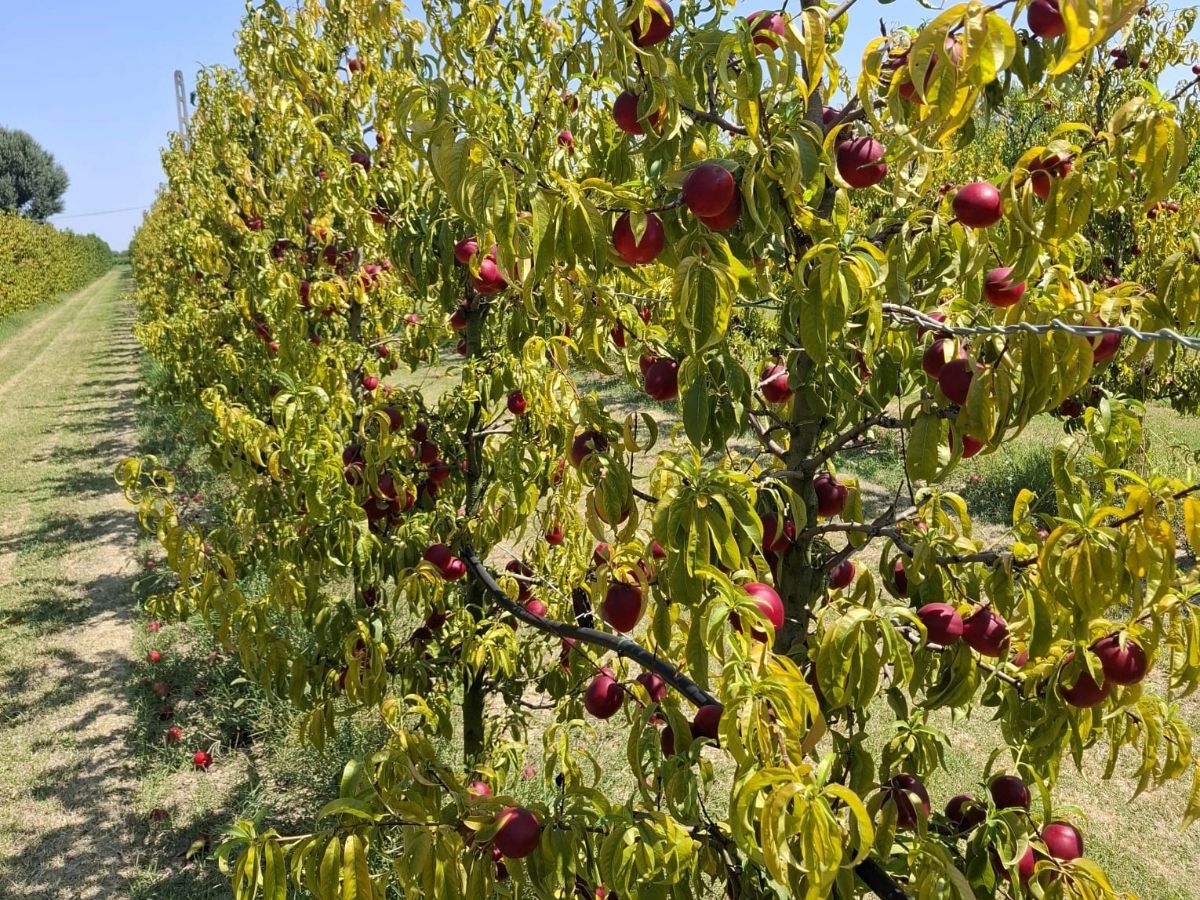
The problem, moreover, does not concern Trentino alone. “In very different areas – point out Zanotti and Fornari – we consistently find difficulties linked to the climate. In Cerignola, for example, after 10 July, production became prohibitive because of the extremely limited availability of water and the deterioration in its quality caused by high salinity. Above certain temperatures, plants also react badly, and problems arise involving a reduction in fruit size, with a corresponding decrease in yields. Peaches, nectarines, apricots and plums can lose size, and the same phenomenon also affects kiwifruit. The Gioia Tauro Plain in Calabria is proving to be a successful choice for kiwifruit, partly because water is currently available there: it comes from the mountains, which are fairly close to our members’ land. But beyond this, it is no longer sufficient to act only when the water emergency arises.”
“Certainly, as a cooperative and as producers,” reiterate Zanotti and Fornari “we must continue to invest. However, public bodies and administrations must also do their part and devise a plan that is no longer merely emergency-based. Reservoirs and infrastructure must be built to retain water when it is available and make it available when needed. And this, precisely, does not concern only the south: it is an issue that now affects the whole country.”
This content was translated with the assistance of artificial intelligence.