Rice: the 2026/27 campaign gets under way amid falling prices, cost pressures and a decline in exports
Rice: the 2026/27 campaign gets under way amid falling prices, cost pressures and a decline in exports
- Information
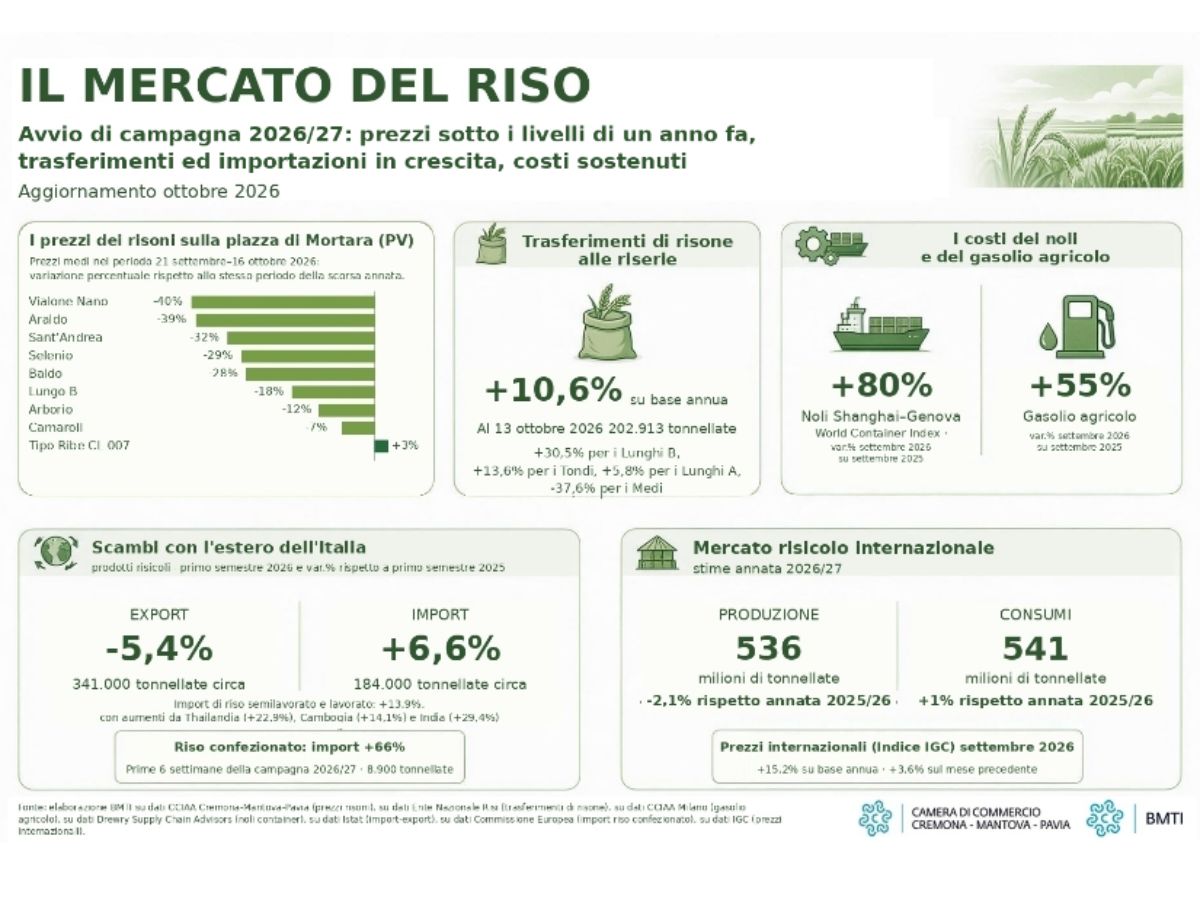
According to the analysis of the Italian rice market carried out by the Cremona-Mantua-Pavia Chamber of Commerce, with the support of Bmti, the start of the 2026/27 campaign highlights an Italian rice market in a period of adjustment.
Paddy rice prices opened at significantly lower levels than in the previous season, remaining essentially stable in the first few weeks. In mid-October, however, some signs of an increase emerged, mainly attributable to the recovery in demand from the processing industry.
Prices of the main varieties
At Mortara, the key trading centre for the Lomellina rice-growing district, the most significant year-on-year declines affected Vialone Nano (-40%), Araldo (-39%), Sant'Andrea (-32%), Selenio (-29%) and Baldo (-28%). For Baldo, the market remains exposed to the risk posed by the new Turkish customs regime for rice, based on a different system for calculating duties. A change in the conditions for access to the Turkish market could penalise a variety for which Turkey represents a significant commercial outlet.
Lungo B is also recording a double-digit year-on-year decline (-18%), while the varieties traditionally used to prepare risotto are showing less pronounced losses: -7% for Carnaroli and -12% for Arborio. By contrast, Ribe paddy rice is showing increases at the start of the season, also supported by the positive trend in demand: the CL variety 007 records an increase of 3% compared with the first few weeks of the previous season.
Cost pressures
Costs meanwhile continue to exert significant pressure on the rice supply chain. On the logistics front, despite the decline observed since July, attributable to cooling demand for transport, freight rates for container shipping remain significantly higher than a year ago, driven by increases in operating components, particularly insurance costs and fuel costs.
The World Container Index on the Shanghai–Genoa route remains 80% higher than in September 2025. Dry bulk shipping rates are also increasing: the Baltic Dry Index recorded growth of 60% between September 2025 and September 2026. On the fuel front, persistent international tensions over petroleum distillates also continue to weigh on the cost of agricultural diesel, which increased by 55% year on year in September.
Foreign trade
Mixed signals are also coming from foreign trade. In the first half of 2026, Italian exports of rice products recorded a volume decline of 5,4% year on year. The decline mainly affected paddy rice (-30,0%) and semi-milled and milled rice (-5,9%), while overseas shipments of husked rice (+2,2%) and broken rice (+1,6%) increased.
On the other hand, imports are increasing, with +6,6% year on year, mainly due to increased purchases of semi-milled and milled rice (+13,9%), with double-digit increases in arrivals from Thailand (+22,9%), Cambodia (+14,1%) and India (+29,4%), and of husked rice (+7,6%), offsetting the decline in paddy rice (-4,0%) and broken rice (-4,8%). A focus on imports of packaged rice in the current season, based on data from the European Commission's DG AGRI, also shows that during the period between 1 September and 11 October 2026, approximately 9.000 tonnes of packaged rice arrived in Italy, an increase of 66% compared with the same period of the previous season. The increase is almost entirely attributable to arrivals of 5-20 kg packs.
This article was translated from the original Italian version with the assistance of artificial intelligence. In case of discrepancies, please refer to the original Italian version.