Brand Finance analysis: trust in grocery retail banners is growing, but loyalty is not
Brand Finance analysis: trust in grocery retail banners is growing, but loyalty is not
- Information
According to Brand Finance’s analysis of supermarket brand strength in Italy, Italian large-scale retail banners enjoy growing trust, but are finding it increasingly difficult to be chosen as consumers’ first option.
Banner by banner
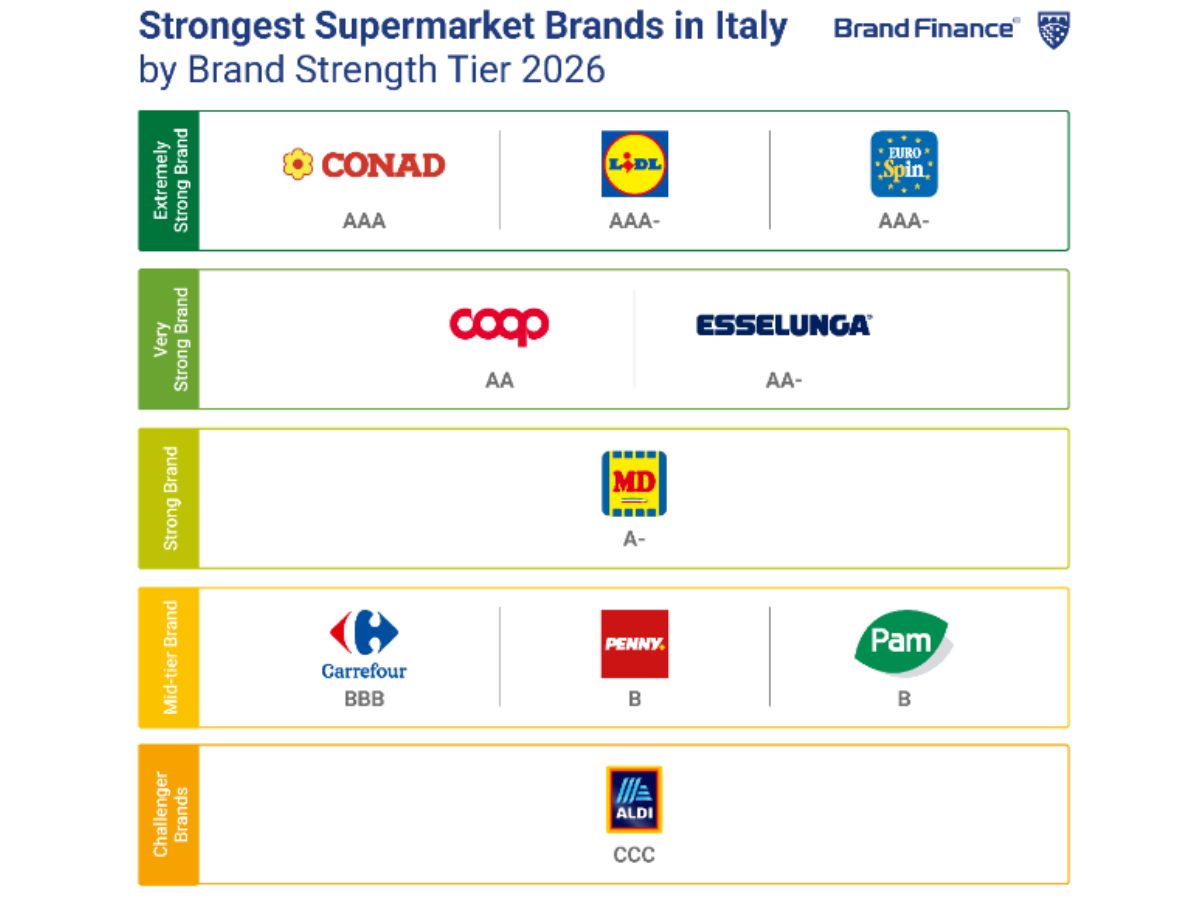
At the top tier, Conad moves up a grade and reaches AAA. It is the only one of the major banners to gain consideration, thanks to a widespread presence that keeps it among consumers’ options. Eurospin also moves up a grade and enters the tier: its reputation for affordability, built up during the years of high inflation, translates into a preference that has remained almost unchanged. Lidl remains one of the strongest brands for trust and reputation, but is losing ground precisely in terms of preference.
Among the very strong brands, Esselunga stands out for its customers’ willingness to pay a price premium, one of the highest in the sector together with Conad. Its limitation is less widespread awareness at national level, linked to a network concentrated mainly in central and northern Italy. Coop remains among the very strong brands, while Md is confirmed as a strong brand, supported by growing trust and reputation.
In the mid-tier, Carrefour drops a grade in a year of profound transformation: the survey was conducted a few months after the announcement of the sale of its Italian operations to NewPrinces, and the network will gradually switch to the historic Gs brand by 2028. Penny and Pam enter the analysis this year. Aldi is among the challenger brands: its name is now well known, but in a segment already served by Eurospin, Lidl and Md, turning awareness into a relationship with the customer remains the main challenge.
The paradox of trust
For almost all banners, trust has grown, while preference has declined, that is, the proportion of people who identify a banner as their first choice. According to Brand Finance, the two are connected: when all banners are perceived as reliable, switching no longer involves any risks, and consumers can follow the offer of the day. Trust has become a basic requirement: it is no longer a reason to choose, but the condition for being considered.
According to Brand Finance, disloyalty arises from the interplay between underlying conditions and more recent factors. Networks have overlapped for some time, and nearby banners and a wide range of options make switching easy. The factors driving change are now widespread trust and the habit of comparison left by the years of steep price rises. They are reinforced by increasingly frequent promotions and an increasingly similar offering across formats: private-label products occupy a growing space, discount stores have raised their quality and supermarkets have lowered their prices.
A context under renewed pressure
The data for the analysis was collected in November 2025, when the annual growth in the shopping basket had fallen to 1,5%. According to preliminary Istat estimates, in October 2026 the basket rose again to 2,5% and unprocessed food products to 7,5%, while overall inflation reached 5,4%. According to Brand Finance, it is reasonable to expect a consumer who is even more price-conscious, and therefore even more likely to switch between banners.
Trust put to the test
The issue of trust has become highly topical. In recent weeks, a series of cyberattacks has hit supermarket refrigeration systems in several European countries, with some incidents also reported in Italy. The analysis data, collected a year ago, do not measure the effect of these events. According to Brand Finance, however, incidents of this kind put precisely what all banners now take for granted to the test: trust. If trust has become a basic requirement, losing it costs far more than gaining it brings. What will make the difference is the banners’ ability to protect customers, manage incidents transparently and communicate promptly: this too is part of a brand’s strength.
What this means for the banners
With prices rising again, the temptation to compete solely through discounts and leaflets will be strong. But according to Brand Finance, promotion brings customers into the store today without giving them a reason to return tomorrow, while reducing margins in the meantime. The banners that perform better, on the other hand, have something the others cannot easily copy: a widespread presence, a credible promise of affordability over time, and a quality for which customers are willing to pay. Today, the private label, which is increasingly similar from one banner to another, can also become a distinctiveness lever, if it expresses what makes the banner unique.
Comment
“Italian large-scale retail has won the trust challenge: consumers now consider almost all banners reliable. But precisely for this reason, they feel free to switch. The new challenge is to be chosen, and being affordable is not enough, because they all are. What is needed is a presence close to the customer, a clear and consistent promise over time, and an assortment and private label that express the banner’s identity. That is how trust becomes preference. The attacks of recent days are a reminder that trust, now taken for granted, can be called into question quickly. The banners that manage these incidents transparently will emerge stronger,” comments Massimo Pizzo senior consultant di Brand Finance.
This article was translated from the original Italian version with the assistance of artificial intelligence. In case of discrepancies, please refer to the original Italian version.