Univo patents the system that makes the authenticity of every bottle of wine verifiable
Univo patents the system that makes the authenticity of every bottle of wine verifiable
- Information
The innovative startup Univo has developed a digital anti-counterfeiting system for wine capable of providing every individual bottle with proof of its authenticity, readable by anyone.
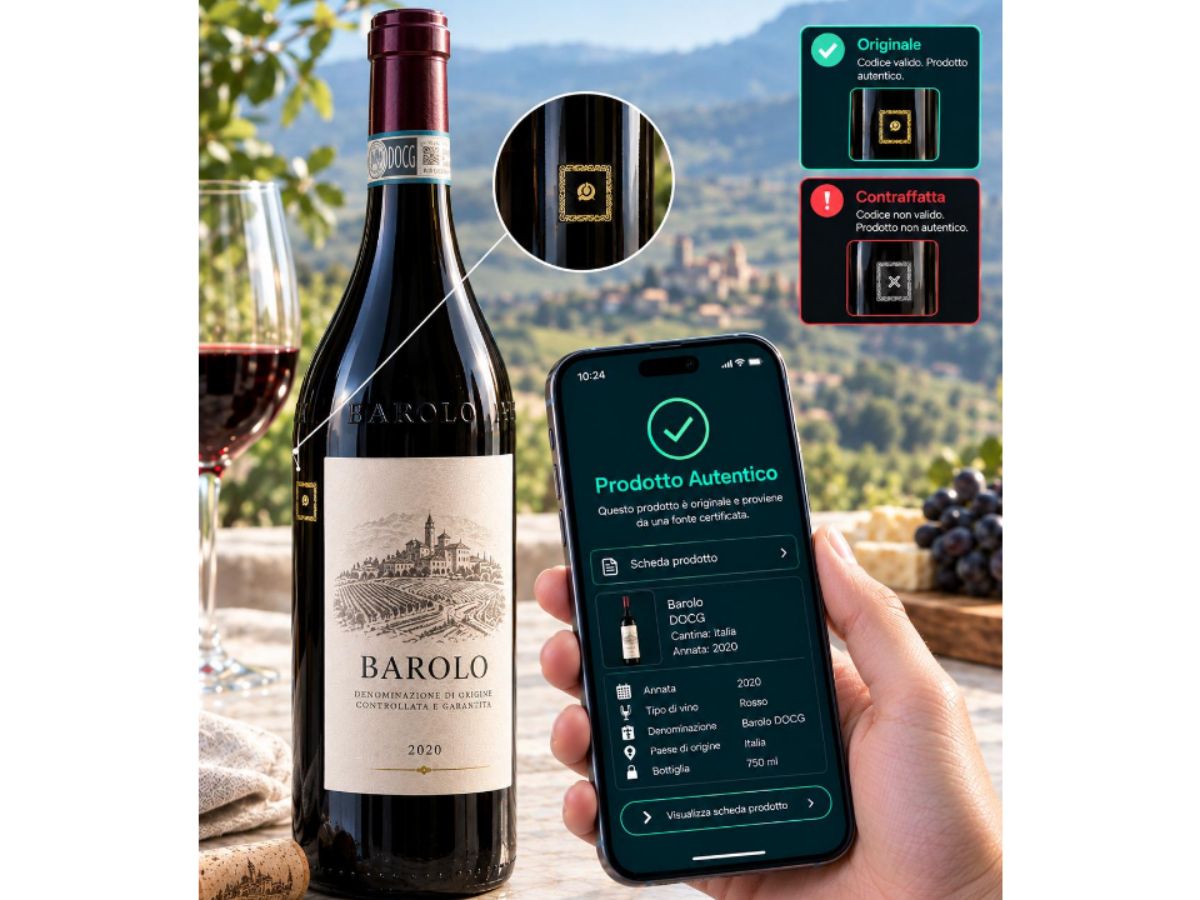
The heart of the system, protected by a patent application, is a fingerprint: each bottle is associated with a unique mark, printed inline during packaging, which cannot be copied or transferred. The consumer, importer or control authority can verify it in a few seconds with the Univo Verify app: the bottle is scanned with a smartphone and the result – authentic or not authentic – arrives immediately, without special devices or technical expertise.
The electronic label
The anti-counterfeiting system, however, is not an isolated device: it is the final link in a platform that accompanies the wine from the warehouse to the shelf. The first is the electronic label. From 8 December 2023, European Regulation 2021/2117 requires ingredients and nutritional information to be indicated, including via a QR code. Univo provides a digital label in 24 languages with dynamic QR codes, which remain active and can be updated over time without reprinting anything: every consumer, in any country, reads the label in their own language.
The warehouse
The second link is the warehouse. The platform manages packaging materials and finished products by cross-referencing supplier deliveries, theoretical consumption from the bill of materials, line waste and physical inventory. The result is data that wineries rarely have: exactly where material is lost along the bottling line, and how much it costs.
Traceability
The third is traceability. Every batch, every pallet and, when necessary, every bottle has its own digital history: when it was bottled, with which materials, in which shipment it left, and for which market. "Every bottle, a map" is the phrase Univo uses to sum up the concept. And it is this map that makes the final step possible: if every bottle has a history, every bottle can prove that it is genuine.
One fundamental choice runs through the entire platform: the data remains the winery's property, can be exported at any time and is stored on Amazon Web Services infrastructure in Europe, in full compliance with Gdpr. The QR codes remain active for at least five years even if the service is discontinued, because a bottle sold today may be opened a long time from now. The system is cloud-based, requires no servers at the winery, updates automatically and integrates with the management systems already in use.
The wineries
Among the first organisations to adopt Univo are two historic names from Barolo: Vietti, in Castiglione Falletto, and Poderi e Cantine Oddero, in La Morra. Two wineries with a strong presence in international markets, where certainty of origin is now part of the product's perceived value. For them, the Univo mark is not just a defence: it is a sales argument. An importer who can verify every incoming bottle, a restaurateur who can show it at the table, a collector who can check a bottle bought at auction ten years later: these are all moments when authenticity ceases to be a promise and becomes a fact that anyone can ascertain.
The commentary
At the helm of the project is Stefano Di Benedetto, an entrepreneur from Alba who has led 1996 Europrint, a company specialising in printing wine labels, since: "I spent almost thirty years printing labels for wineries in Langa, Roero and Monferrato. Then I saw bottles arriving on foreign markets that our wineries had never produced. Italian wine lives on identity: a territory, a family, a vintage. Every time a counterfeit bottle reaches a consumer, a little of that identity is lost. Univo was created to protect the work of those who produce, bottle by bottle."
This article was translated from the original Italian version with the assistance of artificial intelligence. In case of discrepancies, please refer to the original Italian version.