Real estate market: retail confirmed as the leading sector in Q1 2026
Real estate market: retail confirmed as the leading sector in Q1 2026
- Information
After closing 2025 with positive figures (total investments amounting to approximately 13 billion), the real estate market confirms its performance in Q1 2026, with retail as the most dynamic asset class.
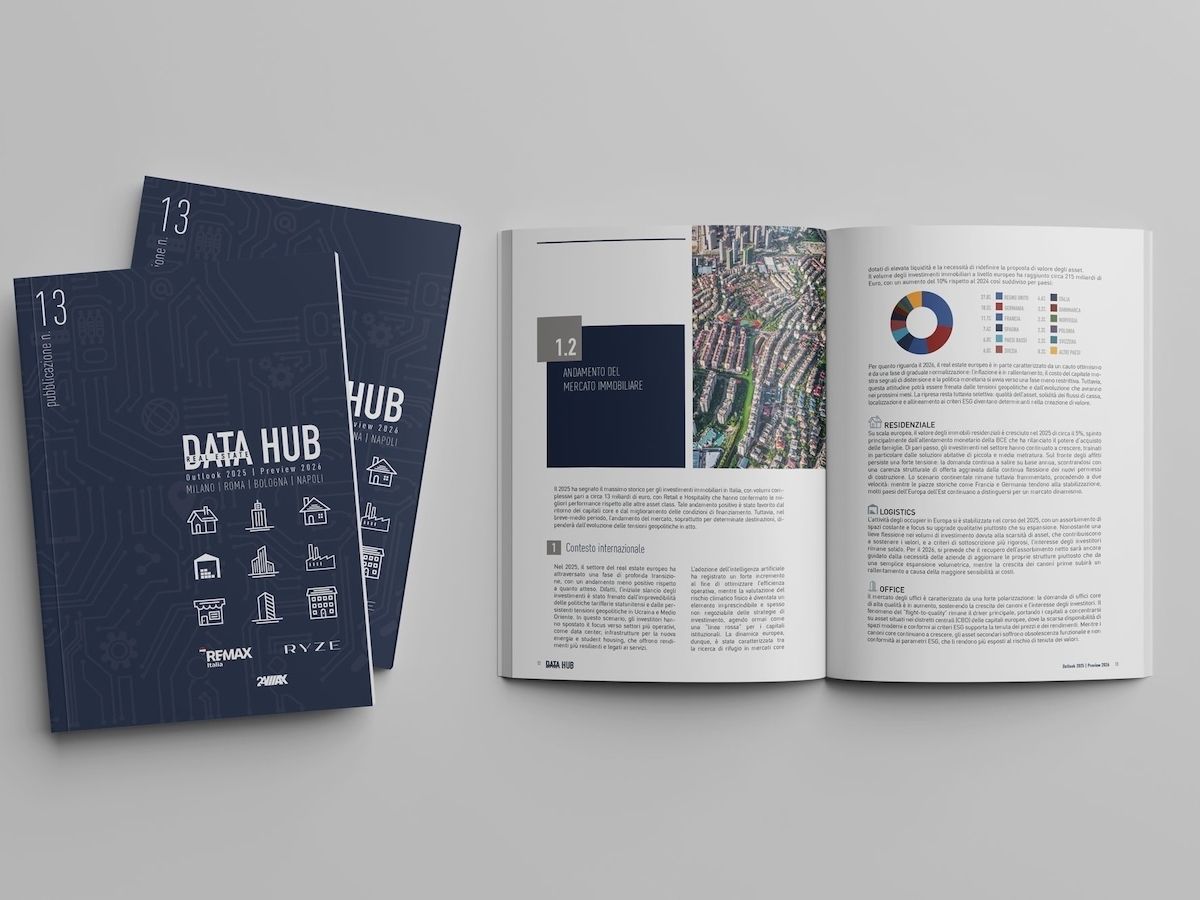
This emerges from the thirteenth edition of the Real Estate Data Hub, the report on the Italian real estate market, produced by Centro Studi Re/Max Italia andUfficio Studi Ryze, with the collaboration ofUfficio Studi 24Max.
Investments of 3,8 billion euros in 2025
Over the past year, the retail sector recorded record levels, returning to the centre of investors’ strategies and positioning itself as the leading asset class in terms of volumes in Italy, with investments amounting to 3,8 billion euros (+46% compared with the previous year). The start of 2026 confirms the sector’s momentum, with growth also in the first quarter.
The market is driven above all by the out-of-town (Oot), which accounts for approximately the80% of the overall investment volume of investments, demonstrating strong interest in assets capable of combining catchment, accessibility and robust cash flows.
Growth was supported by greater availability of debt capital and large-scale transactions. Among the most significant transactions are two share deals: one concerning Scalo Milano (in January 2026, Via Outlets acquired the entire share capital of Locate District, the company that owns and operates Scalo Milano Outlet & More) and the other concerning the Waterfront Mall shopping centre in Genoa, which together represent 45% of the total volume invested in the retail sector. Strong interest from investors in large core assets characterised by high-quality standards and strategic positioning is therefore confirmed.
High street: new openings, experiential formats and the boost from tourist flows
In the high streetsegment, the first quarter 2026 confirms interest in prime locations, in a phase characterised by new openings, expansions and the refurbishment of iconic spaces, as well as the physical entry of digital-native operators and the development of innovative concepts, which affected all the main Italian cities. In addition, during 2026, numerous new openings concerned the cities analysed.
The brand strategies highlight a twofold trend: on the one hand, the consolidation of the high-performance and lifestyle (sportswear) sector and luxury brands with a distinctive identity; on the other, a determined focus on experiential formats that combine contemporary design with pre-existing historic settings.
The expansion is supported by increased spending by international tourists and is tending to extend beyond established destinations, also involving regional markets such as Bologna with growing interest, while Milan remains the most sought-after destination (also benefiting from the past Winter Olympics).
Shopping centres: a mature sector, upgrades and new openings in the pipeline
Shopping centres, retail parks and large-format stores are once again attracting investors’ attention after the post-Covid downsizing, with a focus on dominant, large-scale assets capable of generating stable cash flows, solid catchment areas and value-add transactions involving secondary or repositioning assets.
In Italy, seven new shopping centres are expected by 2028, within a limited but strategic pipeline, with a significant proportion of projects involving refurbishments and expansions. The sector has exceeded 1.000 active complexes, with 16 top-tier facilities , and recorded vacancy rates between 3% and 8% over the past year (a sign that a balance between demand and supply has been achieved).
Among the openings planned for 2026-2028 are, among others, Galleria Porta Vittoria (Milan) and Milanord (Cinisello Balsamo), as well as projects in various Italian cities. From a geographical perspective, the centre of gravity of retail remains firmly anchored in the North-West, which continues to represent the most dynamic and structured area; however, investment is also expanding into metropolitan hinterlands and secondary urban areas. The shopping centre remains the preferred channel for 68% of retailers, but only for 28% of consumers. The period 2021-2025 saw growth in retail parks,, high street and convenience stores, with a net balance of approximately 550 openings.
Outlets and retail parks
The out-of-town format continues to be characterised by solid KPIs and minimal vacancy rates. Q1 2026, in terms of transactions and development, is emerging as a period of strong consolidation of the existing stock. The strategy of investors prioritises the regeneration, repositioning and expansion of existing facilities, at the expense of new greenfield developments as demonstrated by recent initiatives promoted by operators active in the area: these include the expansion and consolidation of Sicilia Outlet Village and Torino Outlet Village and the project to transform the former Soratte Outlet into the new Roma Outlet Village, which is intended to become a premium retail and leisure destination.
Looking ahead, the Italian and European retail market appears increasingly oriented towards a qualitative selection of the offering and highly experiential formats. In this context, the outlet sector is evolving from a channel for clearing excess stock into a fully fledged premium retail platform, with more carefully curated assortments and upscale environments. Increasingly selective brands favour locations with solid catchment areas and operators capable of developing long-term partnerships, while outlets are strengthening their role as an entry point for new consumers and as a point of engagement with the full-price channel. Looking ahead, further professionalisation and consolidation of the sector is expected, also supported by growing tourist flows and increasingly high expectations in terms of sustainability and experience.
The evolution of consumer behaviour, increasingly integrated across physical and digital channels, is also encouraging digital-native brands to enter the outletchannel. At the same time, outlets will continue to evolve into complete leisure destinations, integrating shopping, dining and entertainment, while attention to circular models, including second-hand formats, will grow. Overall, the sector remains resilient and well positioned, capable of offering an effective combination of value, experience and accessibility.
Stabilisation and selective compression of core asset yields
The new wave of openings and refurbishments provides a further stimulus for the market, given the resilience of rents at excellent levels and confirming, particularly in Milan and Rome, the absolute resilience of real estate values in prime locations.
As regards average yields, indications for the latter part of last year suggest the possible start of a new phase of selective compression, driven by renewed interest in resilient prime assets characterised by established, high-footfall locations, a quality tenant mix and indexed, long-term leases.
Data on prime yields show stabilisation, with signs of possible selective compression for core assets. With regard to prime rents, growth that began during the previous year has continued, moving towards a phase of “selective” strengthening, with prime rents rising further or consolidating at the highest levels. This reflects demand that is more focused on quality assets (high visibility, accessibility and strong commercial performance), against a limited supply of available prime space.
This article was translated from the original Italian version with the assistance of artificial intelligence. In case of discrepancies, please refer to the original Italian version.