Protein products: for athletes, yes, but not only. The focus is on the short label
Protein products: for athletes, yes, but not only. The focus is on the short label
- Information
Once the initial boom phase has passed, the protein foods sector is now characterised by growing attention to the balance between nutrients. Proteins are increasingly being integrated into the daily diet without forcing the issue, while consumers favour minimally processed products with short ingredient lists.
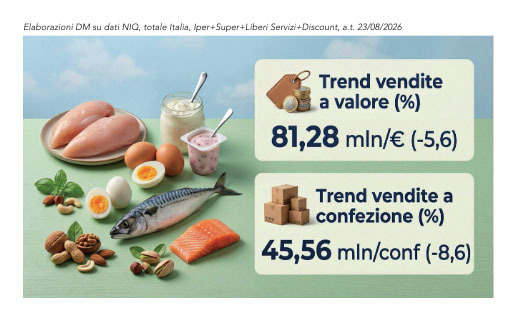 The market closes the year ending on 23 August 2026 (NIQ data, total Italy, Hypermarkets+Supermarkets+Free-service stores+Discount), with turnover of approximately 81 million euros, down 5,6% in value, accompanied by a decrease in packs (-8,6%). In this context, the average price per unit shows growth of 3,3%, while there is a slight reduction both in promotional intensity (-0,5 points) and in the average selling assortment (-2%).
Geographical areas and distribution channels
“At a territorial level – explains Elena Pezzotti of NIQ – all areas recorded a negative sales trend. The 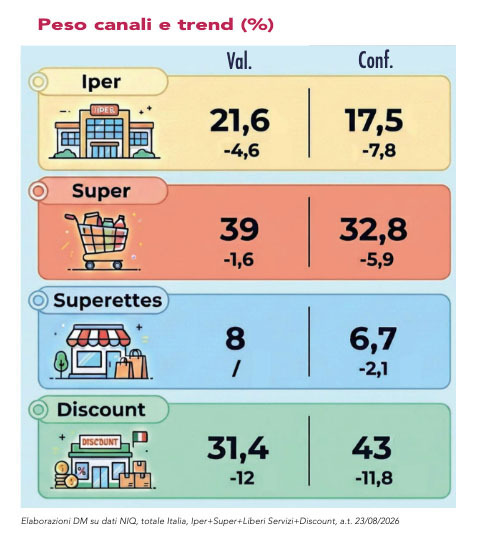 slightest decline was observed in Area -6,3% (-2,5%), the only one to increase its market share (+0,8 percentage points by value), thanks to broadly stable volumes and a stable assortment. The declines in Area 1 (-6,7%) and Area 3 (-7,3%) were more pronounced; both were characterised by a reduction in sales greater than the market average and by a decline in value share. Area 4 limited its contraction to 5,3%, supported by greater promotional activity (+0,9 points), which helped to slightly increase its share of the total market.” As for channels, modern distribution consolidates its role within the category, accounting for almost 69% of total turnover, up by more than 2 points. Despite recording a decline in sales (-2,4%), the channel shows better performance than the market average, accompanied by an increase in the average price per pack (+3,9%) and a slight increase in promotional intensity (+0,4 points), against a substantially stable assortment. Supermarkets remain the main sales channel, generating approximately 39% of turnover. The decline in value in this channel was limited (-1,6%), with an increase in market share (+1,6 points) supported by greater promotional activity and an almost stable assortment. Hypermarkets, on the other hand, recorded a more pronounced decline (-4,6%), also accompanied in this case by a decrease in units (-7,8%) and a significant reduction in assortment (-5,6%). Nevertheless, the channel maintains a high promotional intensity per pack (21,5%), the highest among the main store formats. The discount channel continues to represent just under one-third of the market (31,4% by value), but shows the greatest difficulties in the period analysed. Sales contracted by 12%, with a similar decline in volumes and packs. The loss of value share (-2,3 points) was accompanied by a reduction in promotional intensity (-1,5 points) and a downsizing of the assortment, the most pronounced among the main distribution channels.”
Segment performance
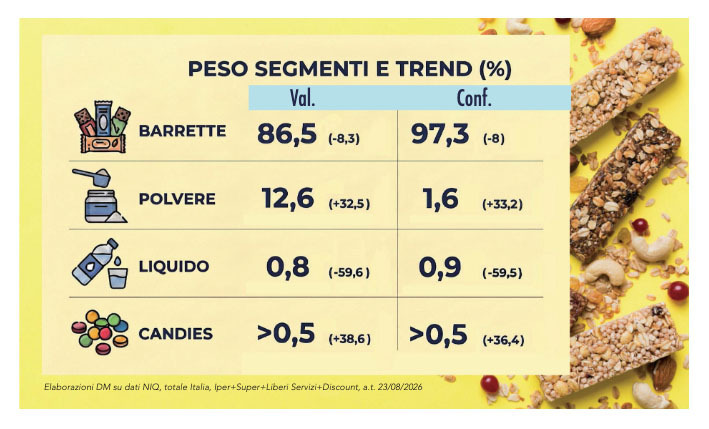 Analysis of the segments reveals a heterogeneous picture, with very different dynamics among the various propositions. “The bars – Pezzotti continues – which account for more than 86% of category turnover, continue to constitute the main segment, but recorded a decline in sales of 8,3% by value, accompanied by a similar decrease in both volumes and packs. The loss of share within the market (-2,6 percentage points of value share) is associated with broadly stable average prices, while the assortment shows a slight decline (-1,4%). The trend for protein powders was the opposite, confirming them as the most dynamic segment in the category. Sales grew by 32,5% in value, supported by an increase in volumes (+37,5%) and packs (+33,2%). At the same time, the segment gained 3,6 percentage points of value share, reaching 12,7% of the market, amid a reduction in average prices. The segment also benefits from a substantially stable assortment. Liquid products, on the other hand, recorded the weakest performance in the entire category, with a decline of 59,6% in value, accompanied by a similar decrease in volumes and packs. The segment lost more than 1 percentage point of market share and recorded a reduction in promotional activity, despite an increase in assortment. Protein candies finally showed high growth rates (+38,6% by value), but continue to represent a marginal component of the segment. The increase was accompanied by growing volumes and packs and greater promotional intensity.”
Read more about DM Magazine October 2026
This article was translated from the original Italian version with the assistance of artificial intelligence. In case of discrepancies, please refer to the original Italian version.