Retail in Touch 2026: retailers and industry discuss the value of local roots
Retail in Touch 2026: retailers and industry discuss the value of local roots
- Information
An afternoon packed with discussions confirmed Retail in Touch as a leading event for the retail sector. On Tuesday 24 November, at Spazio Lenovo in Milan, Edizioni DM held the fourth edition of the event, dedicated to “Giving value to local communities”: from 16.30 until the closing cocktail, 17 speakers from retailers, branded goods manufacturers, technology and food service took turns, with contributions from the group’s four publications – Distribuzione Moderna, PL Magazine, Technoretail and Ristorazione Moderna.
Lusetti: “Proximity is an asset”
The event opened with Mauro Lusetti, president of Conad and vice-president of Confcommercio. His address began with the three-tier cooperative structure – entrepreneur members, cooperatives and the national consortium – tested by the consolidation of retail: a network of over 3.700 stores in 1.578 municipalities, more than 500 of them in towns with fewer than 5.000 inhabitants, where the shop also serves as a social hub. Lusetti compared the village shop with the metropolitan store and explained how data and technology guide decisions about where to open, product ranges and adapting store formats. He then addressed the costs of proximity – energy, security, traffic and logistics in historic town centres – and the responses expected from local authorities. Finally, he turned to employment: the discussion was linked to the Accordo di San Martino, signed on 12 November by Cgil, Cisl, Uil and 13 employer associations, including Confcommercio, and to the upcoming renewals of retail sector agreements, with the skills required in shops and the appeal of working in retail among the issues at stake.
Private label, shared roots
The first debate, organised by PL Magazine and moderated by Maria Teresa Manuelli, brought together Barbara Bravi (owner of Orva), Alessandra Businaro (founder of The Optimist), Mario La Viola (chief development strategy officer at Crai) and Eleonora Graffione (president of Consorzio Coralis). The focus was the role of private label in enhancing local identities, supply chains and relationships with consumers. The four speakers come from different backgrounds: Crai has over 1.800 stores run by local entrepreneurs and has been a Società Benefit since 2024; Orva, a leader in sliced bread, generates 90% of its business through large-scale retail and supported employees affected by the 2023 flood; The Optimist is a branding and packaging agency for fast-moving consumer goods. Coralis, which brings together 21 entrepreneurs, works with local communities through Verdeblu, a project offering local products selected by its members. Discussing the consortium’s projects, Graffione set out the direction: “Supporting local economic ecosystems is the most important thing.”
Technoretail’s debate, “The origin that becomes data”, featured Claudio Dall’Agata (Spettacoli alla frutta), Marco De Luca (Brt) and Piero Tegon (MediaWorld), with Fabio Massi. Ristorazione Moderna presented “Local flavour in store formats”, with Alberto Corte (De Santis Group), Salvatore Grizzanti (Open Baladin) and Tommaso Mazzanti (All’Antico Vinaio), moderated by Nicola Grolla.
Industry and retailers: two views of value
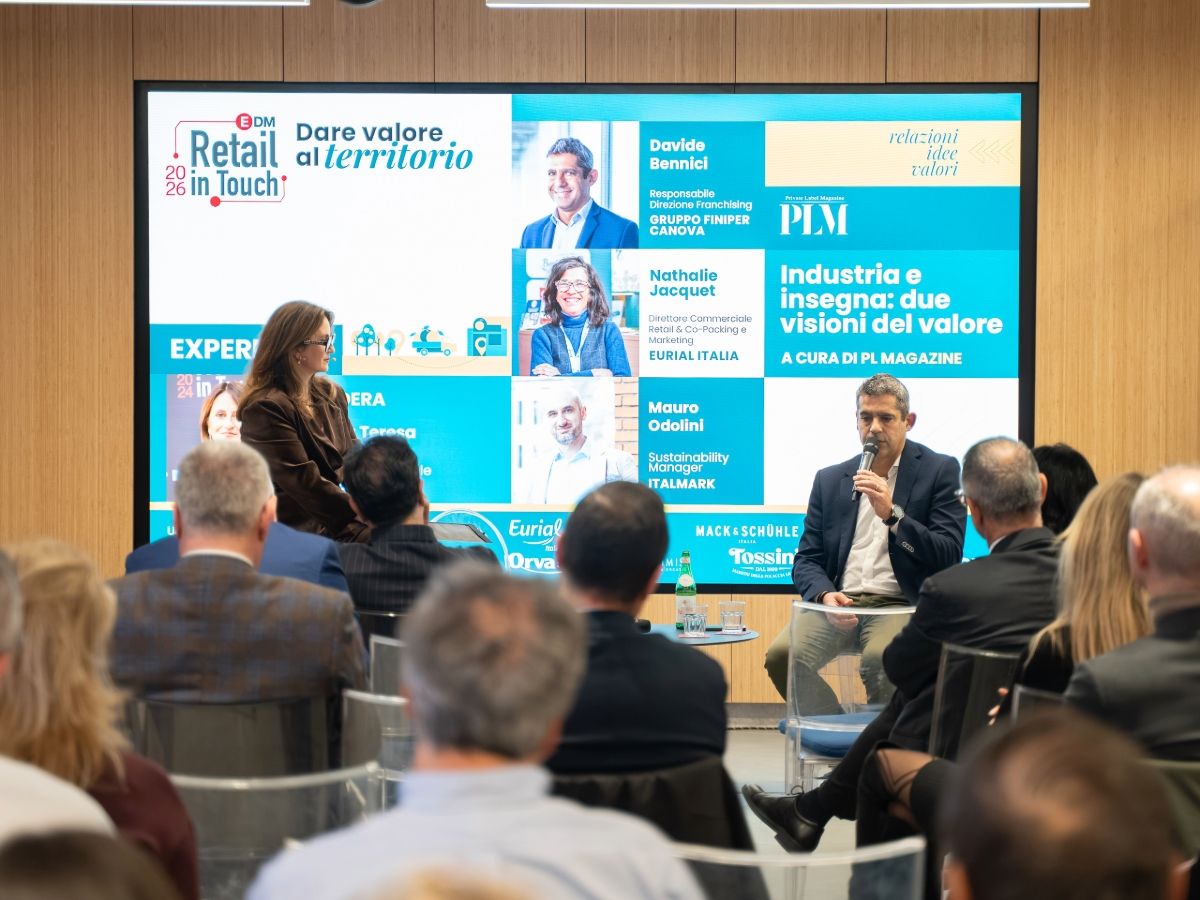
PL Magazine’s experience, featuring interviews conducted by Maria Teresa Manuelli, brought production and distribution face to face. Mauro Odolini, sustainability manager at Italmark, brought the discussion down to the “Our Care” 2026-2028, presented in Brescia on 10 November: at least 800.000 euros for local projects between 2025 and 2028, with the aim of moving from occasional contributions to multi-year initiatives, and a Code of Conduct for suppliers, including Esg mapping of 90% of local producers, around 193 companies, by 2028. Davide Bennici, head of franchising at Gruppo Finiper Canova, presented the perspective of a model in which the entrepreneur knows their local area: Unes has over 200 company-owned and franchised stores and, following its acquisition of Borello in Piedmont – around 50 stores and 800 employees – spoke of complete continuity for suppliers and staff.
Retailers and suppliers: a partnership rooted in local communities
The programme concluded with Distribuzione Moderna’s debate, where Enrico De Stefano (purchasing department lead at Penny Italia), Lucia Forte (managing director of Oropan), and Roberto Romboli (Mdd development director at Dit) discussed collaboration between industry and retailers to showcase local distinctiveness and strengthen supply-chain relationships. Oropan presented its sustainable 100% supply chain in Puglia and its supply-chain agreements, while Dit discussed the social role of the revived corner shop. Romboli reaffirmed the focus on local communities: “This means, first and foremost, local suppliers, often small businesses.”
A look abroad
To close, Fabrizio Valente of Kiki Lab presented “Retail Inspirations”, showcasing successful cases from abroad and the results of the first survey on customer experience at Italian retail chains.
The event was held with the support of partners Eurial Italia, Latterie Inalpi, Mack & Schühle, Oropan, Orva, Cryovac, The Optimist and Tossini, and technical partner Mowi.
This article was translated from the original version in Italian with the assistance of artificial intelligence. In case of discrepancies, please refer to the original version in Italian.