Plant based: the new challenges facing a category that is not only healthy
Plant based: the new challenges facing a category that is not only healthy
- Information
plant-based products, which are increasingly widespread and established, are now taking a step forward, looking beyond a simply health-oriented outlook towards an increasingly tasty and appealing offering, without abandoning their sustainable vocation.
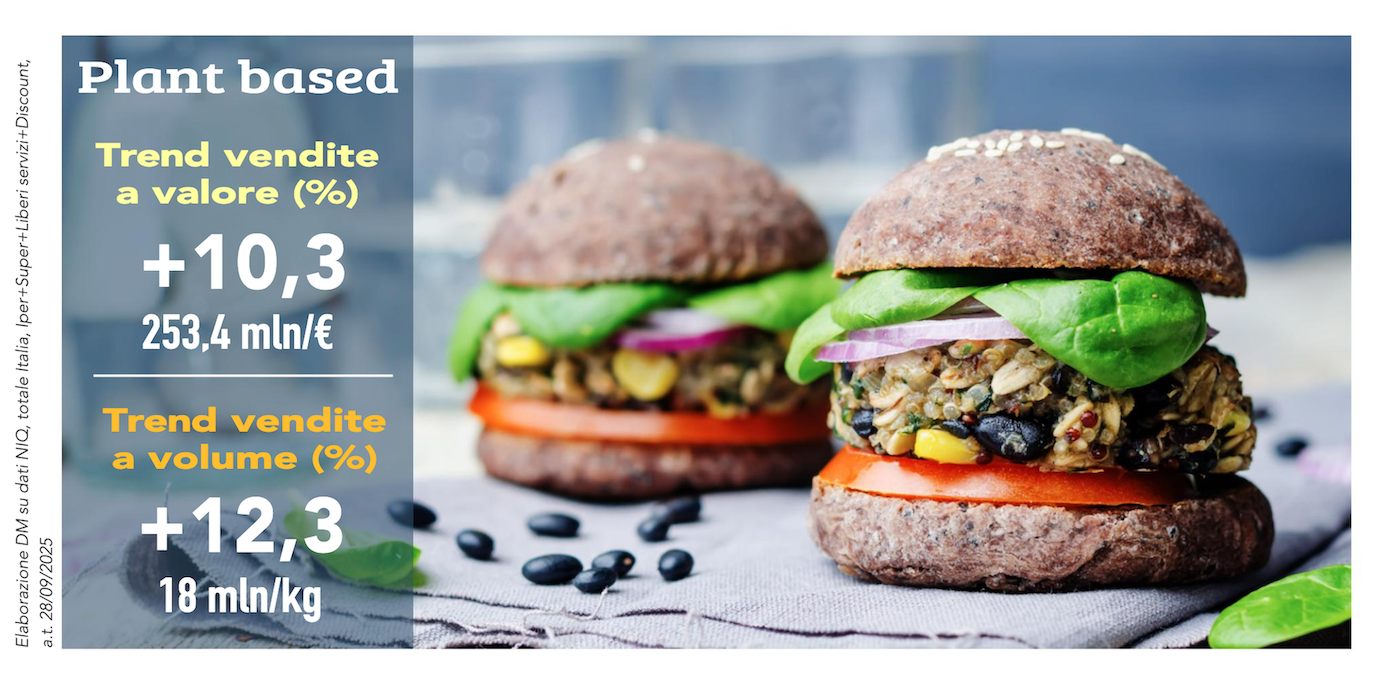 In the year ending 28 September 2025, the plant-based products market (excluding beverages) generated turnover of 253,4 million euros (NIQ data, total Italy, Hypermarkets+Supermarkets+Free-service stores+Discount stores), recording a value trend of +10,3% compared with the previous year. Volume sales also grew compared with the previous year (+12,3%), as did sales by package (+13,9%). Finally, the assortment per point of sale (+9,4%) and promotional intensity (+1,3 points) increased.
Geographical areas and distribution channels
The positive value performance is consistent across both channels and NIQ areas. The best performances were recorded in Area 4 (+16,8% in value), which also boasts a positive volume trend (+18%). Area 1 remains the most important market, with a value sales location share of 35,8%. Next in importance is Area 3 (25,6% sales location share). The number of references per point of sale is growing in all areas, especially in Area 2 (24,6% sales location share), where there are 17,3 references per shop (+10,8%). Finally, in last place for sales location share (14%) is Area 4. “Within the distribution channels,” explains Stefano Battaglia of NIQ, “supermarkets, which account for 36,5% of category turnover, recorded growth in turnover (+5,8%), also driven by a 7,5% increase in the number of references. They are followed by discount stores (value sales location share 32,8%), hypermarkets (25,9%) and, finally, free-service stores (4,9%), which nevertheless recorded increases in both value and volume sales. In volume terms, growth was seen across all channels, led by discount stores (+21,7%), followed by supermarkets (+7,5%). A general increase in promotional activity can be observed, especially in hypermarkets, which are the most heavily promoted channel (43,2 points). Average prices by volume are falling everywhere except in discount stores, where they increased by 2%”.
Segment performance
The vegetable ready meals segment (prepared recipes only) is the main segment in the category, with a value share of 79,7%, and is recording a positive trend in value sales of 8,5% and in volume sales of 11,5%, together with a reduction in average prices (-2,6%). Promotional activity is increasing, as is the average number of references per point of sale (+7,8%). “In this segment,” Stefano Battaglia elaborates, “the main subsegments by value sales are: burgers/croquettes (+6,6% in value and +8,5% in volume), other (+16,3% in value and +21,9% in volume), breaded products (+17,3% in value and +22,3% in volume) and meatballs (-3,8% in value and -0,1% in 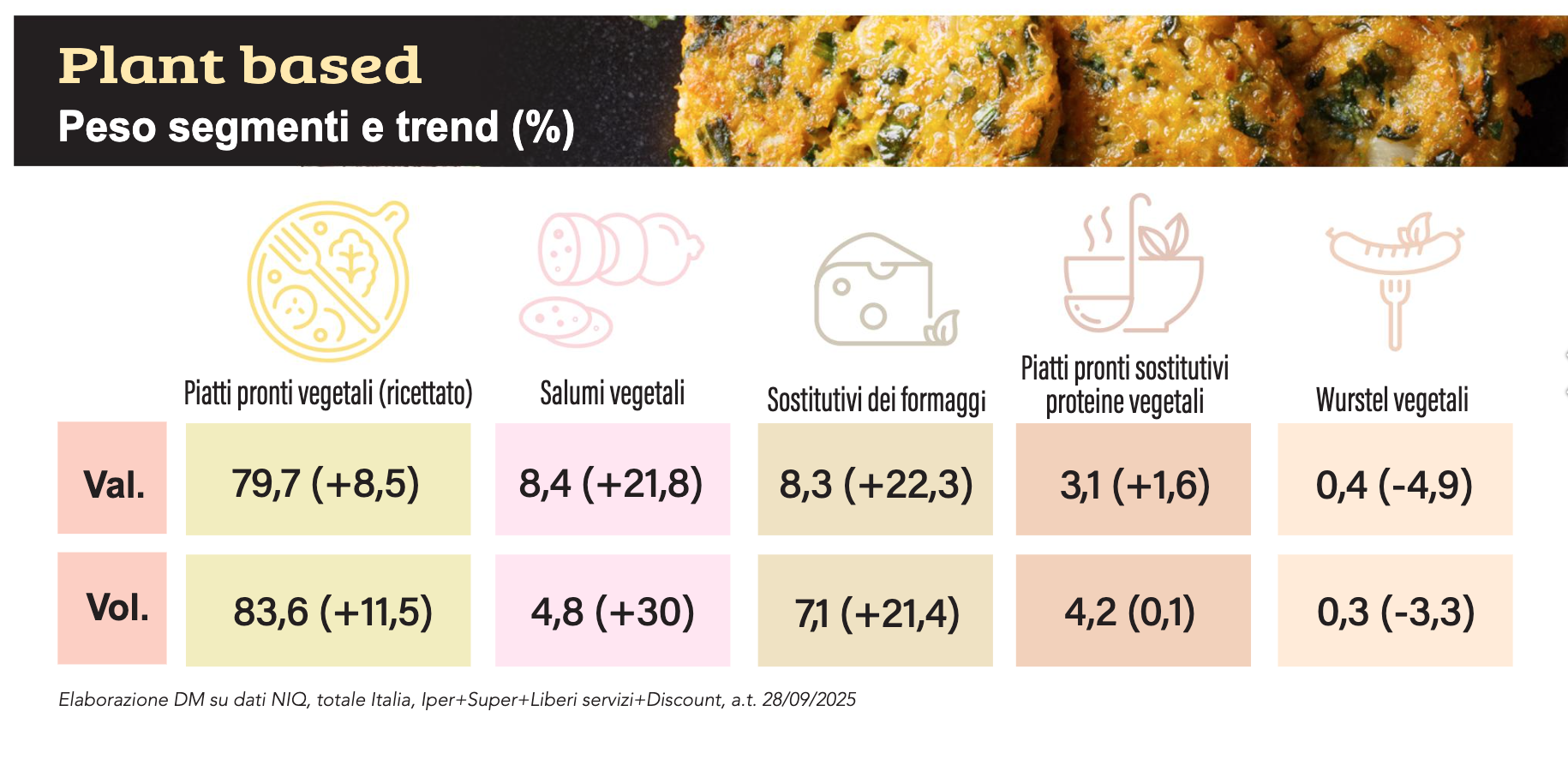 volume). The negative trend in meatballs is attributable to a decline in the number of references.” The second segment by value share (8,4%) is that of plant-based cold cuts, which shows growth trends in value and volume, respectively amounting to +21,8% and +30%. These performances are mainly due to a reduction in the average price (-6,3%). Next come cheese substitutes, with a value share of 8,3%. This segment recorded an increase in value sales of 22,3% and in volume sales of 21,4%. The average price per kilo is increasing (+0,7%), but promotional activity is also growing. The fourth segment by value share (3,1%) is that of ready meals substituting animal proteins. Among its constituent subsegments, the main one is ready meals substituting animal proteins, but the new subsegment of prepared ready meals substituting animal proteins is growing strongly. The former is declining due to a decrease in the number of references (-2,9% compared with the previous year), while the prepared products saw a 6,3% increase in the number of references and a decrease in the average price per kilo. Bringing up the rear are wurstel, with a value share of the total of 0,4%. These recorded a decline in value sales of 4,9% and in volume sales of 3,3%, with a decrease in the price per kilo and a slight increase in promotional activity.
A vegetable range to drink
Plant-based beverages require separate consideration. They are by far the most important category in the plant-based sector, with total turnover of 329,9 million euros, corresponding to 162,6 million litres. For these products too, NIQ data for the year ending 28 September 2025 show a positive performance, with growth of 4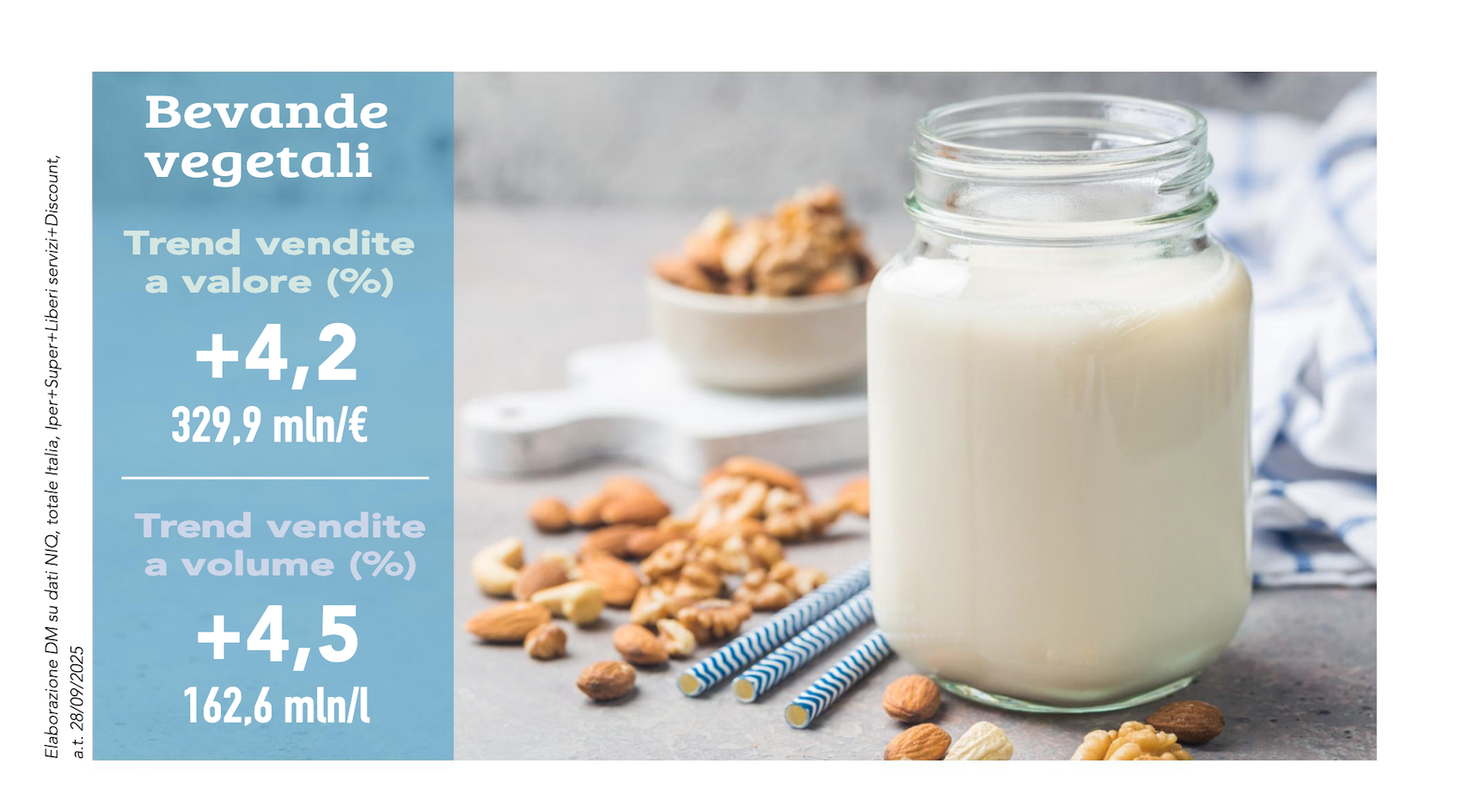 ,2% in value and 4,5% in volume. The currently most important segment is oat-based products, which account for 34,1% in value, followed by soy-based references, with 28,1%. In third place is almond-based (19,2%), while the final two are rice (11,8%) and, lastly, coconut (5,4%). A residual share (1,4% in value) is represented by the “other” category. As for trends, the products that achieved the greatest success over the past year were oat-based products, whose value sales grew by 15,2%. Soy, on the other hand, performed negatively, recording -2,1%. Almond and coconut also grew, while sales of rice-based products declined.
Read more about DM Magazine November 2025
This article was translated from the original Italian version with the assistance of artificial intelligence. In case of discrepancies, please refer to the original Italian version.