Betting in bars and tobacconists: when gambling becomes a service offered by the business
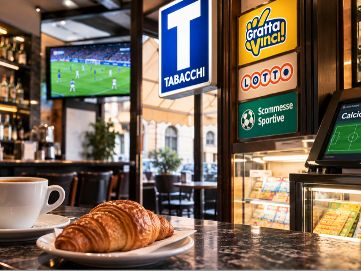
Betting in bars and tobacconists: when gambling becomes a service offered by the business
- Information
In addition to their main income from tobacco and food, tobacconists and bars can complement the sale of products with services relating to regulated gambling, ranging from scratchcards and lotteries to the classic gaming machines found in bars.
football betting accounts for part of this offering and sees increased activity particularly during major sporting competitions. From a distribution perspective, however, the most significant factor is the extensive reach of the network: the first Report on the public gaming sector, submitted by the Ministry of Economy and Finance to Parliament in April 2026, recorded almost 10.000 authorised physical betting outlets.
In this article, we will examine this phenomenon, seeking to understand its figures, economic impact, and ethical and regulatory implications.
More than 4.000 corner outlets operate in Italy where betting is a secondary activity
According to the Report on the public gaming sector, at the end of 2025 concession holders had 3.424 rights relating to “shops”, where betting collection is the primary activity, and 4.180 rights for “corners”, where it is instead a secondary activity. These were joined by 2.270 outlets belonging to regularised network operators, for a total of 9.874 betting outlets.
It is precisely the category of corners that is of greatest interest to proximity retail. The model allows gaming collection to be incorporated into a business that retains another primary function, as may happen in a tobacconist or a public establishment.
Lotto and lotteries also use very extensive networks: as at 31 December 2025, ADM recorded 33.639 outlets for fixed-odds number games and approximately 52.500 points of sale for instant lotteries. Public gaming has therefore long used part of the existing commercial network as distribution infrastructure.
The physical channel remains relevant even though online accounts for most bets
According to ADM data, in 2025, 72,4% of fixed-odds sports betting on events other than horse races took place through the online channel. Online betting amounted to approximately 13,9 billion euros, compared with 5,28 billion through the physical network.
In 2025, both channels recorded a decline: betting through the physical network fell from 5,48 to 5,28 billion euros, while online betting fell from 14,35 to 13,91 billion. The physical channel therefore continues to represent a minority but significant share of total betting.
The extensive reach of the network also raises a location issue
The parliamentary report notes that, starting from 2013, Regions and Municipalities introduced numerous measures to limit the location of gaming outlets and their opening hours. The result, however, was a fragmented framework, with different rules depending on the territory.
The issue has also affected the renewal of concessions for physical betting collection. The original concessions expired in 2016 and were subsequently extended several times; the latest extension indicated in the Report sets their expiry date as 31 December 2026. The document also links this situation to the failure to define a uniform national framework concerning distances from sensitive locations and opening hours.
At the end of August 2026, however, the deadline for the tax delegation expired without the reorganisation of physical gaming having been completed. In September, a new extension of the concessions expiring at the end of the year was therefore under consideration.
Online-linked outlets also become part of the commercial network
The overlap between physical retail and digital gaming became even more evident with the regulation of Punti Vendita Ricariche, the so-called PVRs.
Legislative Decree 41/2024 provided for a specific Register for Punti Vendita Ricariche for businesses providing ancillary services on behalf of online concession holders. ADM specifies that these entities may also include retailers of state-monopoly goods and commercial establishments open to the public that hold the necessary authorisations.
The regulations nevertheless establish precise limits. The Report to Parliament defines PVRs as outlets intended exclusively for ancillary services and refers to obligations concerning financial traceability and anti-money laundering. Automatic equipment lacking systems to identify the player and verify that they are of legal age is also prohibited, as are forms of gaming intermediation by the business owner.
Betting in retail remains an activity subject to specific restrictions
Betting collection can therefore be added to the activities of a bar or tobacconist, but its inclusion in the outlet takes place within a concession system and cannot be equated with simply introducing a new commercial service.
The difference also emerges in terms of communication. Since 2019, Italian law has prohibited any form of advertising, including indirect advertising, relating to games and betting involving cash prizes. AGCOM identifies combating gambling disorder and protecting the most vulnerable consumers as the purposes of the measure.
For tobacconists and public establishments, the framework is therefore twofold. Corners form part of an established distribution network and can complement the outlet’s main activity; at the same time, their presence brings an activity subject to concessions, oversight, territorial restrictions and specific protective measures into proximity retail.
Gambling is prohibited for minors and can cause addiction. Information and support are available from the National Freephone Helpline for gambling-related problems of the Istituto Superiore di Sanità, 800 558822, an anonymous and free service.
This article was translated from the original Italian version with the assistance of artificial intelligence. In case of discrepancies, please refer to the original Italian version.