Spending: in 30 years, technology and leisure overtake food

Spending: in 30 years, technology and leisure overtake food
- Information
How have household consumption patterns changed over time? Confcommercio answers the question. A thirty-year period in Italy is reviewed.
However, the analysis released in August by the confederation’s Research Department contains many insights into 2007-2026, in other words, 20 years.
Real spending rises in 2026
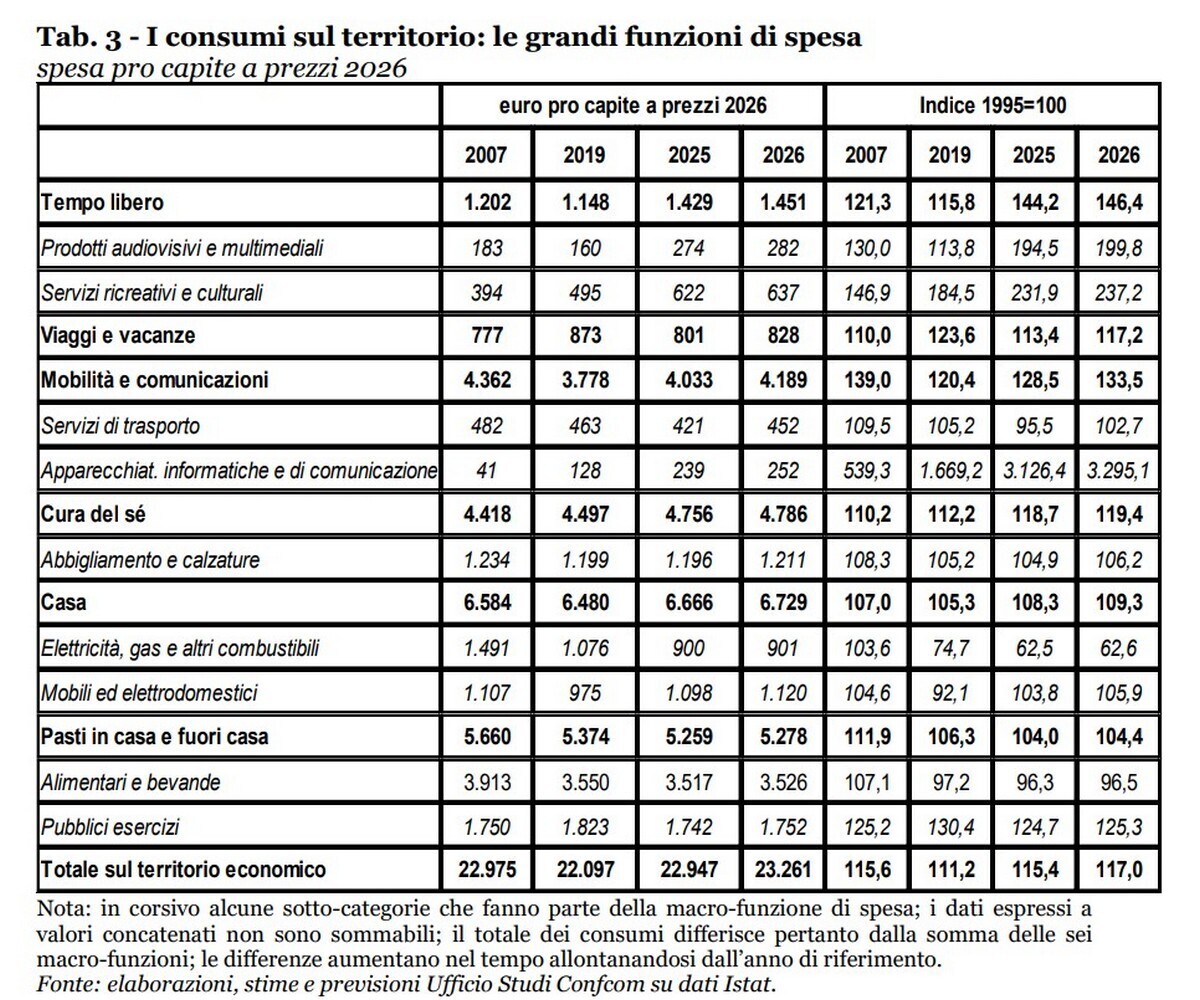
This year real per-capita spending on purchases reached 23.261 euros (it was 19.877 euros in 1995), with an increase of 314 euros compared with 2025, exceeding pre-Covid levels, but also the peak of 2007 (22.975 euros), which nevertheless coincided with the beginning of the global financial crisis.
This trend, also driven by the steady growth in employment and incomes, has nevertheless not enabled demand levels to be fully restored across all segments.
The surge in technology (IT and telecoms) and leisure-related services has led the long charge, with a “monstrous” change in per-person spending. Over 1995, 30 years, this amounts to a positive change of 3.200% in the two categories, ICT and technology in the broadest sense.
Over the same period, they rose, but considerably less, the cultural and recreational services: +137%.
Few other categories show structural signs of expansion: this is the case for catering (+25,3%) and spending on travel and holidays (+17,2%), which nevertheless have not yet returned to pre-pandemic averages.
Consumption sets material goods aside
By contrast, domestic food consumption is in slight decline (-3,5% over the past three decades), also due to highly complex demographic trends and the growth in meals eaten away from home.
Among the less dynamic categories, although still positive, clothing and footwear (+6,2%) remain confirmed, with demand now appearing more oriented towards garments with lower intrinsic value (fast fashion), as does the category of furniture and household goods (+5,9%).
A separate point concerns energy for household use (-37,4%), which is contracting significantly due to greater prudence, but also thanks to the growing use of technology-based energy-saving products and systems.
Real per-capita spending, after the decline recorded between 2007 and 2019, has in recent years embarked on a gradual recovery that should materialise in the first half of 2026.
This was encouraged, as mentioned, by the marked progress in employment: from the January low of 2021, the number of people employed in the production process has increased by more than 2,2 million.
In terms of the distribution of consumption, long-term analyses clearly highlight the progressive dematerialisation of household spending: fewer physical goods and more services.
Thus IT and telecommunications have risen from less than 8 euros per head in 1995 to 252 euros today, also thanks to the transformation of certain items (mobile phones and PCs) and their related functions into indispensable products and, for this reason, much more accessible ones.
Entertainment and culture: +240 euros per capita
The same applies to entertainment, leisure and holidays, which bring the estimated volume of purchases to 637 euros in 2026, compared with 394 euros in 2007 (+243 euros).
Even the increase in spending on housing, as property in which to invest (despite continuously rising prices), has not halted the growth in experiential consumption. Instead, it has accelerated a change in the cultural model, in which households choose to manage spending on material goods more rigorously (clothing, food and furnishings) in order to continue financing travel, catering and culture, as well as many other opportunities related to work, leisure and socialising.
Also read the Confcommercio-Swg survey on the growth of cultural consumption, updated to 2026
This article was translated from the original Italian version with the assistance of artificial intelligence. In case of discrepancies, please refer to the original Italian version.