Perlen Papier launches the innovative paper fibre-based bottle on the Italian market
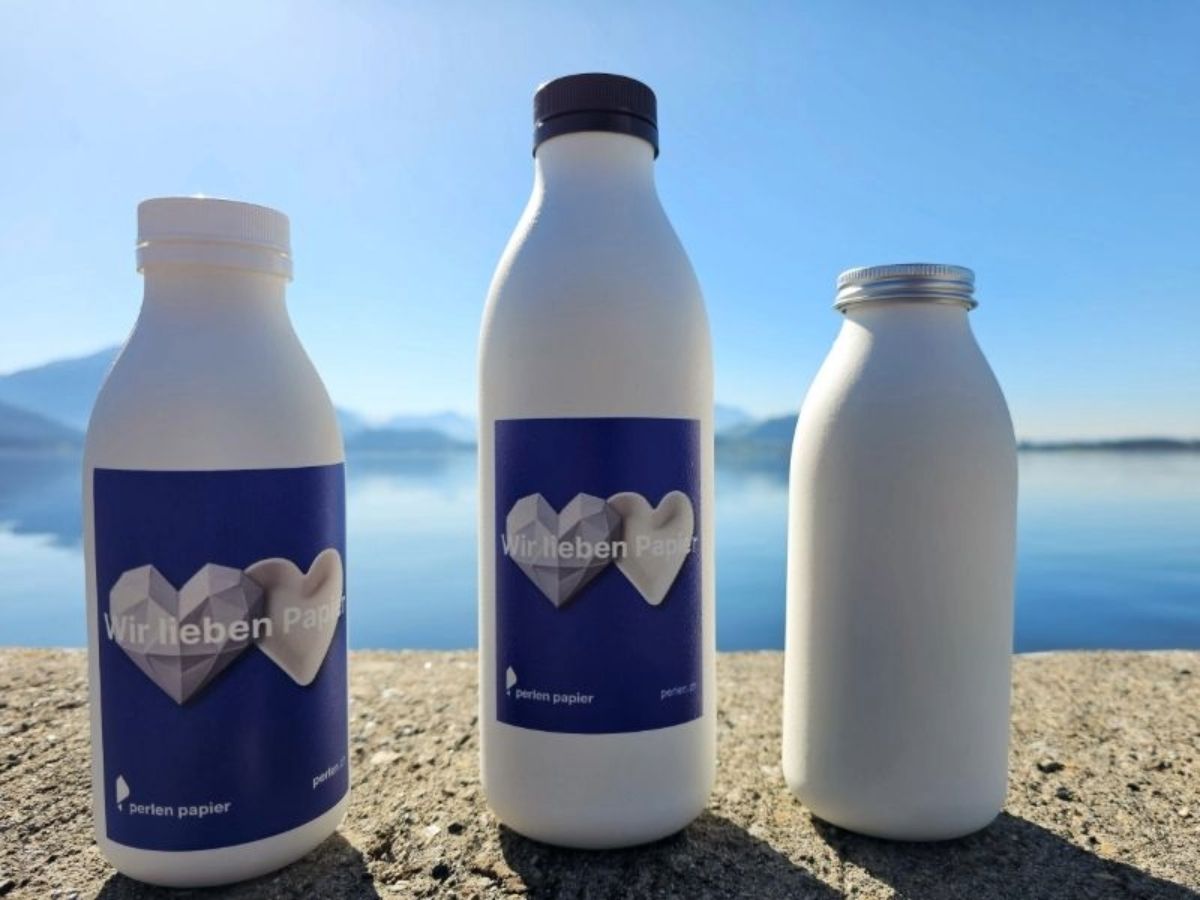
Perlen Papier launches the innovative paper fibre-based bottle on the Italian market
- Information
Perlen Papier has introduced a new generation of paper fibre-based bottles developed by British packaging technology company Pulpex on the Italian market.
The features
This innovative packaging solution, made from moulded paper fibres, combines the functionality of a bottle with the advantages of a recyclable fibre-based material. Lightweight, strong and waterproof, it represents an alternative to traditional glass and plastic packaging for brand owners and bottlers.
The fibre bottles are suitable for a wide range of products: from water and other non-carbonated beverages to food products such as dairy products and oils, as well as wine and spirits, plus cosmetics and personal care products. A food-contact-approved, odourless barrier protects the contents from moisture and oxygen and, depending on the product and closure system, enables a shelf life of more than 24 months. The bottle is also waterproof and can be used both for refrigerated storage and in environments such as bathrooms.
The bottle body is made in a single piece through a process of wet moulding of cellulose fibres and is subsequently dried. The inside is then coated with a thin, food-contact-approved, plastic-free barrier layer. No adhesives are used during production. The fibres used come from certified forests managed sustainably or from recycled paper.
Patented technology and recyclability
The fibre bottle is based on the patented fibre moulding technology developed by Pulpex and recognised internationally. Perlen Industrieholding AG, together with its subsidiary Perlen Papier, holds the exclusive production rights for Switzerland, Austria, Italy and southern Germany. One of the key advantages of Pulpex technology is its recyclability: according to Cepi's 4evergreen test method (Confederation of European Paper Industries), the bottle can be recycled through current paper recovery streams. This solution meets the growing demand from brands and consumers for sustainable and recyclable packaging.
The low weight also offers significant advantages in terms of carbon footprint and logistics. Calculated according to the “cradle-to-gate” criterion, the carbon footprint of the fibre bottle is approximately 90% lower than that of an equivalent glass bottle and approximately 30% lower than that of a PET bottle. Its significantly lower weight compared with glass can also help reduce transport requirements and logistics costs.
Customised designs
Standard formats of 300, 500 and 750 ml are currently available. Further range expansions will make it possible to offer capacities between 200 and 1.000 ml in the future. The fibre moulding process also makes it possible to create custom shapes and distinctive designs for brands. Surfaces and decorations can be customised using in-line digital printing or labelling. The bottles are compatible with standard filling processes and can generally be integrated into existing bottling infrastructure.
The Pulpex solution thus combines the requirements of large-scale industrial production with the opportunities for packaging customisation and the benefits of a recyclable fibre-based material. For the Italian market, this innovative fibre bottle also represents the next step in a long-established collaboration. For decades, paper produced in Perlen has reached Italian newspapers, magazines and readers. Today, the same expertise is being applied to a new generation of sustainable packaging solutions.
The comment
Florian Geiger, ceo of Perlen Papier AG and Perlen Industrieholding Ag, says: “For Italian brand owners and bottlers, sustainable packaging is no longer merely an added value: it must go hand in hand with product protection, process reliability and economic viability. It is precisely in response to these requirements that the fibre bottle was designed: it is lightweight, recyclable, high-performing and can be integrated into existing bottling processes. With the planned production facility in Switzerland, we are also building a short supply chain to one of Europe's most important industrial markets and in the future will be able to serve customers, particularly those in Italy, directly from the region.”
This article was translated from the original Italian version with the assistance of artificial intelligence. In case of discrepancies, please refer to the original Italian version.