Dairy products: functional products drive a recovery in value
Dairy products: functional products drive a recovery in value
- Information
From lactose-free products and smaller pack sizes to highly digestible options, companies are responding to new demands for wellbeing and conscious consumption.
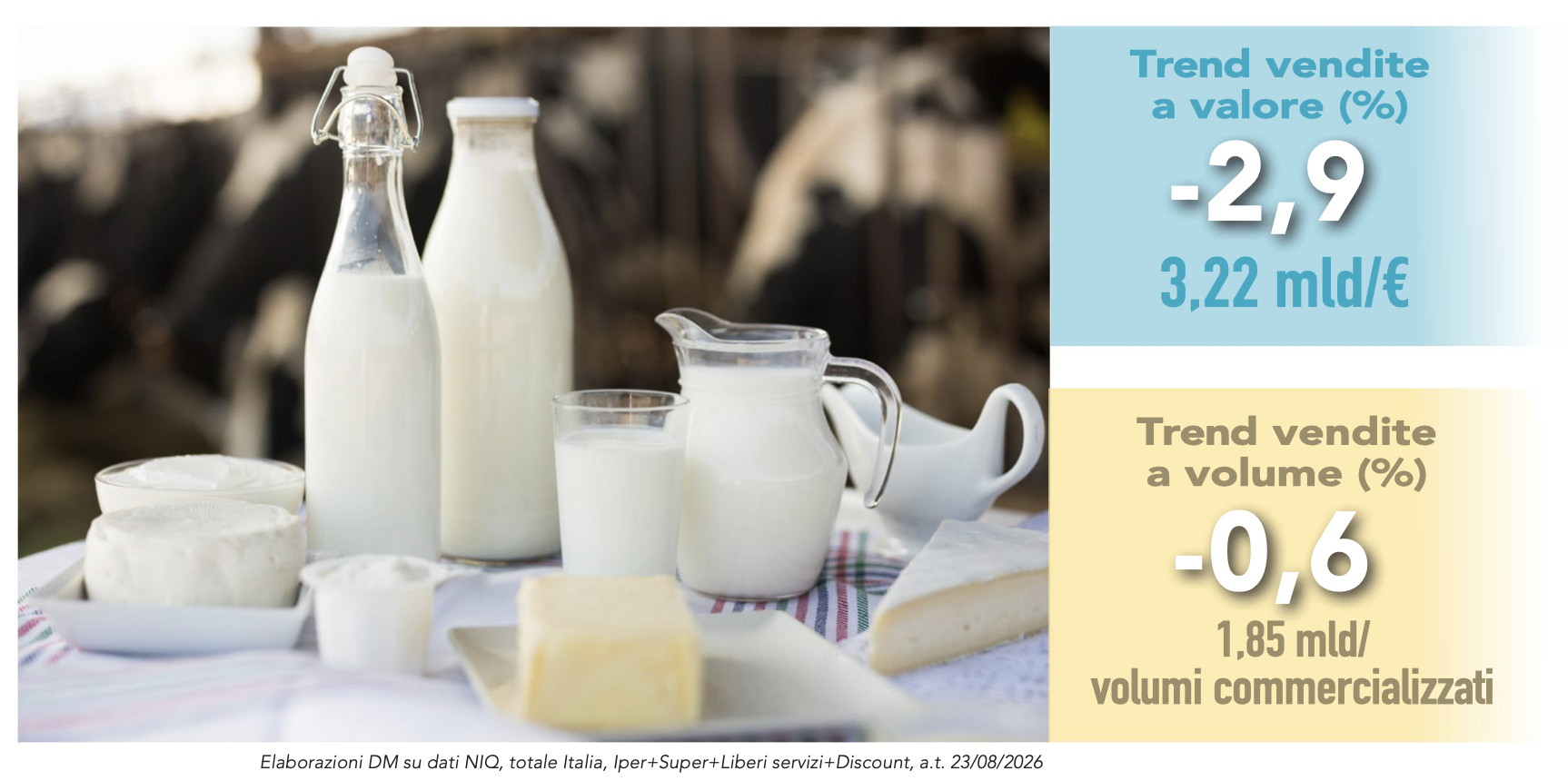 In the year ending 23 August 2026, the dairy products market reached a turnover of almost 3,22 billion euros and 1,85 billion in sales volume. Following the growth recorded in the previous year (+1,9%), the market showed a contraction of 2,9% in value, accompanied by a less marked decline in volume (-0,6%). The average price per kg also fell by 2,3%, reversing the trend observed in the previous period (+4,4%), while promotional intensity stood at 26,5%, up 2,7% (NIQ data, total Italy, Hypermarkets+Supermarkets+Traditional stores+Discount stores).
Geographical areas and distribution channels
“Area 1 remains the category’s leading geographical area, accounting for 28,3% of national turnover,” comments Filippo Morlini of NIQ. “However, its performance is distinctly poor, with a decline of 2,8% in value, but a more limited one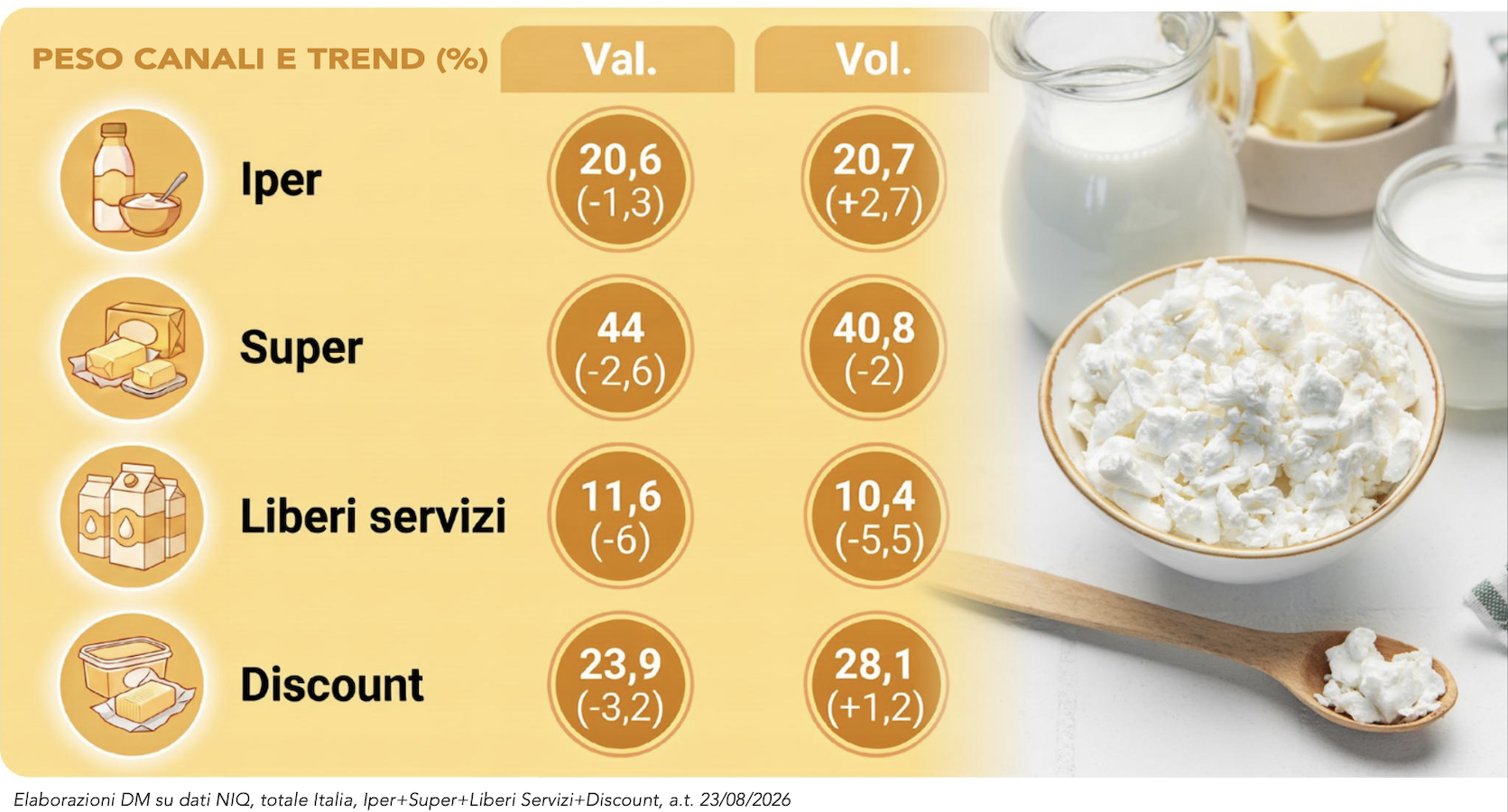 in volume (-0,7%). Area 2 is the smallest market, accounting for just 21,6% of total turnover. Its value decline is more pronounced than in the other areas (-3,3%), but it is the only geographical area to record volume growth (+0,6%); this is due to a more significant fall in the average price (-3,9%). Area 3, which accounts for 25% of the market, follows a similar pattern to Area 1, with declines of 2,3% in value and 0,9% in volume. Area 4 (25,1% of turnover) is no exception to this trend: it sees a sharper decline of 3,3% in value and 1% in volume, recording the worst performance among the geographical areas.” Modern distribution (Hypermarkets+Supermarkets+Traditional stores), which accounts for 76,1% of total turnover, shows a negative trend both in value (-2,8%) and in volume (-1,2%). Looking at the individual channels, supermarkets remain the category’s main sales channel, accounting for 44% of turnover, followed by hypermarkets (20,6%). Both channels show a decline in value, of 2,6% and 1,3% respectively, while hypermarkets record marked volume growth (+2,7%), accompanied by a 3,9% fall in the average price per volume. Traditional stores, by contrast, perform less strongly (11,6% of turnover), with declines both in value (-6%) and volume (-5,5%). Discount stores, accounting for 23,9 of sales locations, show a similar trend to hypermarkets: volumes grow by 1,2%, while turnover falls by 3,2%, alongside a reduction in the average price of 4,4%. Volume growth is therefore seen only in channels where the average price has fallen more sharply.
Segment trends
The dairy products market is made up mainly of six segments: UHT milk (48,7%), fresh milk (22%), butter (15,8%), UHT cream (8,8%), fresh cream (2,5%) and béchamel sauces (2,1%). “UHT milk,” explains Filippo Morlini, “is the category’s largest segment, with a turnover of around 1,57 billion euros. Despite its central role, it records a decline of 2,3% in value, while volumes are broadly stable (+0,1%). Within the segment, highly digestible/lactose-free UHT milk stands out, growing by 1,4% in value and 2,7% in volume, while semi-skimmed UHT milk, the segment’s main component, shows a value decline of 4,4%.” Fresh milk, the second-largest segment with turnover of 708 million euros, records a decline of 2,9% in value and 3,2% in volume. Among the main sub-segments, 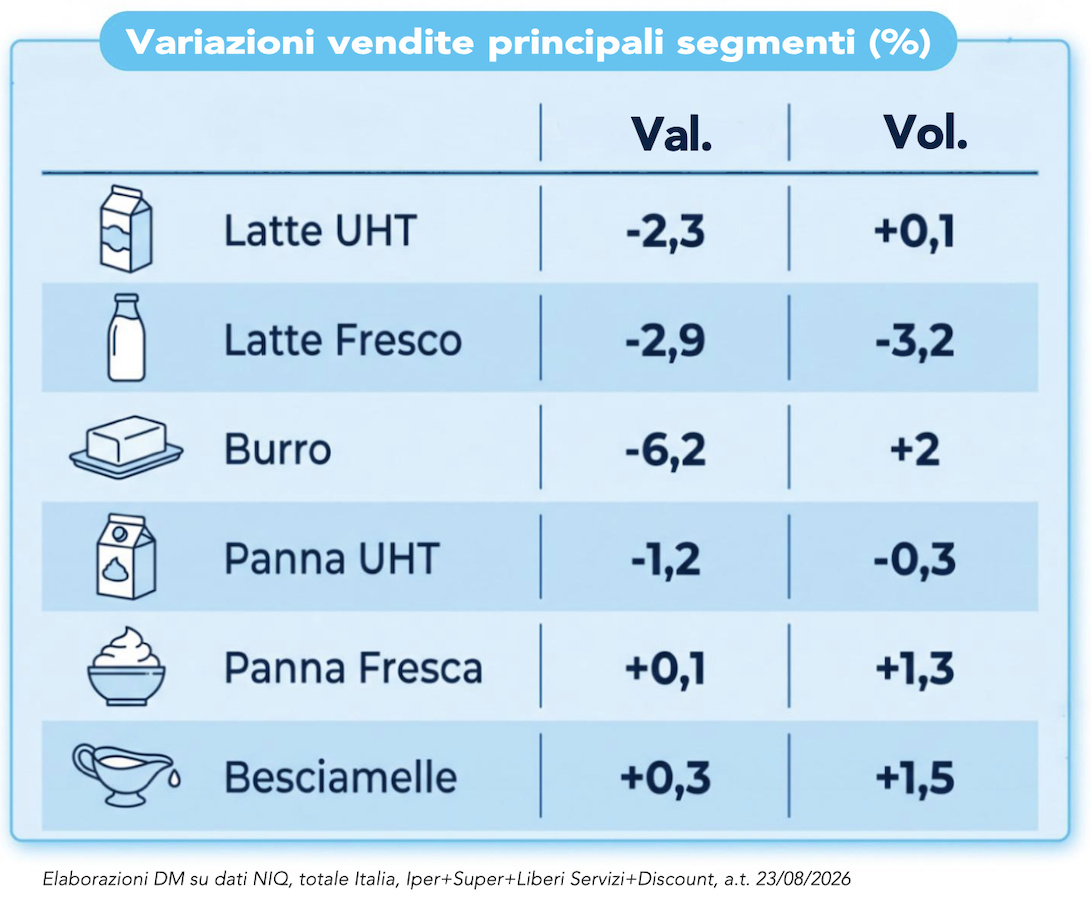 strong performance is seen for highly digestible cow’s fresh milk, which grows by 17,1% in value and 17,4% in volume, while high-quality fresh milk (-4,2%) and semi-skimmed fresh milk (-4,7%) are in decline. “Butter,” continues the NIQ analyst, “is one of the category’s weakest-performing segments; turnover falls by -6,2%, while volumes are growing (+2%). The decline mainly affects regular butter (-6,8% in value), the segment’s main component, while light/lactose-free butter limits the losses (-2,2%). However, almost all sub-segments are growing in volume, and this growth is attributable to a substantial fall in price. The price of the segment as a whole has fallen by 8,1%, that of regular butter by 8,8%, and that of light/lactose-free butter by 6%. The butter sub-segments that do not show this pattern also record the weakest volume performance.” UHT cream, meanwhile, records turnover of 284,7 million euros and a value change of -1,2%, while volumes are more stable (-0,3%). Cooking cream, which accounts for the largest share of the segment, shows declines of 2% in value and 1,1% in volume. Fresh cream sales are broadly in line with the previous year (+0,1% in value), with volumes growing (+1,3%). ESL fresh cream records value growth of 5,7%, while traditional liquid cream falls by 3,4%. Lactose-free fresh cream is also growing (+7,7% in value). A similar trend can also be seen in the béchamel sauce segment: the market is virtually stable in value (+0,3%) and grows by 1,5% in volume. Growth in the segment is driven by the sub-segment of lactose-free béchamel sauce (+17,7% in value) and plant-based varieties (+10%), while regular béchamel sauce records a decline of 2,4%.
Read more in DM Magazine November 2026
This article was translated from the original version in Italian with the assistance of artificial intelligence. In case of discrepancies, please refer to the original version in Italian.