Ivsi launches the “Buoni a Sapersi” campaign to promote accurate information about cured meats
Ivsi launches the “Buoni a Sapersi” campaign to promote accurate information about cured meats
- Information
Ivsi – Institute for the Promotion of Italian Cured Meats has launched, with the support of Assica – Association of Meat and Cured Meat Industries, the “Buoni a Sapersi” campaign at the heart of which is theIvsi Observatory, dedicated to monitoring consumer perceptions and promoting scientifically accurate information.
The Ivsi Observatory
The Observatory is the result of two research activities carried out with the support of the research organisation AstraRicerche, which involved more than 1.200 Italians aged between 18 and 70 years in June, and Extreme, a company specialising in the strategic analysis of online and social conversations and data intelligence, which analysed more than 10.000 pieces of content published online between November 2025 and May 2026.
The Buoni a Sapersi campaign will also have a website dedicated to it, hosting the Observatory’s data and offering useful insights and information on cured meats and nutrition, as well as content aimed at debunking false myths and excessive simplifications that still persist regarding products in this sector. The campaign will also involve social media and several professionals and creators specialising in nutrition and science communication.
Consumers are increasingly attentive, but still poorly informed
The results paint a clear picture: Italians continue to consume cured meats, but want more in-depth and verifiable information about their nutritional profile and their impact on health.
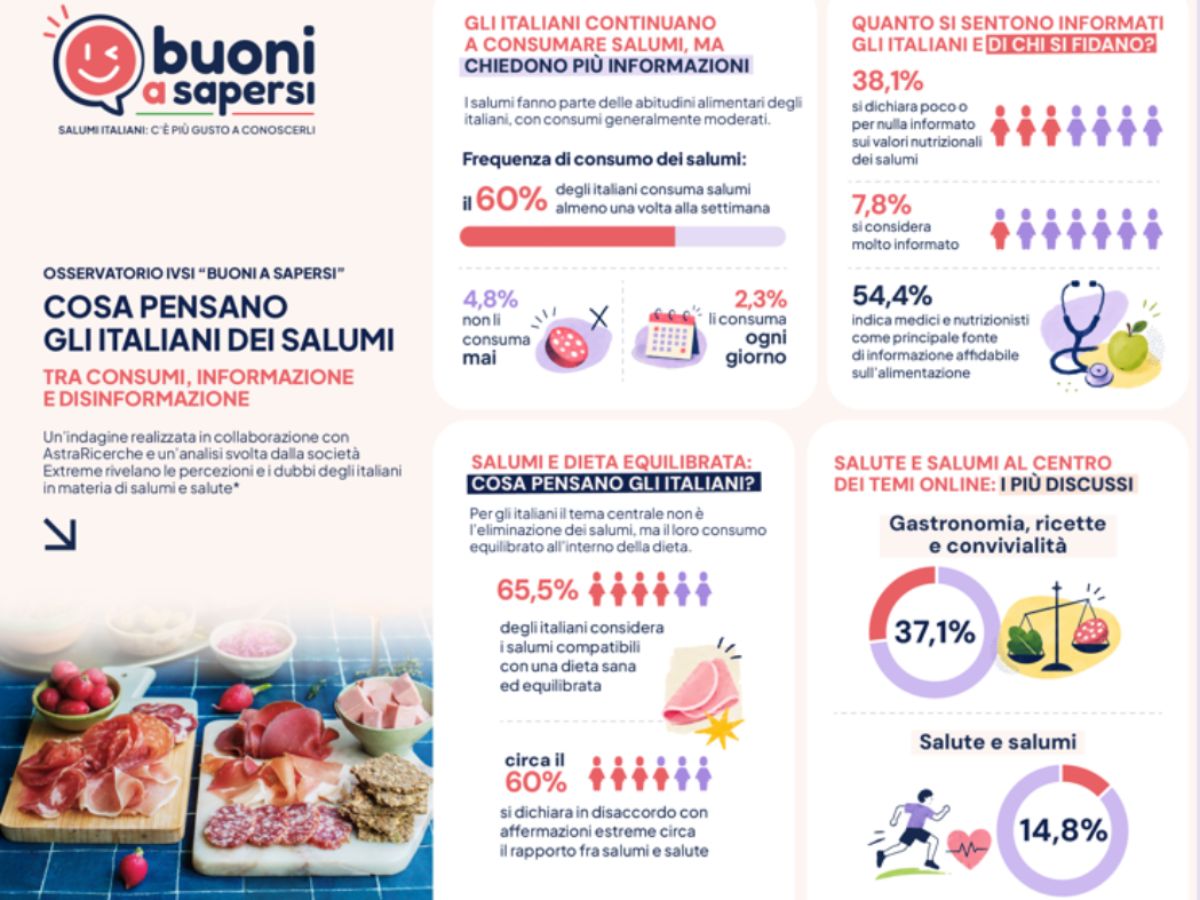
More than 60% of those surveyed say that they consume cured meats at least once a week, while only 4,8% never consume them. Daily consumption remains marginal (2,3%), confirming that these products have a stable, but generally moderate, presence in the country’s eating habits.
Nevertheless, 38,1% of Italians say they feel poorly or not at all informed about the nutritional values of cured meats, while only 7,8% consider themselves very well informed. Several factors also concern Italians: the main concerns relate to the presence of preservatives and additives (40,1%), the impact on health (37,3%) and the origin of the meat (26,2%).
“The data presented above are highly significant: they point to a real need for guidance. Italians continue to consume cured meats, but want to better understand what they are putting on their plates, how to read the label, what differences exist between products and how to incorporate them properly into their diet. This highlights an important responsibility for those working in nutrition: to provide simple, verifiable and contextualised information, without reducing the issue to reassurance or alarm. The main concerns that emerged from the survey are very clear: consumers want to know not only whether a product tastes good, but also whether it is safe, where it comes from, how it was produced and what role it can play in their diet. These questions should not be answered with simplifications, but with transparency: explaining the functions of ingredients, the regulation of processes, the quality of the supply chain and, above all, the concepts of portion size, frequency and dietary context. We need to provide answers explaining that the additives listed in the ingredients have specific functions and that production processes are subject to rules and controls. Salt, spices and any additional preservatives or antioxidants should be understood as components that may contribute to preservation, microbiological safety, stability and the sensory quality of the product, always in compliance with regulations and with declaration on the label. At the same time, for accurate nutritional information, it is essential to talk about portion size, frequency and context: a cured meat consumed in moderate quantities, not every day, and included in a meal rich in vegetables, fruit, whole grains or pulses has a very different significance from frequent, abundant and isolated consumption,” says Elisabetta Bernardi, specialist in Food Science, biologist and nutritionist.
Fake news and excessive simplifications fuel doubts and confusion
One of the most significant findings concerned the perception of misinformation: according to the survey conducted by AstraRicerche, a number of beliefs are considered excessive by significant proportions of respondents. In particular, 36,2% consider the claim that all cured meats are rich in preservatives to be exaggerated, 31,2% consider the idea that they can cause cancer excessive, while 26,6% do not share the belief that they cannot be part of a healthy and balanced diet.
Only 15,3% of Italians believe that, in reality, there are no excessive simplifications or fake news.
Even when faced with one of the most radical claims – “cured meats are carcinogenic and should be avoided completely”, which takes the inclusion of cured meats in Group 1 of the WHO/IARC classification to an extreme – almost 60% of those surveyed say they disagree, signalling a generally balanced approach that is less inclined towards extremes; 31,9% of those surveyed agree with this position.
It is important to stress that the term “carcinogenic” is often perceived by the public as synonymous with absolute danger, whereas in science it simply indicates the presence of evidence linking a given factor to an increased risk of developing certain forms of cancer. In the case of cured meats and, more generally, processed meats, the available scientific evidence indicates that frequent and high consumption may be associated with an increase in relative risk of certain cancers.
However, this finding must be interpreted within a broader framework that includes the quantities consumed, frequency of intake, lifestyle, physical activity and the overall quality of the diet. For this reason, nutritional recommendations do not call for the complete elimination of cured meats, but rather moderate consumption consistent with a varied and balanced diet.
The central principle is therefore moderation, which does not mean giving up: promoting balance, variety and conviviality at the table remains the most effective way to build healthy and lasting habits.
A further significant finding from the survey conducted by AstraRicerche concerns the relationship between cured meats and a balanced diet. Despite the debate often being polarised, 65,5% of Italians consider cured meats compatible with a healthy and balanced diet.
Dr Bernardi comments: “The fact that 36,2% of respondents consider the idea that all cured meats are rich in preservatives exaggerated highlights consumers’ growing ability to distinguish between accurate information and generalisations. Not all cured meats have the same characteristics and, when present, preservatives and additives are regulated, declared on the label and used for specific safety and preservation purposes. A more balanced view also emerges regarding cancer risk: 31,2% consider the claim that cured meats can cause cancer excessive and almost 60% do not share the idea that they are foods to be avoided completely. This reflects greater attention to scientific evidence, which associates the increased risk mainly with high and habitual consumption of processed meats. Nutritional prevention, however, does not consist solely of reducing certain foods, but of building an overall balanced dietary pattern. In the case of colorectal cancer, for example, in addition to limiting excesses, it is important to ensure an adequate intake of fibre through vegetables, fruit, pulses and whole grains, foods that promote intestinal health and contribute to the quality of the diet. Adequate consumption of milk, yoghurt and dairy products may also play a beneficial role thanks to their calcium content. The most accurate message, therefore, is not simply ‘reduce’, but ‘build a better plate’.”.
Trust in authoritative sources and the demand for clarity
In an increasingly fragmented information ecosystem, Italians continue to recognise the value of qualified scientific sources.
For 54,4% of those surveyed, doctors and nutritionists are the main points of reference for obtaining reliable information on nutrition, confirming the need to make clear, accessible and evidence-based content available.
It is precisely from this need that the Observatory was created: a permanent tool for listening, monitoring and science communication, designed to collect consumers’ doubts and questions and provide data-based answers, encouraging transparent dialogue among citizens, health professionals, the media and the business community.
Cooked ham: the “reassuring cured meat”
Versatile and deeply rooted in Italians’ eating habits, cooked ham has a bond with consumers that goes far beyond simply being used today: it is a familiar presence whose roots lie in childhood. For more than a third of the sample surveyed (36,3%), in fact, cooked ham is the first cured meat to resurface in their memories, while for 59% it is still the star of sandwiches and toast. A bond that goes beyond simple consumption and evokes memory, everyday life and conviviality.
Despite the return to public debate of issues related to health and the aforementioned WHO/IARC classification of processed meats, consumption habits have remained substantially stable: 58,7% of Italians say that they have not changed their consumption of cooked ham over the past year, while 17,8% have increased it.
Perceptions of the product remain predominantly positive. For 58,7% of those surveyed, cooked ham is generally a healthy food, like other cured meats, while 31,6% consider it even healthier than others. Only 9,7% consider it less healthy.
The aspects most appreciated include its suitability for the whole family (49,5%), its compatibility with a balanced diet (42,2%), its digestibility (31,7%) and itsprotein content (31,2%).
This article was translated from the original Italian version with the assistance of artificial intelligence. In case of discrepancies, please refer to the original Italian version.