Agrintesa publishes its first sustainability report: members and the future of the supply chain at its heart
Agrintesa publishes its first sustainability report: members and the future of the supply chain at its heart
- Information
Agrintesa has presented its first sustainability report, for the financial year 2025-2026: a document that captures the cooperative’s environmental, social and governance performance.
The process
The first sustainability report was developed over more than 45 meetings involving 17 company departments. Alongside the work of collecting and analysing data, stakeholders were consulted, with hundreds of questionnaires collected from members, employees, customers and suppliers.
“The aim was not simply to describe what we do, but to build a reliable data base from which to assess results, identify areas for improvement and guide future decisions,” explains Cristian Moretti, Managing Director of Agrintesa. “Our stakeholders, starting with our members, contributed directly to defining priorities through what is known as a materiality analysis. In essence, we asked those who work with or engage with Agrintesa to indicate which ESG topics they consider most important for the cooperative’s sustainability. This exchange enabled us to identify 12 significant areas, ranging from remuneration for members to climate change, from food quality and safety to water and energy management, from workers’ health to generational renewal, and including research, innovation, and matters related to ethics and risk management.”
The work continued with a second in-depth study, the so-called double materiality analysis, which makes it possible to examine each of these topics from two complementary perspectives: assessing the effects of the cooperative’s activities on people, the environment and local areas, and considering how the same topics may affect Agrintesa’s financial soundness, costs, risks and development opportunities.
“This analysis helps us understand not only what impact we have on the world around us, but also how major economic, environmental and social changes could affect Agrintesa’s future,” Moretti continues. “Four topics emerged as significant from both perspectives: fair remuneration for members, climate change and resilience, ethics and reputation, and relations with members and local communities. These results offer valuable guidance for shaping our work over the coming years: we will continue to address all 12 topics identified, but the analysis helps us understand where to focus resources, attention and further investigation.”
Sustainability in figures
The report provides a detailed snapshot of Agrintesa’s activities, starting with its economic and mutualist dimension: in the financial year 2025-2026, the cooperative generated economic value of 446,4 million euros, distributing 56% to its members and 96% overall to its various stakeholders.
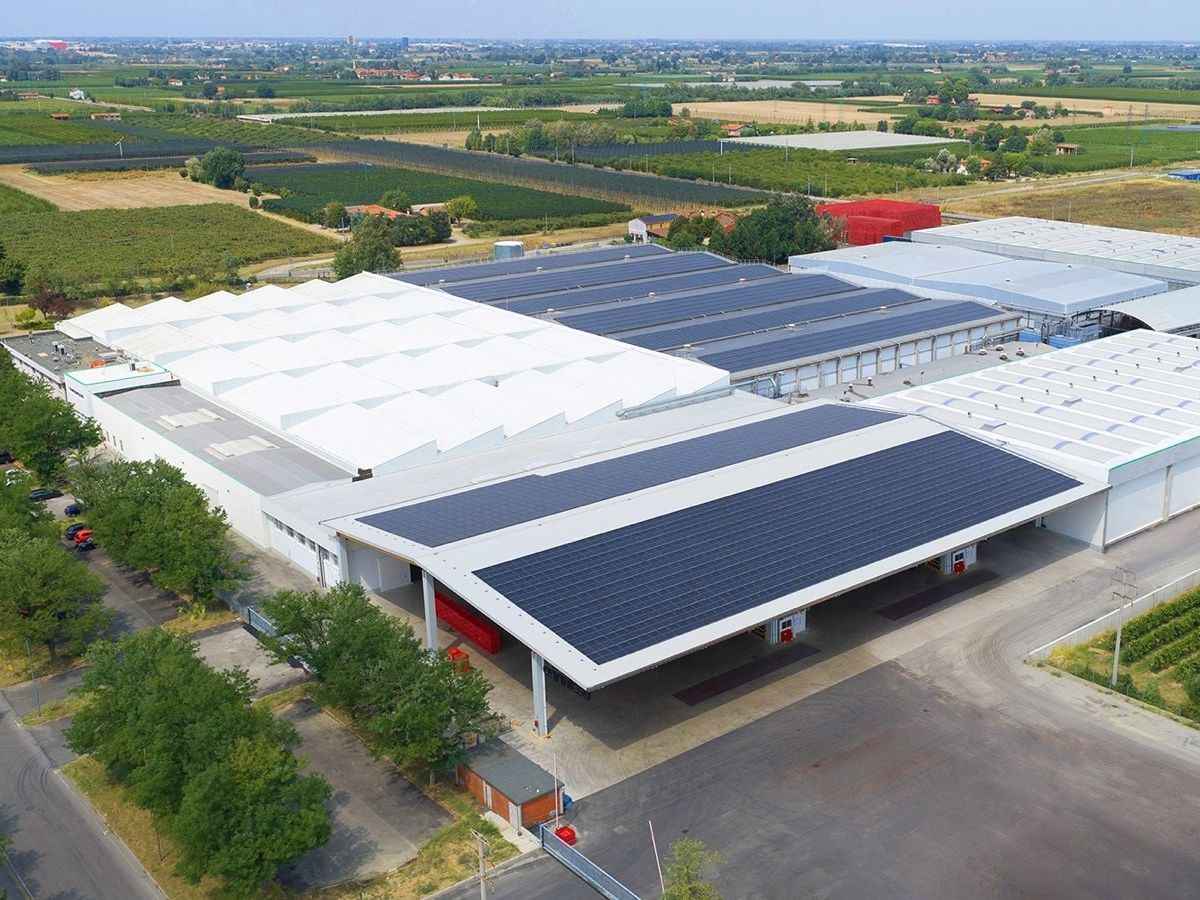
On the environmental front, the energy transition plays a leading role: since 2022, Agrintesa has invested more than 7,5 million euros in photovoltaic power and, during the reporting year, its plants produced 9,8 GWh of electricity, 73,4% of which was consumed on site. This work goes hand in hand with measures to improve the efficiency of production facilities, the gradual reduction of consumption and emissions monitoring. Attention to resource use also extends to the management of resources and waste: the report analyses water consumption at production sites, technological measures to improve efficiency, and the management of packaging and waste, noting that around 68% of the weight of packaging handled is attributable to reusable solutions and that no waste – out of the approximately 4.000 tonnes generated by Agrintesa each year – is sent for incineration or landfill.
Particular attention is also devoted to the circular economy and adding value to produce, with the aim of reducing waste and finding a useful destination for products that do not meet the requirements of the fresh produce market.
An important section is devoted to people. During the reporting period, 3.372 people worked at Agrintesa, with women accounting for 63,4%, an average age of 45,1 years and 56 nationalities represented. Commitment to skills development translated into 7.974 hours of training, through 152 courses, while initiatives continued to promote organisational wellbeing, listen to employees and support work-life balance (including programmes and arrangements to support parenthood and families).
The document also explores the role of varietal innovation, research and technical assistance in making farms more resilient, with specific focus areas covering technological and production investments, including the refurbished Castel Bolognese plant and new solutions for storing and processing kiwifruit.
The comment
“For Agrintesa, sustainability means creating the conditions that enable farms to continue producing, investing and looking to the future,” notes President Aristide Castellari. “The ability to add value to members’ work, support them with innovation and strengthen the competitiveness of their businesses is an integral part of our responsibility, as is caring for the environment, people and the areas in which we operate. We wanted to make this commitment increasingly clear and measurable, because a cooperative’s strength is also reflected in its ability to generate lasting value.”
This article was translated from the original version in Italian with the assistance of artificial intelligence. In case of discrepancies, please refer to the original version in Italian.