NIQ: 8,1 million families choose sustainability, but 8,6 million remain indifferent
NIQ: 8,1 million families choose sustainability, but 8,6 million remain indifferent
- Information
According to the third edition of the Conscious Shopping Observatory founded by NielsenIQ in collaboration with T-ool, a spin-off of the University of Parma, sustainability is now a widespread component of Italian consumers’ expectations, but not for everyone.
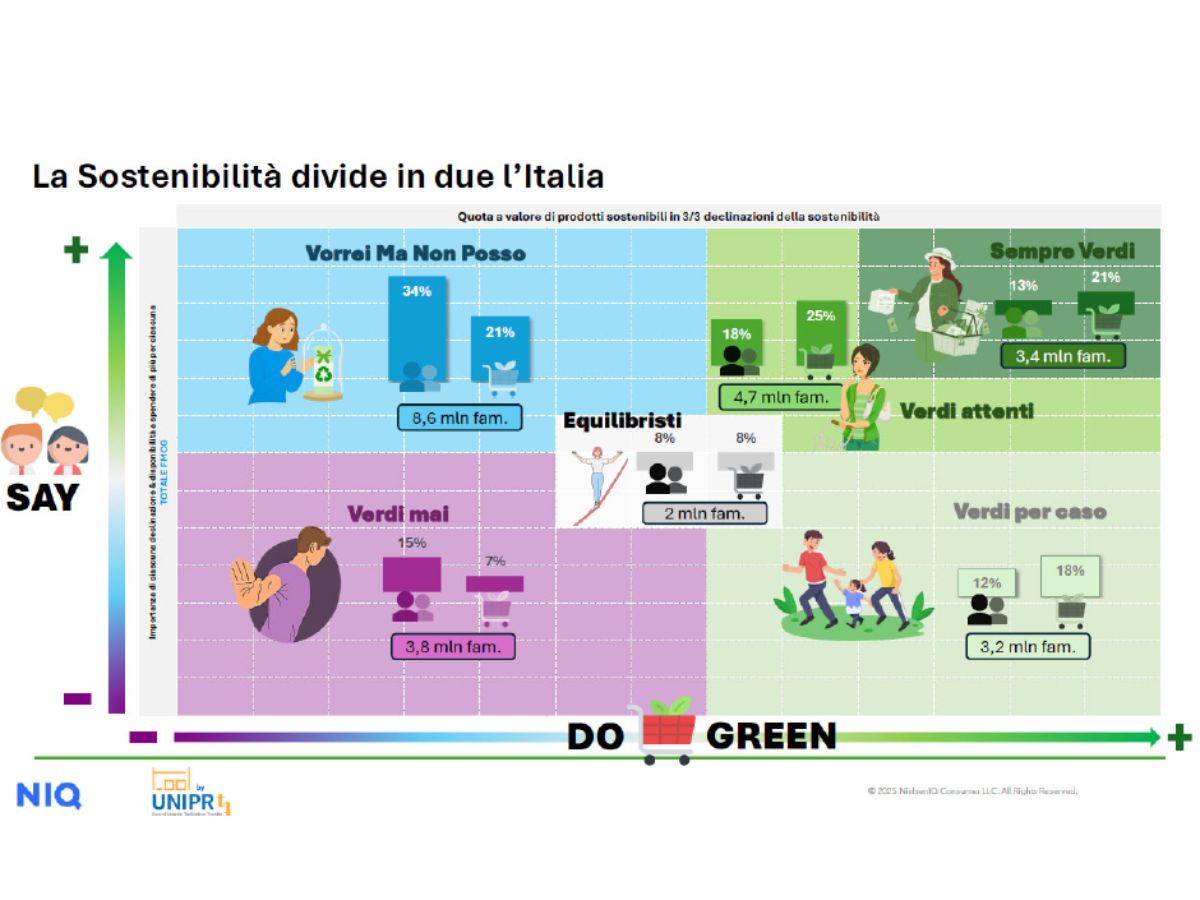
8,1 million families associate sensitivity to the issue with purchasing behaviours that are more sustainability-oriented: they represent 31% of families and have grown by two percentage points compared with 2025. Alongside them, 8,6 million households believe that sustainability is not particularly relevant, either at a declared level or in their purchasing behaviour.
Enzo Frasio, Chief Executive Officer of NielsenIQ Italy, says: “The Observatory is a powerful analytical tool that brings together the expertise of NielsenIQ, the University of Parma and T-ool. NielsenIQ combines consumer statements, through the Consumer Panel, with data on actual purchases captured by Retail Measurement, while T-ool, a spin-off of the University of Parma, contributes scientific expertise to the interpretation of market dynamics and their implications for commercial strategies. This allows us to distinguish between stated attitudes and actual purchasing choices, while analysing the role of prices, assortments and promotions and encouraging dialogue between industry, retail and institutions. The picture is completed by collaboration with leading partners such as Federdistribuzione, GS1 Italy, and Centromarca”.
Established demand and untapped potential
The study has outlined how families approach sustainability: the “Always Green” – the segment in which sustainability most consistently guides intentions and purchases – account for 13% of Italian families, equivalent to 3,4 million households, while the “Conscious Green” – characterised by a high level of sensitivity to the issue – account for 18%, around 4,7 million. The growth in the overall share shows how much ground environmental concerns have gained in consumer choices.
The largest group, however, remains the “Would Like To, But Can’t”: 34% of families, whose stated sensitivity is less reflected in their purchases. Its size highlights demand that is struggling to fully express itself: financial means, the ability to find products and understanding their benefits are becoming key issues for market development.
Stefano Cini, Commercial Director at NielsenIQ, says: “The ‘Always Green’ and ‘Conscious Green’ families represent real demand that businesses must address, while the ‘Would Like To, But Can’t’ show that there is room to make sustainability more accessible. For industry and retail, the challenge is to build offerings that combine recognisable benefits, quality and value for money, while tackling the barriers that influence choices at the shelf”.
Although fast-moving consumer goods are the first place to “put into practice” stated commitment – as indicated by 44% of consumers; sensitivity extends beyond supermarket aisles and embraces everyday habits: 88% use their washing machine and dishwasher with full loads, 69% wash at low temperatures and 61% reuse or repair items. Furthermore, 48% feel guilty when they do not buy sustainably despite being able to (+7 pp vs 2025).
Recognisable sustainability: the challenge for businesses
80% of Italians believe sustainability should not be a luxury for the few, while 73% struggle to identify genuinely sustainable products, despite an improvement of 12 percentage points on 2025. For businesses, making sustainability accessible therefore means combining prices that fit family budgets with clear and verifiable information. This need is addressed by EU Directive 2024/825, which provides for the application of national measures that prohibit generic claims such as “green” or “ecological” when benefits relating only to one component, such as packaging, are attributed to the entire product.
Bruno Aceto, CEO of GS1 Italy: “The transition towards more sustainable consumption models requires, first and foremost, reliable, transparent and verifiable information. Consumers’ ability to recognise the true environmental value of products is essential to guiding informed choices and highlighting businesses’ sustainable choices. In this process, shared standards and high-quality information are a strategic asset for strengthening trust throughout the supply chain”.
Quality and tangible benefits strengthen perceived value
Sustainability is increasingly associated with quality: one in two Italians consider sustainable food to be of higher quality than the alternatives (+7pp vs 2025). This correlation is also found in personal care (33%) and home care (24%). However, this concept takes on different meanings: for 38%, it means buying Italian or locally produced goods; for 28%, biodegradable or recycled packaging; and for 23%, production with limited emissions.
Davide Pellegrini, Professor of Marketing at the University of Parma, says: “With the Observatory, we did not limit ourselves to investigating environmental sustainability, and indeed discovered that it translates into three different dimensions: Good for Me, linked to individual well-being, with a willingness to pay more of 57%, stable compared with 2025; Good for Planet, focused on the environment, reaching 44% (+2 points); and Good for Society, relating to people and supply chains, reaching 49% (+4 points). Growing attention to the environmental and social dimensions shows how these expectations are evolving and represent a tangible opportunity for businesses. Integrating consumer and sales data makes it possible to understand what conditions can turn these expectations into purchases and where to invest to make the offering more relevant”.
Sales show the decisive role of the offering
Growing interest coexists with varied market results. In the year ending September 2026, Good for Me is worth 18,3 billion euros and is growing by 1%; Good for Society reaches 16,3 billion, with an increase of 0,2%. Good for Planet records 48,2 billion and a decline of 2,9%, while packaged fast-moving consumer goods are growing by 1,5%.
Filiera (+3%), rich in (+2,7%), free from (+2,2%) and organic (+1,5%) are growing. Products carrying packaging sustainability claims are down 3,4%, along with their distribution presence, down 5,3%: a result that calls for demand and product availability to be considered together.
Vittorio Cino, General Manager of Centromarca, observes: “The gap between stated sensitivity and actual purchases shows how important it is to understand the conditions that make sustainability relevant to everyday choices. People seek products that meet their needs, combining quality, effectiveness and sustainability with what they can afford. Branded manufacturers are committed to responding through research and innovation, translating improvements in environmental and social impacts into tangible, recognisable benefits. It is therefore essential to continue promoting clear communication, supported by verifiable evidence, to encourage informed choices and strengthen consumer trust”.
Carlo Alberto Buttarelli, President of Federdistribuzione, notes: “The aim is to achieve sustainability that is increasingly integrated into the strategies of the entire supply chain through closer collaboration between industry and retail. In the ecological transition, to achieve significant effects, existing demand must be supported, including by making products more accessible. Sustainability must be compatible with affordability; it must not remain a choice for the few but become widespread behaviour. At Federdistribuzione, we work to ensure that regulations, both at European and Italian level, move in this direction: a balanced regulatory framework that supports investment and innovation, safeguards businesses’ economic sustainability and facilitates change without adding bureaucratic burdens”.
This article was translated from the original version in Italian with the assistance of artificial intelligence. In case of discrepancies, please refer to the original version in Italian.