Ivsi presents the results of research into consumers’ perceptions of cured meats
Ivsi presents the results of research into consumers’ perceptions of cured meats
- Information
Ivsi-Istituto Valorizzazione Salumi Italiani, with the support of Assica-Associazione Industriali delle Carni e dei Salumi, is launching the information campaign Buoni a Sapersi, at the heart of which is the Ivsi Observatory, a project dedicated to monitoring consumer perceptions and online conversations about cured meats.
The aim is to promote accurate scientific information and counter excessive oversimplification and alarmism in an information landscape that is very often inaccurate and fragmented.
The Observatory stems from a two-part research project carried out with the support of the research organisation AstraRicerche, which involved more than 1.200 Italians aged between 18 and 70 in June, and Extreme, a company specialising in strategic analysis of online and social media conversations and data intelligence, which analysed more than 10.000 items published online between November 2025 and May 2026.
The Buoni a Sapersi campaign will also have a website featuring the Observatory’s data and offering insights and useful information on cured meats and nutrition, as well as content aimed at debunking myths and excessive oversimplifications that still persist about products in this sector. The campaign will also involve social media and a number of professionals and creators specialising in nutrition and science communication.
Consumers are increasingly attentive, but still poorly informed
The results reveal a clear picture: Italians continue to eat cured meats, but want more detailed and verifiable information about their nutritional profile and their impact on health.
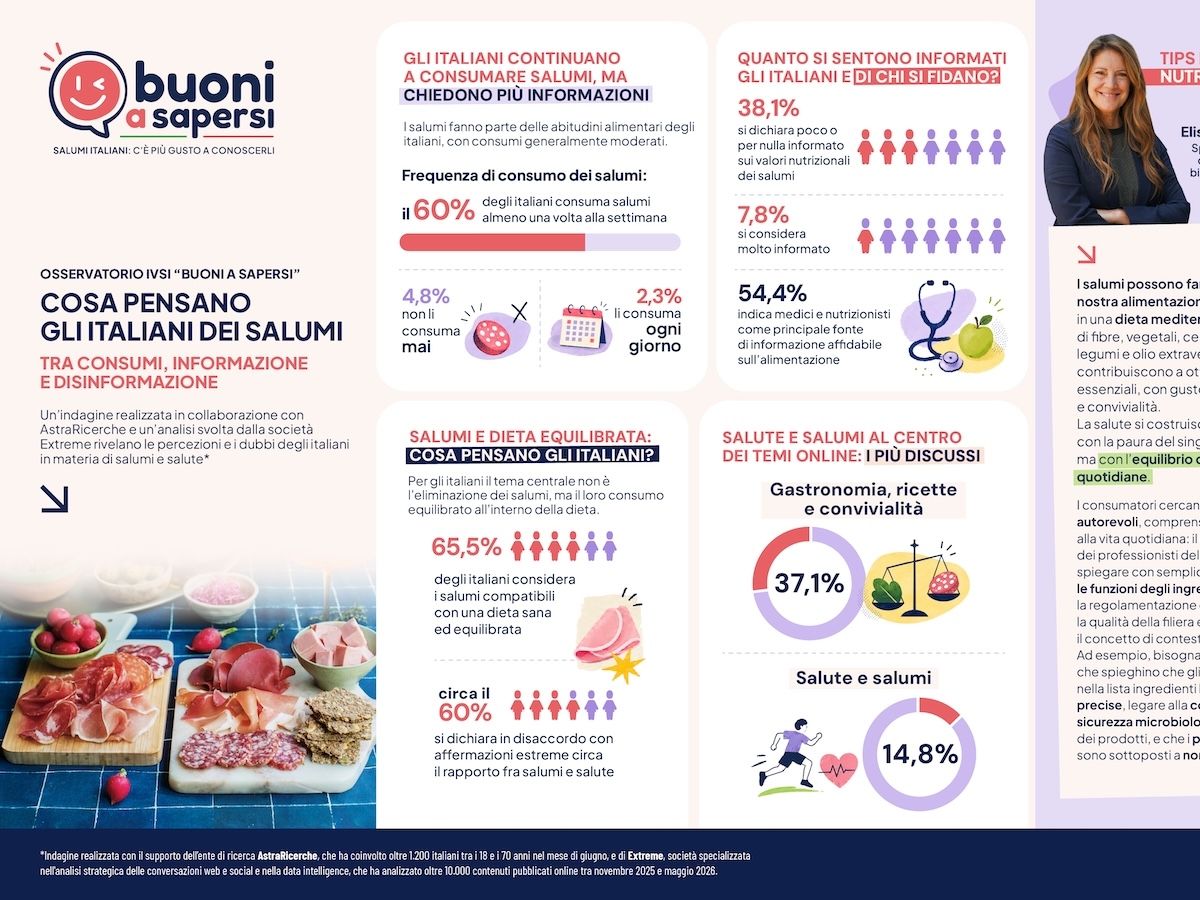
More than 60% of respondents say they eat cured meats at least once a week, while only 4,8% never eat them. Daily consumption remains marginal, however (2,3%), confirming that these products are a regular, but generally moderate, part of the country’s eating habits.
Despite this, 38,1% of Italians say they feel poorly or not at all informed about the nutritional values of cured meats, while just 7,8% consider themselves very well informed. Several factors also concern Italians: their main concerns relate to the presence of preservatives and additives (40,1%), the impact on health (37,3%) and the origin of the meat (26,2%).
Fake news and excessive oversimplification fuel doubts and confusion
One of the most significant findings concerns the perception of misinformation: according to the survey conducted by AstraRicerche, a substantial proportion of respondents describe several beliefs as exaggerated. In particular, 36,2% consider the claim that all cured meats are rich in preservatives to be exaggerated, 31,2% consider the idea that they can cause cancer excessive, while 26,6% disagree with the belief that they cannot be part of a healthy, balanced diet. Only 15,3% of Italians believe that there is in fact no excessive oversimplification or fake news on the subject of cured meats.
Even when confronted with one of the most radical claims – “cured meats are carcinogenic and should be avoided completely”, which takes the inclusion of cured meats in Group 1 of the WHO/IARC classification to an extreme – nearly 60% of respondents say they disagree, a sign of a generally balanced approach that is less prone to extremes; 31,9% of respondents agree with this position.
Moderation is the watchword
It is important to emphasise that the term “carcinogenic” is often perceived by the public as synonymous with absolute danger, whereas in scientific contexts it simply indicates the presence of evidence linking a given factor to an increased risk of developing certain forms of cancer. In the case of cured meats and, more generally, processed meat, the available scientific evidence indicates that frequent and high consumption may be associated with an increase in relative risk of certain cancers.
However, this finding needs to be interpreted within a broader context that includes quantities consumed, frequency of consumption, lifestyle, physical activity and the overall quality of the diet. For this reason, nutritional recommendations do not call for the complete elimination of cured meats, but rather for moderate consumption as part of a varied and balanced diet. Moderation is therefore key, and does not mean abstinence: promoting balance, variety and conviviality at the table remains the most effective way to build healthy, lasting habits.
Another significant finding from the research carried out by AstraRicerche concerns the relationship between cured meats and a balanced diet. Despite the debate often being polarised, 65,5% of Italians consider cured meats compatible with a healthy, balanced diet.
The online conversations analysed by Extreme also reveal a growing focus on the concept of balance: users are less concerned with individual foods than with how and how often they are consumed. The most common questions concern the proper inclusion of cured meats in a balanced diet, recommended pairings and appropriate quantities.
Health and cured meats: a leading topic in online debate
The analysis conducted by Extreme confirms that the relationship between cured meats and health is now one of the main drivers of digital conversation on the subject. While gastronomic content ranks first – recipes, cooking uses and conviviality, accounting for 37,1% of conversations – the “health and cured meats” topic ranks second, with a 14,8% share of voice and more than 237 million potential views potential.
Although there are fewer conversations about health than about food, they generate a particularly high volume of messages and have a significant influence on the overall perception of the category.
In detail, the most discussed topics concern frequency of consumption, compatibility with a balanced diet, the presence of additives, nitrites and nitrates, food safety and interpretation of the WHO/IARC classification of processed meat.
Among the main “negative” factors emerging online are concerns about food safety and possible contamination (12,7%), along with carcinogenicity and cancer risk (11,9%), often addressed in oversimplified or alarmist terms.
Trust in authoritative sources and demand for clarity
However, in an increasingly fragmented information ecosystem, Italians continue to recognise the value of qualified scientific sources.
For 54,4% of respondents, doctors and nutritionists are the main sources of reliable information on food-related topics, confirming the need to provide clear, accessible content based on scientific evidence.
It is precisely in response to this need that the Observatory was established: a permanent initiative for listening, monitoring and communication, designed to gather consumers’ doubts and questions and provide answers grounded in data, fostering transparent dialogue among the public, health professionals, the media and the production sector.
Cooked ham: the “reassuring cured meat”
For more than a third of those surveyed (36,3%), cooked ham is the first cured meat that comes to mind, while for 59% it is still the star ingredient in sandwiches and toast. A connection that goes beyond simple consumption and evokes memories, everyday life and conviviality.
Despite the renewed public debate about health and the aforementioned WHO/IARC classification of processed meat, consumption habits have remained broadly stable: 58,7% of Italians say they have not changed their cooked ham consumption over the past year, while 17,8% have increased it.
Perceptions of the product remain predominantly positive. 58,7% of respondents consider cooked ham a generally healthy food, on a par with other cured meats, while 31,6% consider it even healthier than other options. Only 9,7% consider it less healthy.
Among the most appreciated aspects are its suitability for the whole family (49,5%), compatibility with a balanced diet (42,2%), digestibility (31,7%) and protein content (31,2%).
The analysis of online conversations confirms this picture: the main positive attributes associated with cooked ham are familiarity in the home (30%), practicality and versatility of use (22%), a perception of lightness (18%) and its place in balanced meals (12%).
Cooked ham therefore continues to enjoy a high level of consumer trust, but calls for increasingly clear, transparent communication based on scientific evidence to address the doubts arising in public debate.
The Observatory as a response to the need for knowledge
The research results paint a picture of consumers who are more aware and better informed than in the past, but still seeking reliable sources of guidance. The Ivsi Observatory was established to meet this need by continuously monitoring opinions, perceptions and online conversations, and promoting a food culture based on data, scientific evidence and accurate contextualisation of information.
In a debate often dominated by oversimplification and polarisation, Italians are asking for more knowledge, more transparency and less alarmism.
“The data gathered by our research give us a picture of consumers who are attentive, aware and keen to better understand the relationship between food and health, but clearly show that doubts, distorted perceptions and information that is often oversimplified or taken out of context still exist around cured meats,” says Monica Malavasi, director of Ivsi. “That is why we decided to establish the Ivsi Observatory: a permanent initiative for listening and monitoring that will enable us to identify consumers’ questions and contribute to public debate grounded in data and scientific evidence. Our aim is to address the issues raised with transparency, rigour and responsibility, providing accurate and verifiable information about products that are part of Italy’s food tradition and which, when consumed in moderation, have a place in a healthy lifestyle.”
This article was translated from the original version in Italian with the assistance of artificial intelligence. In case of discrepancies, please refer to the original version in Italian.