Casalini chooses Bosch Rexroth to automate its croissant line producing 200 million pieces a year
Casalini chooses Bosch Rexroth to automate its croissant line producing 200 million pieces a year
- Information
Casalini turned to Bosch Rexroth for an end-of-line handling system designed to ensure operational continuity, optimise space and make operators’ work easier on the new croissant production line.
At the Orzinuovi plant (Bs), one of the five production sites of a Group that now generates total annual revenue of around 280 million euros and employs approximately 500 people, in 2025 Casalini chose to develop a line that respects the timings, methods and characteristics of artisanal production, transferring them to a highly automated industrial setting. This choice calls for managing substantial volumes without compromising process consistency or product quality.
Handling designed for production continuity
The new line has a stated capacity of approximately 40.000 croissants per hour and an annual capacity of 200 million pieces. These figures make the handling of packaged products a strategic stage: any slowdown or build-up at the end of the line would inevitably risk affecting the entire production process.
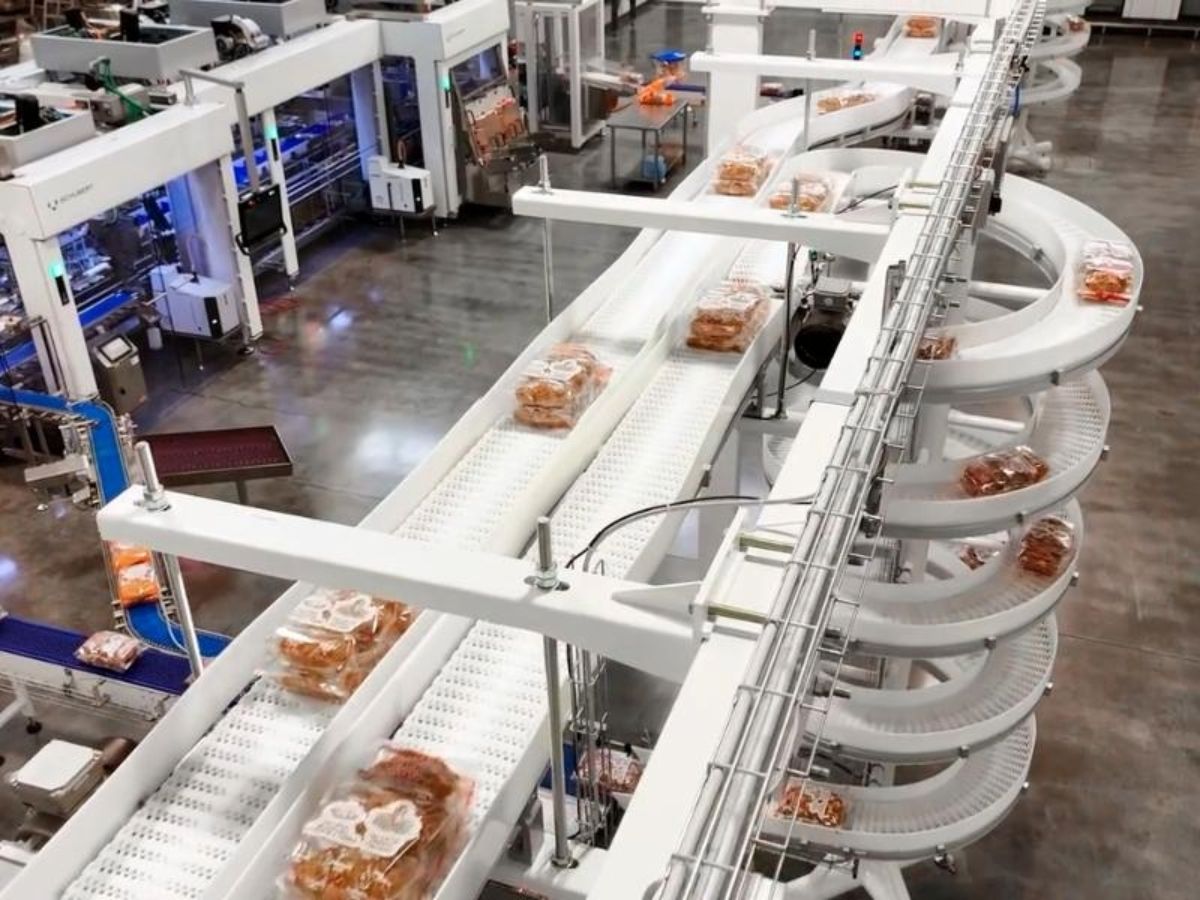
To meet this need, Bosch Rexroth developed an overhead conveying solution based on its VarioFlow technology, a powerful, standardised and versatile conveying system with routes and upward and downward spirals that can be customised according to the plant layout and system requirements. The system collects flows from four independent lines, conveys them to the next stages and feeds the final packaging machine in a coordinated manner.
One of the project’s distinctive features is the support structure for the overhead conveyor. Rather than using a series of floor-mounted columns or fixing it to the ceiling, the system makes use of the support structures for the spirals. This configuration reduces the footprint and leaves much clearer access to the machines, facilitating maintenance work and the movement of operators.
The route geometry was also designed to make the best possible use of the available space. The downward spirals, made to measure, allow the conveyor to be compacted and supply a packaging machine with a double infeed, capable of receiving products simultaneously from two lines.
“In a plant with these volumes, the priority is not just speed, but above all continuity of handling,” explains Alessandro Moro, business developer for the Assembly Technologies division at Bosch Rexroth Italia. “The system must keep pace with production without creating bottlenecks or interfering with operators’ work. The overhead solution, together with the customised spirals and coordinated management of the lines, enabled us to meet this need, while also keeping the floor clear and improving access to the plant.”
Integrated control and communication with production systems
Bosch Rexroth’s contribution is not limited to mechanical handling. The solution incorporates its ctrlX Automation control platform, which manages the motors and coordinates the conveyor’s operation, as well as interfacing with Casalini’s information systems.
Production parameters, including recipes, quantities and speeds, are received directly from the company’s servers and used to configure the system automatically. In this way, handling management is integrated with information on the different production runs, reducing the need for manual intervention at the control panels and helping to ensure greater consistency between production settings and line operation.
Digital integration thus contributes to the flexibility of the plant, allowing different production configurations to be managed through a centralised control system.
A results-focused collaboration
The project involved approximately a year of work covering concept definition, development and revision of layouts, design, component manufacture and installation. Commissioning of the handling system took approximately two months, as part of an overall project involving various stakeholders and technologies.
The collaboration between Casalini and Bosch Rexroth made it possible to refine the solutions during installation as well, adapting certain details to requirements that emerged during the integration phase and optimising the overall operation of the plant.
“For us, it was essential to build an efficient, automated line while also respecting the timings and methods that characterise our approach to production,” says Marco Casalini, director of Casalini. “The handling solution had to ensure continuity, take up as little floor space as possible and provide easy access to the machines. Bosch Rexroth’s availability and attention to finding the solutions best suited to our needs were fundamental to completing the project.”
The result is an end-of-line solution in which mechanical design, handling and digital control contribute to a common goal: supporting exceptionally high production volumes while keeping flows smooth, machines accessible and production management flexible.
This article was translated from the original version in Italian with the assistance of artificial intelligence. In case of discrepancies, please refer to the original version in Italian.