Push and pull models: how warehousing and production can become more efficient
Push and pull models: how warehousing and production can become more efficient
- Information
Demand-driven production offers an integrated approach to reducing waste and improving efficiency: you can learn about it through the Toyota Simulation Game.
During production processes and warehouse management, waste is an obstacle to efficiency that every company must tackle. Excess stock, materials accumulating in work areas and unnecessary movements create costs which, as they build up, make work less efficient.
These problems largely depend on how flows are managed. There are two possible management models, which are completely different: the push model, the traditional one, and the pull model.
The differences between the push and pull models
In the push model, production is planned based on demand forecasts and predetermined schedules. Products are made and materials moved according to a plan that is independent of what subsequent stages require.
This system is effective only in certain contexts where this lack of coordination between stages has no consequences. However, it has some drawbacks, first and foremost the possibility of forecasting errors. When this happens, companies end up accumulating stock or not having enough, tying up a lot of resources in warehousing, or not having enough, resulting in stockouts and delays for the customer.
These accumulations are not only a problem in themselves, but also conceal potential flaws in logistical movements or production flows, which then emerge when stock levels are reduced.
By contrast, the pull model is based on a completely different principle. Production and movement focus only on what is needed, when it is needed and in the quantity required. Activities are initiated only and exclusively when subsequent stages require them.
Managing flows in this way means starting them from actual customer demand. It is not only a more efficient system, but, when waste occurs in the process, it becomes much easier to identify.
An integrated approach: the Toyota Production System
The pull model is one of the principles underlying the Toyota Production System (TPS). This process, developed by Toyota, helps improve quality, efficiency and work organisation while reducing waste.
This is not a single technique, but an integrated approach. It involves processes, people and business organisation, with the aim of stabilising flows, identifying inefficiencies and finding their causes, as part of a continuous improvement approach (Kaizen).
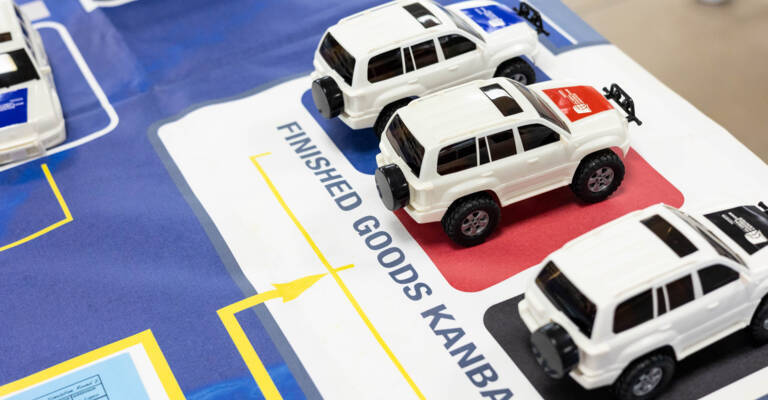
Moving from a push model to a pull model does not simply mean changing production scheduling. The company and its employees must understand how the different activities are connected and, at the same time, recognise how an apparently small decision can ripple across the entire chain, creating inefficiencies.
Learning the pull model with the Toyota Simulation Game
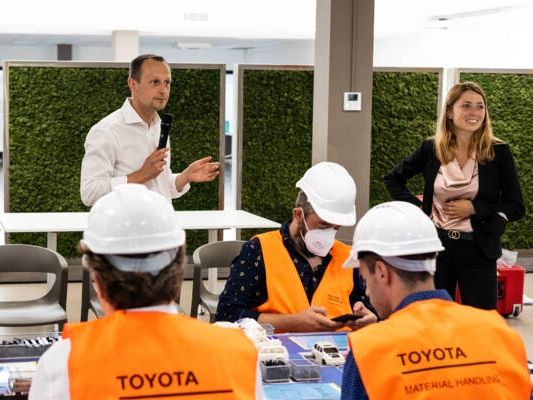
Through the Toyota Simulation Game, Toyota Material Handling Italia, with its & Consulting division, offers a hands-on learning experience that allows participants to see the benefits of the pull model compared with the traditional one. Participants can learn to react quickly to new market conditions, eliminate waste and improve productivity.
The aim is to absorb, through the game, the culture of continuous improvement and show how the principles of lean production can help simplify processes.
KW: Push and pull model, Waste reduction
This article was translated from the original version in Italian with the assistance of artificial intelligence. In case of discrepancies, please refer to the original version in Italian.